
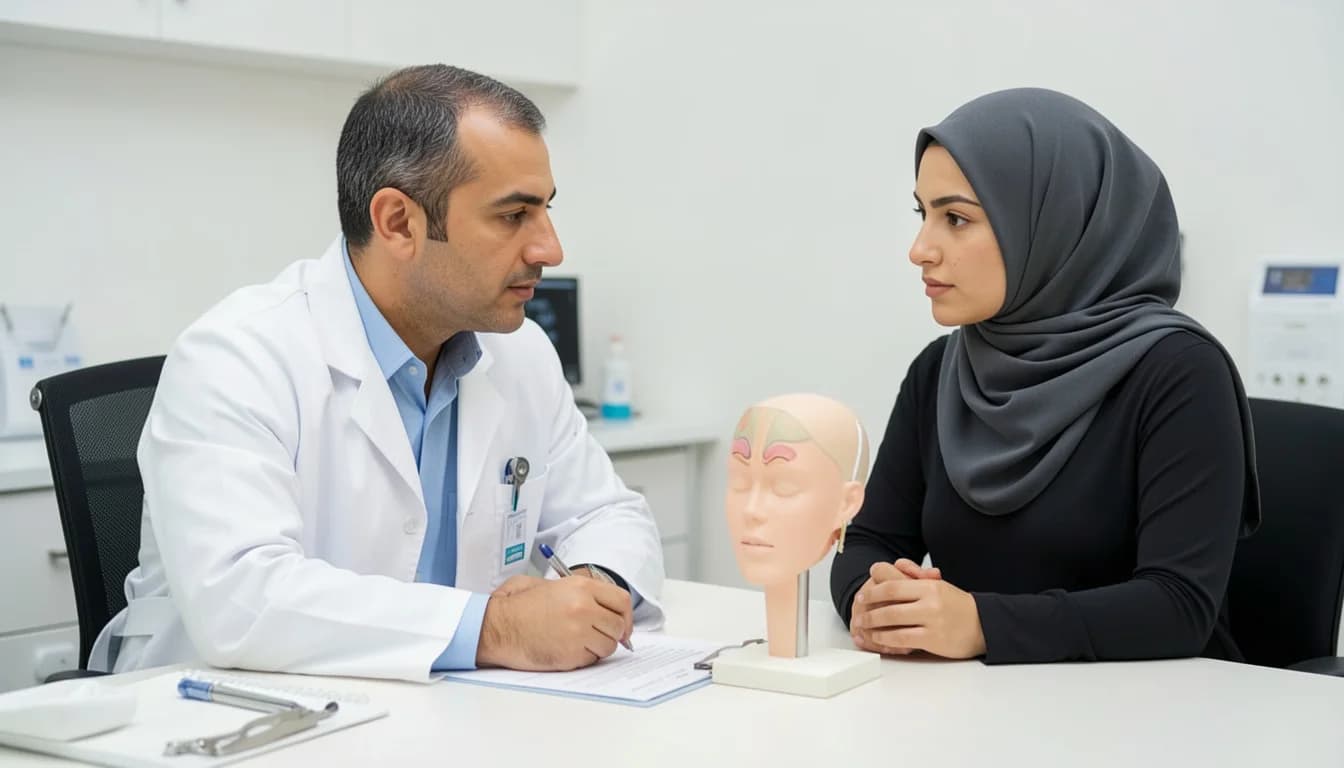
Beard hair transplantation is a cosmetic procedure in which hair is moved from a donor area at the back and sides of the head to gaps in the beard, moustache, chin or cheeks, graft by graft and under local anaesthesia. The technique is the same one used for scalp transplantation, but execution differs in important ways: hair exit angles on the face are much flatter, direction changes from cheek to jawline to moustache, and single-hair grafts are selected for the front borders so the result looks natural. Patients seek it for several reasons: genetically patchy beard growth, thin cheek coverage, scars after injury, surgery, burns or cleft lip repair, and the wish to thicken an existing beard or reshape its borders. The number of grafts varies widely: a few hundred may cover a limited gap, while building a full beard commonly needs around two thousand or more. That number is set by examination and assessment of the donor area, not by preference alone. The limits should be stated frankly before booking. The procedure moves hair, it does not manufacture it. A patient without an adequate donor area cannot be given the density he imagines, and every graft harvested from the scalp is deducted from a donor reserve he may himself need for scalp transplantation later. Transplanted scalp hair keeps its own characteristics: it grows longer and faster than native beard hair and needs regular shaving and trimming, and its texture may differ slightly. Transplantation also does not treat a medical cause of hair loss; active alopecia areata of the beard must be treated and quiet before transplantation is considered, otherwise the grafts are lost. Understanding the real timeline matters just as much. Transplanted hairs shed in the first weeks after surgery, which is expected and not a failure, then the follicles begin a new growth cycle, and the final result is usually judged at eight to twelve months. Some patients need a top-up session to refine density. Candidacy, graft numbers and beard line design are all determined by clinical examination and a frank discussion of expectations, not by photographs of someone else's result.
Procedure steps
- 1
Donor assessment and beard line design
Donor density, hair calibre and scalp laxity are measured, and the face is examined to map gaps, scars and the native growth pattern. The beard line and borders are drawn with the patient in front of a mirror and photographed, and an approximate graft number is agreed along with what is realistically achievable.
- 2
Local anaesthesia and graft harvesting
The harvest site is anaesthetised locally, then follicular units are extracted one by one with fine punches, favouring single-hair units for the front borders and two-hair units for inner zones. Grafts are kept in chilled holding solution and sorted by hair count before implantation.
- 3
Creating recipient sites at natural facial angles
Fine recipient sites are created at very flat angles that mirror the natural direction of beard hair, with the angle changing between cheek, jawline, moustache and below the lip. Accuracy of these angles is what separates a natural result from an artificial one, and density is graded to avoid an unrealistically sharp front border.
- 4
Implanting grafts and matching calibre
Grafts are placed gently into the sites to minimise trauma, with hair calibre matched to zone: the finest at the borders and thicker units deeper in, so density looks graded. Coverage is reviewed visually at the end of the session and extra grafts are added to sparser zones if needed.
- 5
Recovery instructions and staged follow-up
Instructions for the first days are explained for both the face and the donor area, and the patient is warned that transplanted hairs are expected to shed over weeks before regrowth begins. Follow-up with standardised photography is scheduled at three, six and twelve months, and the need for a top-up density session is assessed.
Before the procedure
Tell your doctor about every medicine and supplement you take, especially blood thinners, antiplatelet drugs and herbal products that increase bleeding, and do not stop anything on your own; follow the arrangement he sets. Report chronic conditions such as diabetes, hypertension and clotting disorders, any skin disease of the face or scalp, any past alopecia areata or patchy beard shedding, and any allergy to local anaesthetic, antibiotics or dressings. Avoid alcohol and smoking as much as you can beforehand, since smoking impairs blood supply and healing, and do not shave or shape the beard except as the team instructs. Sleep well, eat breakfast on the day, wear a button-up shirt that does not need pulling over your head, and arrange transport home plus a day or two of rest.
After the procedure
Expect swelling, redness and small crusts around each graft in the first days; this is a normal course. Sleep with your head elevated, follow the team's washing instructions precisely for the first wash, and do not scratch, rub or pick crusts, or touch your face with unwashed hands. Do not shave or use a trimmer on the recipient area until your doctor allows it, avoid swimming pools, sauna, steam, vigorous exercise and heavy bending for two weeks, and protect your face from direct sun. Take prescribed medicines exactly as directed, and avoid smoking, which impairs blood supply. Remember that temporary shedding of transplanted hair in the first weeks is expected, and the result is judged at 8 to 12 months. **Seek care urgently for fever or chills, increasing pain after the third day, hot painful swelling, pus or foul odour, bleeding that does not stop with gentle pressure, widespread pustular folliculitis, spreading red streaks on face or neck, swelling extending to the eye with pain or blurred vision, or breathlessness or an allergic reaction after any medicine.**
Expected duration
The session usually takes 4 to 7 hours under local anaesthesia depending on graft numbers; most people return to work after two to three days, and the final result is judged at 8 to 12 months.
Our directory of Beard Hair Transplant doctors in Jordan is growing
There are no matching published profiles in this directory yet. ClinicsJo is expanding its coverage and working to welcome more Beard Hair Transplant doctors in Jordan. Check this page regularly for newly added profiles, practice details and available contact options.
Browse all doctorsBrowse Hair Treatment profilesFinding Beard Hair Transplant services in Jordan
Which doctors are listed for Beard Hair Transplant in Jordan?
There are currently no doctor profiles linked to Beard Hair Transplant in this directory. You can browse the related specialty or the wider doctors directory. This does not mean that the service is unavailable in Jordan.
How can I find an appointment for Beard Hair Transplant?
Start with an available doctor's profile and use the contact or booking options shown there. Confirm the service, practice location and appointment time with the clinic. If this list is empty, broaden your search using the directory links on this page.
What does Beard Hair Transplant cost in Jordan?
Ask the practice for the current price and what it includes. A consultation fee shown on a profile is not necessarily the price of a procedure, tests or follow-up. Confirm any additional charges and insurance arrangements before your visit.