
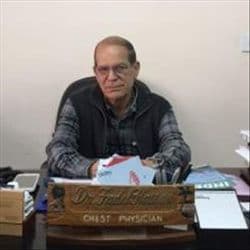
Dr. Fadel Hassan Al-Hajj Ahmed Clinic
Dr. Fadel Hassan Al-Hajj Ahmed is a pulmonology and asthma consultant and internal medicine specialist who studied medicine at Cairo University. At his Shmeisan…
Trusted medical platform in Jordan

Lung cancer screening looks for cancer at an early stage in people who have no symptoms at all but who fall into a high-risk group. The established tool is a low-dose computed tomography scan of the chest, repeated annually. It is quick, requires no contrast dye, and can reveal small nodules long before they would ever be noticed clinically. Eligibility follows defined criteria: older age, typically from the sixth decade of life onward, a heavy smoking history that is either current or given up relatively recently, no symptoms suggesting established disease, and general health good enough to act on whatever is found. Eligibility is settled by clinical assessment and by calculating smoking history with a physician rather than by personal preference, because screening someone outside the target group does more harm than good. It is essential to understand what screening does not do. It does not prevent lung cancer and offers no protection against it; the only genuine prevention is stopping smoking completely, and an annual scan is neither a substitute for quitting nor a licence to continue. A plain chest X-ray is also not an adequate early-detection test and should not be relied on for this purpose. A clear result today does not mean permanent safety, which is why screening is repeated on schedule. Screening is likewise not for people who already have symptoms such as coughing blood, weight loss, or persistent chest pain: they need prompt diagnostic work-up, not a screening test. Screening carries costs that must be explained before consent. Most nodules it finds are benign, yet they open a path of repeated scans, anxiety, and sometimes invasive procedures that carry their own complications. The decision therefore rests on a frank conversation between patient and physician about expected benefit and probable burden, not on an advertisement or a relative's advice. Most importantly, screening is an opportunity to treat the cause. Every screening visit should come with effective support to stop smoking, because quitting reduces the risk of both cancer and heart disease, and it is the only intervention that slows the decline in lung function once chronic obstructive pulmonary disease has begun. Vaping and waterpipe are not safe alternatives and are not a treatment step.
The physician calculates your smoking history with you in years and daily amount, and asks when you quit, about occupational exposure, family history, and any previous lung disease. Absence of symptoms is then confirmed, because symptoms shift the pathway from screening to urgent diagnostic assessment, which follows a completely different route.
The expected benefit and the limits are explained: the likelihood of finding benign nodules that require follow-up, the possibility of further procedures, and a radiation dose that is low but not zero. This conversation is a precondition for screening rather than a formality, and it ends with a decision you understand rather than one imposed on you.
You lie on the scanner table with metal removed from your chest area, and you are asked to take a deep breath and hold it for a few seconds while images are acquired so the pictures stay sharp. There is no contrast dye and no needle, the scan takes only minutes, and you can return to your normal day immediately afterwards with no restrictions.
The radiologist measures any nodule and classifies it by size, shape, and density, then recommends the next step: return at the annual interval, an earlier follow-up scan to compare growth, or wider evaluation through specialist review. Most detected nodules are benign, and it is follow-up over time that distinguishes them.
Every screening visit is paired with practical support to stop smoking, which is the single most beneficial part of the whole programme. The next scan is then scheduled and you are told when to come back sooner, namely if any alarm symptom appears, because an annual scan does not cover what happens between two appointments.
Low-dose computed tomography requires no fasting and no medication preparation. Before the appointment, gather your information: how many years you smoked and how much per day, when you quit if you did, your work history and any exposure to asbestos, silica, dust, or radiation, and any lung cancer in the family. Tell the team about new symptoms such as coughing blood, weight loss, chest pain, or hoarseness, because these move you from screening to urgent diagnostic assessment. Say if you are pregnant or might be, and bring all previous chest imaging and reports on a disc, since comparison with older scans is more informative than a new image alone. Wear clothing without metal buttons or zips and remove chains and necklaces before entering.
You can resume your day immediately after the scan with no restrictions or after-effects. Ask when the result will be available and make sure you review it with your physician, because a radiology report alone does not replace a clinical decision, and do not read the word nodule as cancer, since most nodules are benign. If an interim scan is recommended before the annual one, keep to it precisely, because the value of screening lies in comparison over time rather than in a single image. Keep your own copy of the scan and report. Most importantly, make this visit the starting point for stopping smoking completely and ask for practical support. **See your doctor promptly, without waiting for the annual scan, if you cough up blood, lose weight unexpectedly, develop persistent chest pain, become hoarse for more than three weeks, or notice new breathlessness.** **Go to the emergency department immediately for sudden severe breathlessness with chest pain, blue lips, or breathlessness that stops you finishing a sentence.**
The low-dose CT scan itself takes only a few minutes, with about 10 to 15 minutes inside the scanner room including positioning and instructions. An eligibility and shared decision-making visit adds roughly 20 to 30 minutes, results usually arrive within days, and screening is normally repeated once a year while eligibility continues.
Dr. Fadel Hassan Al-Hajj Ahmed is a pulmonology and asthma consultant and internal medicine specialist who studied medicine at Cairo University. At his Shmeisan…
There are currently 1 doctor profiles linked to Lung Cancer Screening on ClinicsJo. Review the listed services and contact the practice to confirm availability with the doctor and branch you choose.
Start with an available doctor's profile and use the contact or booking options shown there. Confirm the service, practice location and appointment time with the clinic. If this list is empty, broaden your search using the directory links on this page.
Ask the practice for the current price and what it includes. A consultation fee shown on a profile is not necessarily the price of a procedure, tests or follow-up. Confirm any additional charges and insurance arrangements before your visit.