

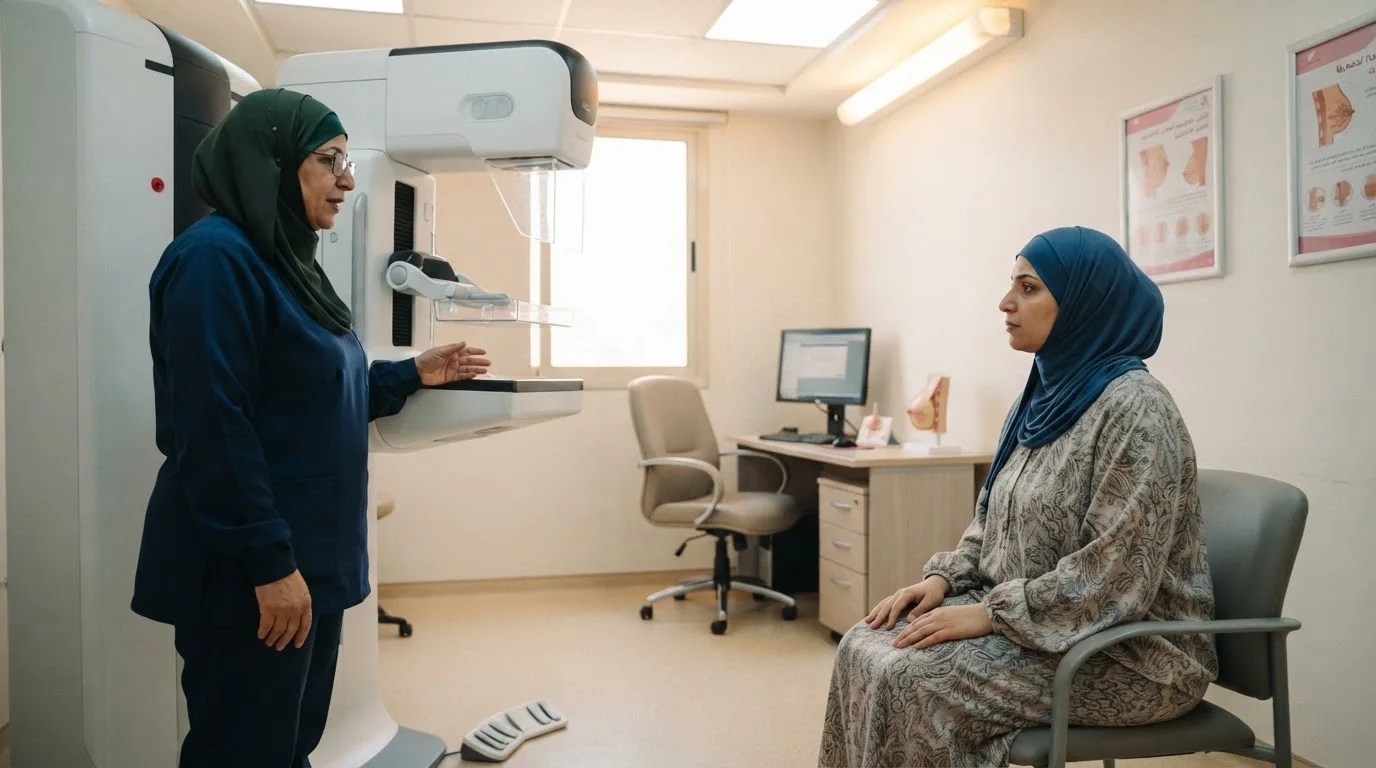
Breast cancer is the most common cancer among women in Jordan and worldwide, accounting for 30% of women's cancers. Early detection raises survival from 30% to over 95%. The ClinicsJo Editorial Team reviews screening and prevention.
Important Statistics
- 1 in 8 women will develop breast cancer in their lifetime.
- About 1,200 cases are diagnosed annually in Jordan.
- 50% of Jordanian cases are detected late (stage 3–4).
- Reason: low awareness of self-exam and delayed mammograms.
Risk Factors
Non-Modifiable
- Sex (women 100x more than men).
- Advancing age (>50).
- Family history.
- Genetic mutations (BRCA1, BRCA2).
- Early menarche (<12 years).
- Late menopause (>55 years).
- No children or first child after age 30.
Modifiable
- Postmenopausal obesity.
- Physical inactivity.
- Alcohol.
- Smoking.
- Postmenopausal hormone therapy.
- Not breastfeeding.
Monthly Self-Examination — Steps
Best time: the first week after your period ends (breasts are less tender).
1. In Front of a Mirror
- Lower hands. Note breast shape, symmetry, any change in size or contour.
- Raise hands overhead. Look for dimpling or skin puckering.
- Place hands on hips and press. Observe shape changes.
- Inspect nipples: retraction, discharge, sores.
2. In the Shower
Wet skin makes palpation easier. Place left hand behind head, use right hand's middle three fingertips:
- Examine with small circular motions.
- Apply three pressures (light–medium–firm).
- Cover the entire breast from collarbone to lower chest, and from armpit to mid-chest.
- Use a systematic pattern (concentric circles, or vertical/horizontal stripes).
- Repeat for the other breast.
3. Lying Down
Place a pillow under your shoulder. Repeat the shower exam.
4. Check Lymph Nodes
In the armpit and above the collarbone — feel for any lumps.
Warning Signs
- A new lump in the breast or armpit.
- Change in breast size or shape.
- Skin dimpling (like orange peel).
- Skin retraction.
- Redness or warmth in the breast.
- Nipple shape change (retraction, inversion).
- Nipple discharge (especially bloody or serous).
- A non-healing sore on the nipple.
- Persistent localized breast pain.
- Swelling under the arm.
Medical note: Many lumps (80–90%) are benign (cysts, fibroadenomas, inflammation), but don't delay evaluation to find the difference. Only a doctor can determine this accurately.
Medical Screening
1. Clinical Breast Exam
Annually for women over 20, or with any symptom.
2. Mammogram
Low-dose X-ray. Recommended schedule:
- 40–49 years: every 2 years (or annually with risk factors).
- 50–74 years: every 2 years.
- >74 years: based on general health.
- With family history: 10 years before the relative's diagnosis age, or from age 30.
3. Breast Ultrasound
Complements mammography, useful for cystic lumps and dense breasts.
4. MRI
For high-risk women (BRCA, strong family history).
5. Biopsy
For suspicious lumps, a sample is taken and microscopically examined:
- Fine Needle Aspiration (FNA).
- Core biopsy.
- Surgical biopsy.
Types of Breast Cancer
- Ductal carcinoma: most common (80%).
- Lobular carcinoma: 10%.
- HER2-positive: grows quickly, responds to targeted therapy.
- Triple negative: fewer treatment options.
- Inflammatory breast cancer: rare but aggressive.
Prevention
- Maintain a healthy weight.
- Exercise 150 minutes weekly.
- Limit alcohol.
- Breastfeed if possible.
- Limit long-term postmenopausal hormone therapy.
- Eat a diet rich in vegetables, fruits, and low in saturated fat.
- Monthly self-exam.
- Timely mammogram.
- BRCA genetic testing with strong family history.
Treatment (If Diagnosed)
Depends on tumor type and stage:
- Surgery: lumpectomy or full mastectomy.
- Chemotherapy.
- Radiation therapy.
- Hormone therapy: tamoxifen, aromatase inhibitors.
- Targeted therapy: trastuzumab (Herceptin) for HER2 types.
- Breast reconstruction after treatment.
For routine screening or if you notice any breast change, book an immediate appointment with a gynecologist or breast surgeon on ClinicsJo.