

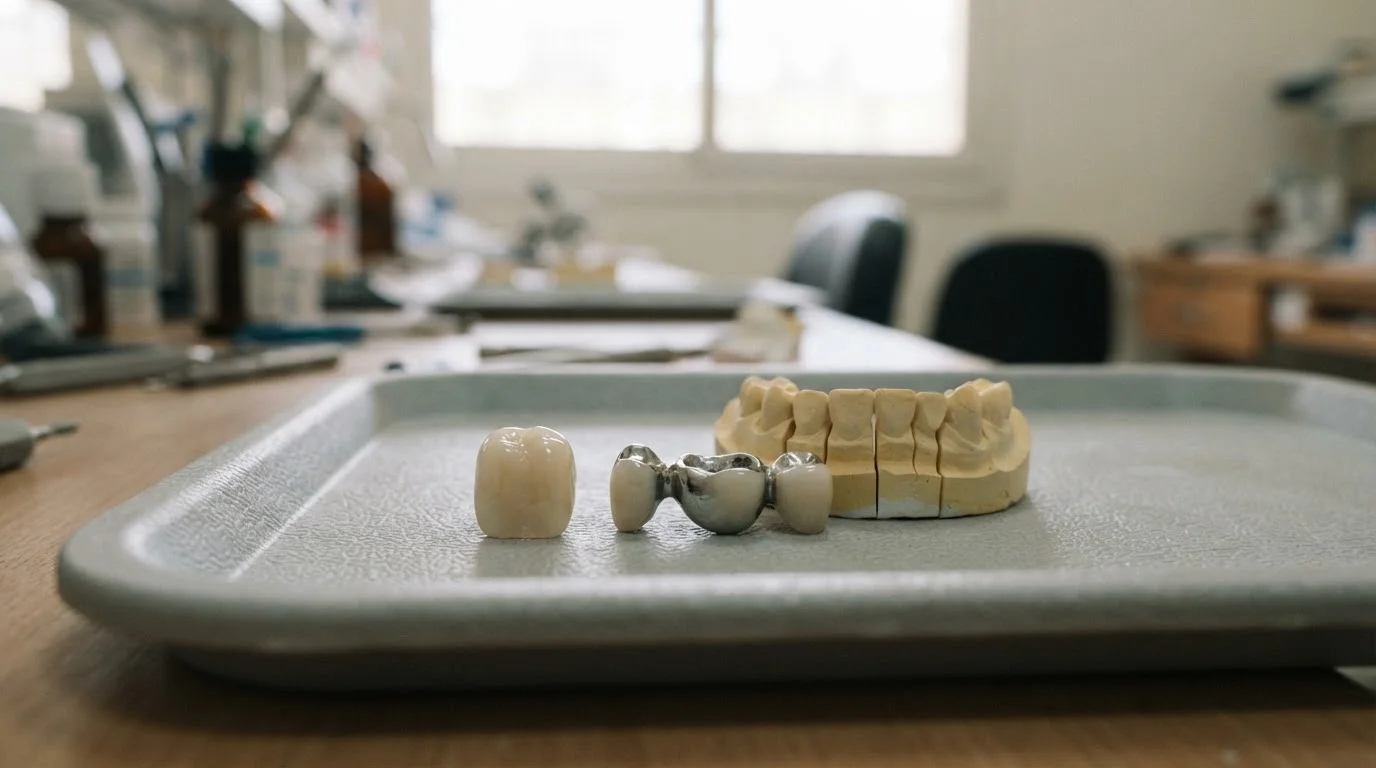
Dental crowns and bridges are among the most common restorative solutions in dentistry — restoring damaged teeth and replacing missing ones. The ClinicsJo Editorial Team reviews types, Jordan prices, and how to choose the right option.
What Is a Dental Crown?
A crown (cap) is a full cover placed over a prepared tooth from all sides. It restores the shape and strength of a damaged tooth. Crowns are lab-fabricated and permanently bonded with strong cement.
When Do You Need a Crown?
- A tooth that has had a root canal — the crown protects it from fracture.
- A cracked or broken tooth.
- Large decay unsuitable for a regular filling (>50% of the tooth).
- A crown on a dental implant.
- Cosmetic reasons (shape, color).
- An abutment for a multi-unit bridge.
Types of Crowns
1. Zirconia Crowns
Currently the most requested. Made from zirconium dioxide, very strong, natural-looking, metal-free. Lifespan: 15–25 years. Suitable for both anterior and posterior teeth.
2. Porcelain-Fused-to-Metal (PFM)
A metal base + porcelain overlay. Strong but a metal line may show at the gum margin over time. Lifespan: 10–15 years. Cheaper than zirconia.
3. All-Porcelain (E-Max)
Lithium disilicate ceramic. Excellent translucency — most natural-looking. Best for anterior teeth. Lifespan: 10–15 years.
4. Metal Crowns
Gold or base metal. Strongest type but not aesthetic. Used on posterior teeth in severe grinders.
Bridges
A bridge is a fixed prosthesis that replaces one or more missing teeth, supported by adjacent teeth (abutments). It includes:
- Two crowns on the teeth adjacent to the gap.
- An artificial tooth (pontic) suspended between them.
Bridge Types
- Traditional bridge: the most common; requires preparing the adjacent teeth.
- Maryland bridge: bonded with metal or ceramic wings to the back of adjacent teeth, with minimal preparation.
- Cantilever bridge: supported by one adjacent tooth only, rarely used.
- Implant-supported bridge: the best long-term option for multi-tooth replacement.
Bridge or Implant?
An implant is generally the better choice, but a bridge fits when:
- There isn't enough bone for an implant.
- You want a lower cost.
- The patient can't tolerate surgery.
- You need faster completion (2 weeks vs 6 months).
- The adjacent teeth already need crowns.
Crown or Bridge Procedure
- Local anesthesia and tooth preparation (light reduction).
- Digital or manual impression.
- Temporary crown placed for 1–2 weeks.
- Final crown fitted and bite checked.
- Permanent bonding with definitive cement.
Crown and Bridge Costs in Jordan
- Zirconia crown: JOD 250–450.
- E-Max crown: JOD 280–500.
- PFM crown: JOD 150–250.
- Metal crown: JOD 100–180.
- 3-unit zirconia bridge: JOD 750–1,350.
- Implant-supported bridge (2 implants): JOD 1,500–2,800.
Medical tip: Zirconia is usually best for posterior teeth due to strength; E-Max wins aesthetically for anterior teeth visible when smiling.
Caring for Crowns and Bridges
- Brush twice daily.
- Use a bridge floss (Superfloss) to clean under the pontic.
- Alcohol-free mouthwash.
- See your dentist every 6 months.
- Avoid biting very hard objects (ice, pits).
- Wear a night guard if you grind your teeth.
For the right crown or bridge for your case, book an appointment with a prosthodontist on ClinicsJo.