

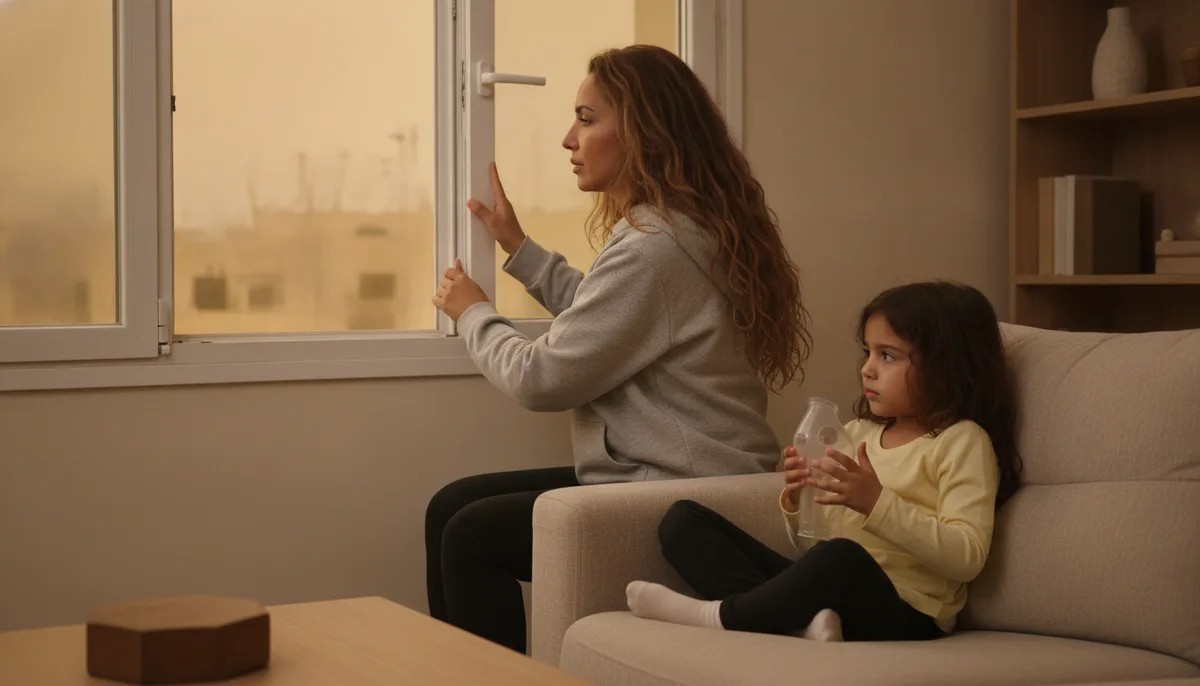
Dust and sandstorms raise the level of suspended particles in the air. They can irritate the lungs, eyes, and nose and worsen asthma and allergies. Children, older adults, and people with heart or lung disease are more vulnerable to harm. The best approach is to stay indoors, carry your prescribed inhaler, wear an N95 mask when necessary, and call 911 if shortness of breath becomes severe.
How do dust and sandstorms affect health?
Air pollution is a mixture of solid particles and gases. Suspended particles can include dust, pollen, and mold spores [2]. During a sandstorm, the concentration of these particles in the air we breathe rises.
Some pollutants are toxic, and inhaling them increases the likelihood of health problems [2]. Symptoms usually appear in the respiratory system, eyes, nose, and throat.
- Coughing, chest wheezing, and shortness of breath.
- Red, watery, and itchy eyes.
- Sneezing, runny nose, or nasal congestion.
- Dry, irritated throat.
Most healthy people improve after the storm ends and the air clears. However, people with chronic chest conditions may need closer monitoring.
Are dust and sandstorms a risk for people with asthma and allergies?
Yes, they can be an important trigger. Asthma is a common condition that affects breathing. Its main symptoms are wheezing, coughing, shortness of breath, and chest tightness [1]. Symptoms can be triggered by high levels of air pollution or by exposure to allergens, including dust, pollen, and mold [1].
In asthma, the airways swell and narrow, making breathing difficult [1]. Symptoms come and go and may worsen at night and in the early morning [1]. For this reason, a person with asthma may feel apparently better during the day, then have a worse night after a dusty day.
People with allergic rhinitis or seasonal allergies may notice more intense sneezing, itching, and congestion on dusty days. The chances of developing asthma are also higher in people with allergic conditions such as eczema or hay fever, or with relatives who have asthma or allergies [1].
To learn more about asthma, you can read the asthma page on ClinicsJo.
Who is most at risk: children and older adults?
The source indicates that people with heart or lung disease, older adults, and children are more vulnerable to the risks of air pollution [2]. Exposure to air pollution in childhood is one of the factors associated with a higher likelihood of developing asthma [1].
Children
- Keep them indoors during the storm, and postpone outdoor play and sports.
- If a child has asthma, make sure their inhaler is within easy reach, along with a spacer if the doctor has prescribed one [1].
- Medication doses for children are based on weight and must be prescribed by a doctor or advised by a pharmacist. Do not give your child any medication on your own initiative.
- Inform the school about the asthma action plan. You can find answers on the role of teachers in managing a child's asthma at school on ClinicsJo.
Older adults
- Stay indoors, and make sure you have enough of your long-term heart and lung medications before the storm.
- No one should stop or change a medication without consulting a doctor or pharmacist.
- Influenza may worsen asthma symptoms, so vaccination, such as the influenza vaccine, is recommended [1].
If you are pregnant and have asthma, tell your doctor or midwife, because controlling asthma during pregnancy is important for your safety and the safety of your baby [1].
How do you protect yourself at home during dust and sandstorms?
The best step is to reduce exposure. Guidelines recommend avoiding asthma triggers such as air pollution, smoke, and pollen [1]. During dust and sandstorms, this means staying inside a closed building as much as possible.
- Monitor air quality. Check how to check air quality in your area in Jordan before deciding to go outside.
- Close windows and doors, and seal gaps through which dust can enter.
- Postpone running and outdoor exercise. If exercise triggers your symptoms, ask your doctor how to exercise safely [1].
- Do not smoke, and do not allow smoking in the home. Smoke is a trigger for asthma, and smoking is not recommended for anyone who has it [1].
- Organize your medications. Keep your inhaler nearby, and always take it with you if you need to go out [1].
Indoor air can also become polluted and affect health [2]. Therefore, after the storm, wipe surfaces with a damp cloth instead of dry sweeping, which stirs up dust again. The guide to home cleaning and disinfection provides general tips that may help you.
Some air purifiers produce ozone, a gas that is a major component of air pollution in cities [2]. Read Are ozone-generating air purifiers beneficial for people with asthma? before buying any device.
Do masks help? And what is an N95 mask?
If you must go outside, a mask reduces the inhalation of particles, but it does not replace staying indoors. Its effect depends on the type of mask and how well it fits the face.
| Mask type | Benefit against dust | Notes |
|---|---|---|
| Regular cloth or surgical mask | Blocks only large particles | Less effective against fine particles, and particles leak through its sides |
| N95 mask (or equivalent) | Designed to filter fine particles to a higher degree | Requires a good seal on the face, with the chin and nose covered |
| Scarf or damp cloth | Very limited protection | Not a substitute for a proper mask |
When using an N95, follow these points:
- Press the metal strip against your nose, and make sure air does not leak from the sides.
- Do not touch the outer surface. Discard it if it becomes dirty or wet, or if breathing through it becomes difficult.
- These masks may make breathing harder. For this reason, people with heart or lung disease should ask their doctor before using them for long periods.
- They usually do not fit young children, so it is best to keep them indoors.
Do not rely on a mask instead of your treatment plan. The source indicates that prevention also depends on medications, follow-up, and avoiding triggers [1].
What is the inhaler plan for people with asthma during a storm?
The personal asthma action plan (Asthma Action Plan) is prepared by your healthcare team. It explains when and how to use your medications, how to monitor your asthma, and what to do if symptoms worsen [1]. Bring a copy to every appointment [1]. If you do not have a plan, request one before dust season.
Before the storm
- Make sure the inhaler is not empty and has not expired. If it is no longer valid, return it to the pharmacy for safe disposal [1].
- Use your daily preventer inhaler in the way your doctor prescribed [1].
- Ask your doctor, pharmacist, or nurse to show you the correct technique, since a medication does not work well if used incorrectly [1].
- Do not take medications for other conditions without consultation, as some drugs such as aspirin, ibuprofen, and beta-blockers may trigger asthma symptoms in some people [1].
To learn about available inhalers and how they are prescribed, see the prescription bronchodilators service and the asthma treatment page.
During an asthma attack
Sit upright and try to stay calm, then use your reliever inhaler if you have one [1]. According to NHS guidance for people with a blue reliever inhaler, the usual dose prescribed by your doctor or pharmacist is one puff every 30 to 60 seconds until you improve, to a maximum of 10 puffs, shaking the inhaler between puffs and using a spacer if available [1]. If your plan specifies a different maximum, follow your plan [1].
The situation differs for those who use an inhaler that serves both preventer and reliever functions (MART or AIR). Its usual dose is one puff every 1 to 3 minutes, to a maximum of 6 puffs [1]. Ask your doctor which type you use.
Call 911 immediately if your condition worsens at any time, if you do not improve after the maximum dose of inhaler, or if you do not have an inhaler [1]. Do not drive yourself to the emergency room [1].
How do I deal with irritation of the eyes, nose, and throat?
Suspended particles irritate the mucous membranes, which is why the eyes may become red, itchy, and watery.
Eyes
- Do not rub your eyes, as rubbing may scratch the cornea.
- Rinse your eyes with clean water or sterile lubricating eye drops (artificial tears) as advised by your pharmacist.
- Remove contact lenses and wear glasses instead during dusty periods.
- Wash your face and hands after returning from outside.
See an eye doctor if you experience severe pain, vision loss, severe sensitivity to light (photophobia), redness that persists for more than a day or two, or yellow discharge.
Nose and throat
- Drink enough fluids, as they help relieve a dry throat.
- Saline nasal rinses may relieve congestion.
- Antihistamines and nasal sprays should be used on the advice of a doctor or pharmacist.
If exposure to dust coincides with extreme heat, also read heat stress and heatstroke.
When should I see a doctor, and when should I go to the emergency room?
See a doctor if:
- You or your child develop asthma symptoms for the first time [1].
- Treatments are no longer sufficient, or you need your inhaler more often than usual [1].
- Symptoms do not improve, prevent you from carrying out your usual activities, or wake you at night [1].
- You have recovered from an asthma attack. You should see a doctor within two days to discuss treatment and prevent recurrence, even if you feel better [1].
Call 911 or go to the nearest emergency room if:
- Shortness of breath becomes severe, or you have difficulty speaking in full sentences.
- Symptoms do not improve after the maximum dose of reliever inhaler [1].
- Your lips or face turn blue, or you feel confused and severely exhausted.
- You experience chest pain, fainting, or severe palpitations, especially if you have heart disease.
- You are having an asthma attack and do not have an inhaler [1].
If symptoms do not improve after 10 minutes and an ambulance has not arrived, repeat the same maximum dose of inhaler if you have one [1]. In hospital, treatment may include oxygen by mask, a nebulizer with high doses, or steroids in tablet or injection form [1].
How do I find the right doctor in Jordan?
If symptoms recur with dust exposure, it is most appropriate to see a specialist. Browse pulmonology doctors in Jordan and select your governorate, such as Amman, Irbid, or Zarqa.
What to check on a doctor's or clinic's page
- Specialization and experience in asthma, allergies, and chest diseases.
- Location, working hours, and the contact methods available on the page.
- Services offered, such as asthma assessment or breathing tests.
- Whether booking or contacting is possible, as shown in the profile.
Questions to ask at the appointment
- Do I need a breathing test to confirm the diagnosis? The assessment may include questions, listening to the chest, and a simple breathing test, and sometimes a peak flow meter for monitoring at home [1].
- What is my personal asthma plan, and how do I use my inhaler correctly?
- What are my triggers, and can tests to identify environmental asthma triggers be performed?
- When do I need follow-up? It is recommended to have a check-up at least once a year to review treatment, inhaler technique, and update the plan [1].
A doctor or clinic appearing in the directory does not indicate an assessment of the quality of their care, so rely on the information displayed and ask the doctor directly. Primary services are also available in governorates through Ministry of Health health centers and maternal and child health centers.
Reminder: This article is for general education and does not replace your doctor's assessment and personal treatment plan.The references cited by number are linked to the list of sources at the bottom of the page.
Frequently asked questions
Do I need to stay at home during sandstorms?
Yes. Staying in an enclosed space is the best way to reduce inhalation of particles, especially for people with asthma or allergies, children, older adults, and people with heart or lung disease. Close windows and doors, postpone outdoor exercise, and keep your medications close at hand.
Is an N95 mask better than a regular mask for dust?
An N95 mask is designed to filter fine particles to a higher degree than a cloth or surgical mask, provided it is sealed to the face with no leakage from the sides. However, it may make breathing harder, so people with heart or lung disease should consult their doctor before using it for long periods.
What should I do if I have an asthma attack during a storm?
Sit upright, stay calm, and use your reliever inhaler according to the plan your doctor has prepared. If your condition worsens, you do not improve after the maximum inhaler dose, or you do not have an inhaler, call 911 immediately and do not drive yourself.
How can I relieve eye irritation after exposure to dust?
Do not rub your eyes. Rinse them with clean water or sterile lubricating drops as advised by your pharmacist, and temporarily remove contact lenses. See an eye doctor if you experience severe pain, vision loss, severe sensitivity to light, or persistent redness.
Can dust cause asthma in someone who has never had it before?
Dust is not the sole cause of asthma, and its causes are not fully understood. However, it can trigger symptoms in people who are predisposed, such as those with allergies or a family history of asthma. If you develop wheezing, persistent coughing, or shortness of breath, see a doctor for an assessment.
What should I check for my child with asthma before dust season?
Make sure there is a written asthma plan from the doctor, that the inhaler and spacer (if prescribed) are not expired, and that the school knows the plan. Children's doses are based on weight and must be prescribed by a doctor or advised by a pharmacist, and a child should not be given medication without consultation.
Sources and references
- Asthma — NHS (UK National Health Service). Accessed: 2026-10-26.
- Air Pollution: MedlinePlus — MedlinePlus — U.S. National Library of Medicine. Accessed: 2026-10-26.