

Moles are very common — every person has 30–40 on average. While most are benign, some can develop into deadly skin cancer. Early detection saves lives. The ClinicsJo Editorial Team reviews the warning signs.
What Are Moles?
Moles (naevi) are clusters of pigment cells (melanocytes) at a specific spot. They appear from childhood and may change over time. Types include:
- Congenital: present at birth.
- Acquired: appear during life, especially before age 30.
- Senile: after age 50.
The ABCDE Rule for Suspicious Moles
A — Asymmetry
A benign mole is usually symmetrical. If you halve it, the halves should match.
B — Border
Benign mole borders are clear and smooth. Irregular or jagged borders are a warning sign.
C — Color
Benign moles are one color. Multiple colors (brown, black, red, white, blue) in the same mole are concerning.
D — Diameter
Benign moles are usually less than 6 mm (pencil eraser size). Larger ones warrant a check.
E — Evolving
Any change in size, shape, color, itching, or bleeding requires an immediate doctor visit.
Types of Skin Cancer
1. Basal Cell Carcinoma
The most common (80% of skin cancers). Slow growing, rarely spreads, but causes local damage. Appears as a translucent pearly bump or non-healing sore. 95% curable with early detection.
2. Squamous Cell Carcinoma
The second most common. Can spread if neglected. Appears as a scaly bump or sore on sun-exposed skin.
3. Melanoma
The most dangerous — can be fatal if it spreads. Arises from pigment cells. Spreads quickly. Early detection saves lives (>95% cure rate in early stages).
4. Rare Types
- Merkel cell carcinoma.
- Skin sarcomas.
- Amelanotic melanoma.
Skin Cancer Risk Factors
- Heavy sun exposure.
- Severe childhood sunburns.
- Tanning beds.
- Very fair skin.
- More than 50 moles.
- Family history.
- Weak immunity.
- Chemical exposure (arsenic).
- Prior skin cancer.
Monthly Self-Examination
Check your entire skin once monthly:
- In front of a mirror, examine face, ears, neck, chest, and abdomen.
- Raise arms and check the sides.
- Inspect the back of hands and arms.
- Sit and check legs and feet (between toes).
- Use a hand mirror to inspect the back, buttocks, and scalp.
- Photograph existing moles for later comparison.
When to See a Doctor Immediately
- A mole that changes in size, color, or shape.
- A new mole after age 30.
- A mole that bleeds or itches persistently.
- A sore that doesn't heal in a month.
- Any mole that doesn't look like the others ("ugly duckling").
- A mole in non-sun-exposed areas.
Medical Examination
- Naked-eye examination.
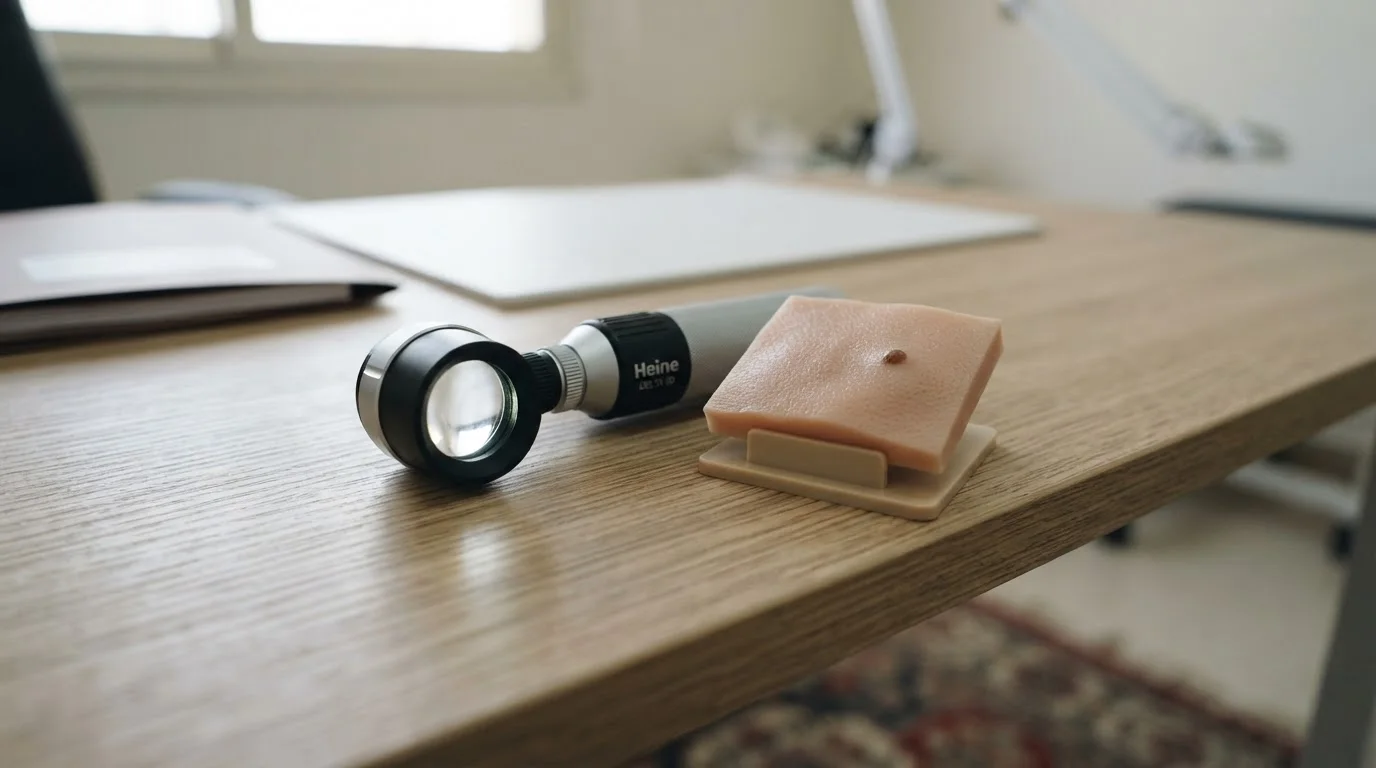
- Dermoscopy: high-resolution magnification.
- Full body mapping: digital imaging to track all moles.
- Biopsy: sample taken for microscopic examination when suspicious.
Mole Removal
Medical Reasons
- Suspected cancer.
- A mole exposed to constant friction.
- Recent adverse change.
Cosmetic Reasons
Removing a benign mole for cosmetic reasons is possible:
- Electrocautery.
- CO2 laser.
- Surgical excision (the best option if there's any doubt).
Medical warning: Never remove a mole yourself (by burning, cutting, or folk creams). This may hide signs of cancer and leave a scar while letting the original tumor spread unnoticed.
Skin Cancer Prevention
- SPF 30+ broad-spectrum sunscreen daily.
- Hats and sunglasses.
- Protective UV clothing.
- Avoid sun between 10 AM and 4 PM.
- Avoid tanning beds.
- Monthly self-examination.
- Annual medical exam, especially with age.
- Educate children — childhood sunburns increase melanoma risk 2–3 fold.
For routine screening and accurate mole evaluation, book an appointment with a specialist dermatologist on ClinicsJo.