

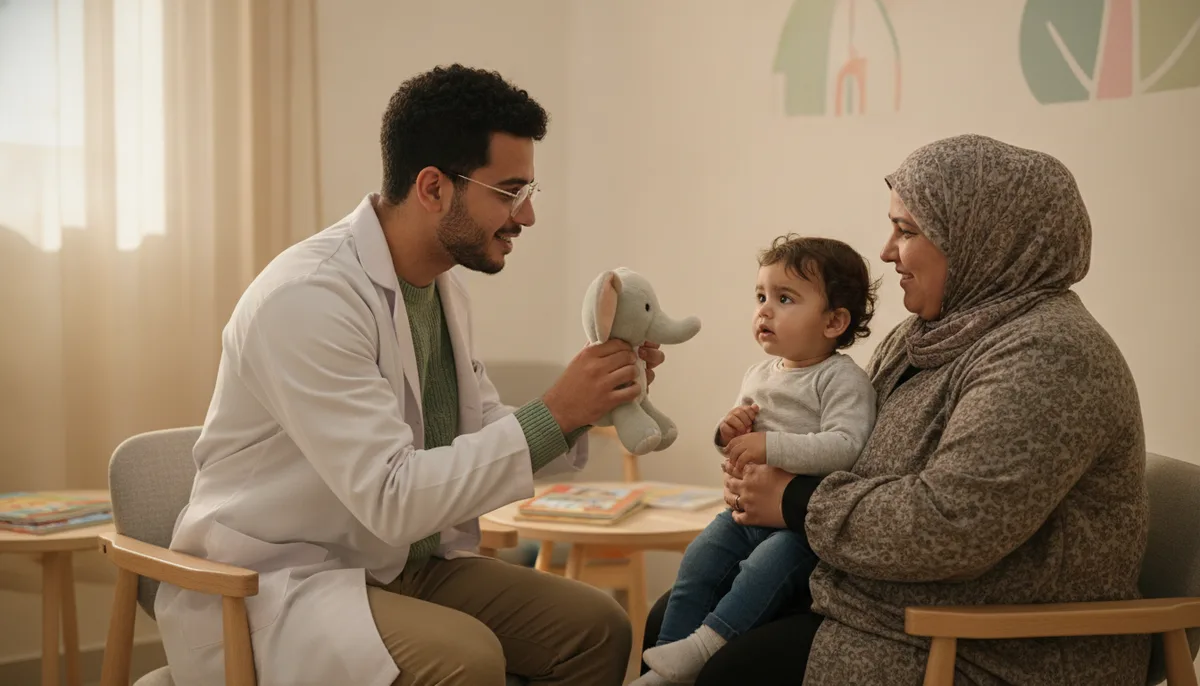
If you are looking for a pediatrician for vaccinations in Amman, you have two main options: Mother and Child Health Centers run by the Ministry of Health, which give National Program vaccines free of charge to every child in Jordan, or a private pediatric clinic that offers the same vaccines along with optional vaccines at varying prices. Bring the vaccination card, the birth certificate, and any previous records, and always ask about the date of the next dose.
Many parents start looking for a pediatrician for vaccinations in Amman right after birth, when the two-month vaccine is approaching, or when they move to a new area of the capital. This guide explains how to choose the right place, what is given free of charge and what is optional, and what to bring with you so the appointment goes smoothly.
Why does it matter that your child gets vaccines on time?
Vaccination is a simple, safe, and effective way to protect a child from serious diseases before they are exposed to them. It trains the immune system to recognize the germ and remember it [1]. The World Health Organization estimates that childhood vaccines alone save more than 4 million lives every year [1].
Following the schedule gives your child's body the chance to build immunity before exposure to these diseases [2]. Delaying a vaccine exposes the child to the risk of severe disease, and there may not be enough time for the vaccine to work if you wait until an outbreak appears [1]. Vaccination also protects the people around your child, including very young infants and people with weak immunity, through what is called "herd immunity" [2].
In Jordan, routine vaccination has been mandatory since 1979. A high coverage rate (95%) has contributed to a decline in deaths and in vaccine-preventable diseases, and Jordan has been free of polio since 1992 [3].
Pediatrician for vaccinations in Amman or a Mother and Child Health Center: which should you choose?
There is no single "right" choice for every family. The decision depends on what suits you in terms of cost, appointments, and follow-up. What matters most is that the correct vaccine is given at the correct age and recorded in the child's card.
Ministry of Health and Mother and Child Health Centers
Every child in Jordan, regardless of nationality, has the right to receive vaccines free of charge at any Ministry of Health health center [3]. Mother and Child Health Centers are spread across the different areas of Amman and in all other governorates, and they are the official reference for the National Program schedule.
Private pediatric clinic
Some parents prefer that the pediatrician who follows their child's growth also give the vaccines, combining the routine check-up and the vaccination in one visit. Private clinics also offer optional vaccines outside the National Program, and their prices vary from place to place.
| Comparison | Mother and Child Health Center (Ministry of Health) | Private pediatric clinic |
|---|---|---|
| Cost of National Program vaccines | Free for every child in Jordan | May be paid; ask the clinic in advance |
| Optional vaccines | National Program vaccines are given | Usually available at varying prices |
| Routine check-up with vaccination | Varies by center | Often possible to combine both in one visit |
| Recording in the vaccination card | The vaccine is recorded in the official card | Ask for every dose to be recorded in the same card |
Many families combine both options: they take the National Program vaccines at the health center and see the pediatrician for follow-up or for optional vaccines. For more on selection criteria, see our answer to the question How do I choose a good pediatrician for my child?
What are the free National Program vaccines in Jordan?
Below is a summary of the national schedule as published in our guide The Complete Jordanian Vaccination Schedule and Its Importance. Remember that the official vaccination card and the health center are the final reference for any update.
| Age | Vaccines |
|---|---|
| At birth | BCG (tuberculosis) + first dose of hepatitis B |
| 2 months | DaPT + inactivated polio (IPV) + Haemophilus influenzae type b (Hib) + hepatitis B + Rotavirus (dose 1) |
| 3 months | DaPT + IPV + Hib + hepatitis B + oral polio (OPV) + Rotavirus (dose 2) |
| 4 months | DaPT + IPV + Hib + hepatitis B + OPV + Rotavirus (dose 3) |
| 9 months | Measles + booster dose of OPV |
| 12 months | First dose of measles, mumps, and rubella (MMR) + varicella (chickenpox) for children born on or after 1 January 2025 |
| 18 months | MMR booster + OPV + DaPT |
| 6 years (school entry) | Td + OPV booster |
| 16 years | Td |
New in 2026: varicella vaccine
The Ministry of Health announced the introduction of the varicella (chickenpox) vaccine as the fourteenth vaccine in the National Program. It is given as a single dose at 12 months of age to children born on or after 1 January 2025 who have completed their first year. Administration began in all health centers through the Mother and Child departments starting 9 May 2026 [4].
Pneumococcal vaccine
The pneumococcal conjugate vaccine (PCV) was introduced into the National Program in 2025 [4]. Because the ages for its doses may differ depending on the child's date of birth, ask the health center to review your child's current card and determine what they need.
Jordan also uses combination vaccines that protect against several diseases with a single injection, such as the MMR vaccine and the hexavalent vaccine, which reduces the number of injections the child receives [4]. The rotavirus vaccine is given orally.
What optional vaccines are available at private clinics?
In addition to the National Program vaccines, the pediatrician may suggest additional vaccines depending on the child's age, health condition, or family circumstances. The World Health Organization explains that some vaccines are not needed in every country, and that some are given before travel or in specific areas. Therefore, speak with your health provider to learn what your child actually needs [1].
- Cost: Optional vaccines at private clinics are priced variously, so ask about the price before the appointment.
- Regulatory authority: Medicines and vaccines, and their general prices, are regulated by the Jordan Food and Drug Administration (JFDA).
- Coordination: Tell the doctor what the child has received at the health center so that no dose is repeated and no appointments conflict.
If your child previously received a vaccine at a private clinic and that vaccine was later added to the National Program, show the record to the health center so it can determine whether your child needs additional doses.
What should I bring to the vaccination appointment?
Good preparation saves you time and reduces the chance of the vaccine being postponed. In most countries, a child receives a vaccination card that shows what they have received and the date of the next or booster dose [1].
- Vaccination card: The most important document of all, so do not go without it.
- Birth certificate: You may be asked to show it, especially at the first visit.
- Previous records: Any vaccines given at a private clinic, hospital, or outside Jordan, with translations if possible.
- Health summary: Such as a hospital discharge report, notes about a premature birth, or chronic illnesses.
- List of allergies and medicines: Especially any previous severe allergy or treatments that affect immunity.
Call the center or clinic before the appointment to confirm the required documents and whether the vaccine is available that day.
What questions should I ask before booking and during the visit?
Clear questions help you feel reassured and avoid surprises. Both leading global references confirm that the health provider is the trusted source for answering any question about vaccines and the schedule approved in your country [1].
Before booking
- Is the required vaccine currently available? Is it free or paid?
- Do I need an appointment in advance, or can I come directly?
- What documents should I bring?
During the visit
- Which vaccines will my child receive today, and against which diseases?
- What symptoms are expected afterward, and when should I call you?
- When is the next dose due? Was today's dose recorded in the card?
- If my child misses a dose, how do we make it up?
If your child misses any dose, do not worry. Talk to the health provider about a catch-up plan [1]. For a more comprehensive list, read our article How to Choose the Right Doctor for You in Jordan: Questions to Ask Before Booking.
Can more than one vaccine be given in a single visit? And when should it be postponed?
Yes, giving several vaccines at the same visit is safe. Combination vaccines are as safe and effective as single vaccines, and they help protect the child early and complete doses on time [1]. Vaccines do not overwhelm the immune system: the amount of antigens in them is tiny compared with what a child encounters every day in their environment [2].
Some parents ask a recurring question about the link between vaccines and autism. Many scientific studies have examined this matter and found no connection between them [2]. You can read more in our answer to the question Do vaccines cause autism?
Situations that may call for postponement or evaluation
- Severe illness with a high fever on the day of vaccination.
- Chronic diseases or treatments that affect immunity, such as chemotherapy.
- A severe, life-threatening allergy to a component of the vaccine, which is very rare.
These situations vary from one vaccine to another, and the decision rests with the doctor or health provider [1].
What should you expect after the vaccine?
Most reactions after a vaccine are mild and temporary. According to UNICEF Jordan, citing the Ministry of Health, the possible symptoms include [3]:
- Mild fever up to 38 degrees Celsius.
- Pain, redness, or warmth at the injection site.
- Mild diarrhea.
These mild reactions usually disappear on their own within a few days, and warm compresses and pain relievers can help [3]. Ask your doctor or pharmacist which pain reliever or fever reducer is suitable. Children's doses depend on weight and must be prescribed by a doctor or advised by a pharmacist, so do not give your child any medicine without consulting a professional.
When should you contact a doctor or go to the emergency room after a vaccine?
The Ministry of Health recommends contacting the doctor or calling the vaccination clinic for any condition or concern [3].
See a doctor or call the clinic if you notice
- A fever above 38 degrees Celsius or one that does not improve.
- Symptoms that do not go away after a few days, or swelling at the injection site that keeps increasing.
- Unusual crying or refusal to breastfeed or eat.
Call 911 or go immediately to the nearest emergency room if you notice
- Difficulty breathing or wheezing.
- Swelling of the face, lips, or tongue, or a rash that spreads quickly.
- Convulsions, extreme lethargy, or difficulty waking the child.
How do you find a pediatrician for vaccinations in Amman and other governorates?
ClinicsJo helps you search for pediatricians by specialty and governorate, read their profiles, and contact them or book where the profile allows. Start with the page Pediatricians in Amman. If you want a clinic near your neighborhood, see our answer to the question How do I find a doctor in Amman by area?
What to check in a doctor's profile
- Specialization in pediatrics, and mention of vaccination or routine follow-up services.
- Clinic location, working hours, and ease of access.
- Contact methods and booking availability.
If you live outside the capital or near its borders, you can browse pediatricians in Zarqa, pediatricians in Balqa, or pediatricians in Irbid, or view pediatricians in all governorates of Jordan. For steps on searching within the website, see How to search for a doctor on ClinicsJo.
Remember that choosing a suitable pediatrician for vaccinations in Amman does not replace keeping the vaccination card up to date, since it holds your child's complete health history.
This article is for general health education and does not replace consultation with a pediatrician or health center. In emergencies, call 911.
Frequently asked questions
Are children's vaccines free in Jordan for non-Jordanians?
Yes. National Program vaccines are free for every child in Jordan regardless of nationality, and they are given at Ministry of Health health centers and Mother and Child Health Centers. Optional vaccines outside the program are given at private clinics at varying prices.
What should I bring to my child's vaccination appointment?
Bring the vaccination card first, then the birth certificate, and any records of previous vaccines from a private clinic, hospital, or outside Jordan, as well as reports on the child's health and a list of any allergies or medicines. It is advisable to call the center in advance to confirm the required documents.
When does my child get the varicella vaccine in Jordan?
The varicella vaccine has been added to the National Program as a single dose at 12 months of age for children born on or after 1 January 2025. It is given at all health centers through the Mother and Child departments since 9 May 2026. Check with the health center to confirm your child's appointment.
Is it safe for my child to receive more than one vaccine on the same day?
Yes, giving several vaccines at one visit is safe, and combination vaccines are as safe and effective as single ones. The amount of antigens in vaccines is very small compared with what a child encounters every day, so they do not overwhelm the immune system, and they help complete doses on time.
What should I do if my child misses a vaccine dose?
Do not worry and do not wait too long. Visit the health center or pediatrician with the vaccination card, and the health provider will set a plan to make up the missed doses based on the child's age and previous vaccines, then determine the dates of the next doses.
When should I go to the emergency room after my child is vaccinated?
Call 911 or go immediately to the nearest emergency room if you notice difficulty breathing, swelling of the face or lips, a rash that spreads quickly, convulsions, or extreme lethargy. A mild fever and pain at the injection site are usually temporary, and you can consult a doctor about them.
Sources and references
- Vaccines and immunization: What is vaccination? — World Health Organization. Accessed: 2026-10-26.
- Vaccines for Children | Childhood Immunization — MedlinePlus — U.S. National Library of Medicine. Accessed: 2026-10-26.
- Routine Childhood Immunizations | UNICEF Jordan — UNICEF. Accessed: 2026-10-26.
- Ministry of Health: "Chickenpox" Vaccine Added to the National... — www.jordannews.jo. Accessed: 2026-10-26.


