

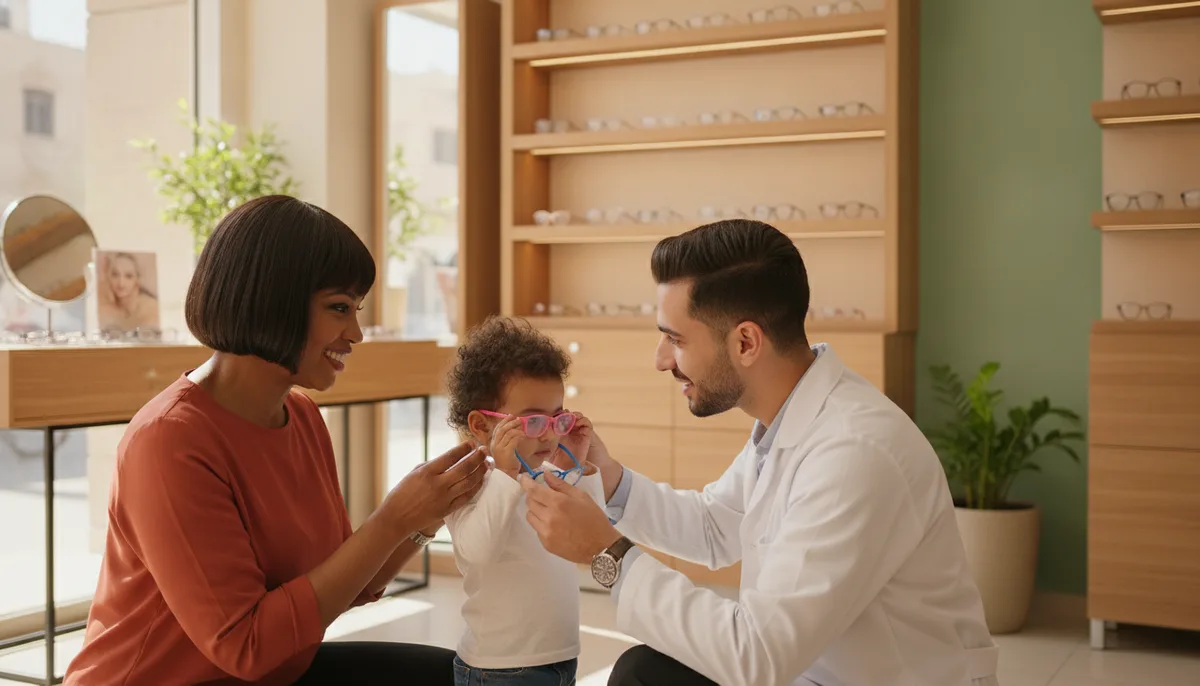
Poor eyesight in children is often detected late, because the child does not realize that their vision differs from other people's. Signs include sitting close to the TV, holding books close to the face, rubbing the eyes, headaches, and eye misalignment. A child needs glasses when a refraction test by a specialist or eye doctor shows that they are necessary, and a child's vision can be tested at any age.
What Is Poor Eyesight in Children, and Why Is It Hard to Detect?
Serious eye problems during childhood are rare, but routine checks for infants and young children exist to detect any abnormality early [1]. The earlier an eye problem is detected, the earlier treatment and support can begin [1].
The difficulty is that children may not realize they have a vision problem. A child who has seen the world blurred since birth assumes that everyone sees it the same way. For this reason, without regular testing, a problem can go unnoticed, and a child's development and education may be affected [1].
Refractive errors (the need for glasses) are the most common type of vision problem, while some eye diseases may cause no symptoms at first [2]. Therefore, it is not enough to wait for the child to complain.
What Signs of Poor Eyesight in Children Should Parents Watch For?
The British National Health Service (NHS) lists signs that may indicate a problem in an older child's eyes [1]:
- The eyes do not point in the same direction (squint).
- Complaints of headaches or eye strain.
- Reading difficulties, such as holding a book close to the face or constantly losing their place in a line.
- Difficulty with hand-eye coordination, such as stumbling during ball games.
- Bumping into objects more than usual.
- Frequently rubbing the eyes.
- Sitting very close to the TV.
One sign does not necessarily mean there is a problem, but it is reason enough to book an examination. The earlier a problem is detected, the better [1].
Does a Decline in School Performance Mean My Child Has Poor Eyesight?
Not necessarily. Difficulty reading and losing one's place in a line may be related to vision [1], but academic decline has many other causes, such as hearing, attention, or learning difficulties in children.
An eye test is a simple, painless step, and it rules out a cause that is relatively easy to treat. If your child also has a speech delay or does not respond to sounds, read about speech delay and hearing testing.
How Can I Monitor My Infant's Vision at Home?
In infants, the doctor or midwife tests whether the child's attention is drawn to an attractive object moved in front of them, to see whether their eyes follow it [1]. You can observe the same thing during daily play: does your child follow your face or a colorful toy? If this does not happen, or if you notice that one eye turns outward or inward, take the child to the doctor without delay.
When Should a Child's Eyes Be Tested? Test Schedules and Vision Screening
The following table shows the eye-check schedule used in England under the NHS. It is an example that illustrates the idea of staged follow-up [1]. Recommended schedules in Jordan may differ, so ask your pediatrician or eye doctor which timing is most suitable for your child.
| Age | What happens (per NHS) |
|---|---|
| Within 72 hours of birth | Examination of the eyes for obvious physical problems as part of the newborn clinical check |
| 6 to 8 weeks | Follow-up check to detect what was not noticed immediately after birth |
| Around 1 year, or between 2 and 2.5 years | Parents are asked about any concerns regarding vision, and tests are arranged if needed |
| Around 4 to 5 years | Vision screening after starting school to detect poor vision in one or both eyes |
This screening is usually done at school, but it does not happen in every area. In that case, it is recommended to take the child to an optometrist for an examination [1]. In Jordan, you can ask your pediatrician or staff at your nearest health center or Mother and Child Care center about the best time to test your child's eyes.
Most importantly, an eye test is possible at any age, and a child does not need to be able to read or even speak [1]. Testing becomes even more important if there is a family history of childhood eye problems such as squint or amblyopia [1].
What Types of Vision Problems May Require Glasses or Monitoring?
Problems detected by children's eye tests include the following [1]:
| Problem | Simplified meaning |
|---|---|
| Myopia (nearsightedness) | Distant objects appear blurred, while near objects are seen clearly |
| Hyperopia (farsightedness) | Distant objects are seen clearly, while near objects are unclear |
| Astigmatism | The cornea, the transparent layer at the front of the eye, is not perfectly regular in curvature |
| Amblyopia (lazy eye) | Vision in one eye does not develop properly |
| Strabismus (squint) | The eyes look in two different directions |
| Congenital cataract | Cloudy patches in the eye's lens present from birth |
| Color blindness | Difficulty seeing colors or distinguishing between them; it is more common in males |
Refractive errors (myopia, hyperopia, and astigmatism) are usually treated with glasses. As for squint, amblyopia, and cataract, the eye doctor determines the treatment plan according to the case.
What Is Amblyopia, and Why Does Early Detection Matter?
In amblyopia, vision in one eye does not develop as it should [1]. The child may not complain because the other eye compensates, which is why testing is relied upon rather than complaints. This is one reason for vision screening at ages 4 to 5, as its goal is to detect poor vision early so that treatment can be given if needed [1].
The sources we relied on do not specify an age after which the chance of treatment closes, so we do not mention a number. The practical rule that the sources confirm is that the earlier a problem is detected, the better [1]. If you notice an eye turning, or your child closing one eye or tilting their head to see, do not wait until they start school.
Depending on the case, treatment options for eye diseases may include new glasses, medications, drops, or surgery [2]. The doctor decides what suits each child.
How Is a Child's Vision Tested, and When Do They Need Glasses?
The test varies according to the child's age and ability to cooperate [1]:
- Infants: Examination of the red light reflex in the eye using an ophthalmoscope, and the pupil's response to light. A white reflex instead of red may indicate a problem [1].
- Young children who do not know letters: Pictures or symbols are used instead of letters.
- Older children: Charts of letters and numbers in decreasing sizes (Snellen or LogMAR) are read from a set distance.
- Eye movement: An attractive object is moved in 8 directions to test the eye muscles.
- Colors: A color blindness test is usually performed on older children when suspected (Ishihara test).
The decision about glasses depends on a refraction test, which determines whether a child needs glasses and what their prescription is [1]. Different lenses are placed in front of the child's eyes while they look at a light or at letters. Special drops that dilate the pupil may be given so the examiner can see the back of the eye clearly [1]. Do not worry if your child remains slightly sensitive to light afterwards, and ask the doctor what to expect.
Do not buy ready-made glasses for your child, and do not rely on the prescription of a relative's or sibling's glasses. Look for a vision test for children service in the directory, and if the problem is confirmed, see treatment of pediatric vision problems.
Do Screens Cause Poor Eyesight in Children?
This is a frequently asked question. The sources we relied on do not address permissible screen time, nor do they prove that screens cause myopia, so we will not mention numbers or state a cause with certainty.
What we do know is that myopia means blurred distance vision with clear near vision [1], and that headaches and eye strain are signs that a problem may exist [1]. Prolonged near vision, whether on a screen or a book, may tire the eyes.
Reasonable general advice:
- Encourage your child to take breaks, and to play outdoors and be physically active.
- Watch whether they bring the device or book very close to their face, and provide suitable lighting.
- If they complain of headaches, redness, or blurriness after using a screen, book an examination instead of only reducing screen time.
- Do not assume glasses are unnecessary just because the child uses screens less; diagnosis is made through examination.
How Can I Help My Child Wear and Keep Up With Their Glasses?
Consistently wearing glasses is half of the treatment. Some children refuse them at first, and this is normal.
- Explain simply that the glasses help them see clearly and are not a punishment.
- Involve them in choosing the frame so they feel the glasses are theirs, and make sure they are comfortable and stay steady on their face.
- Follow the doctor's instructions about wearing times, and do not change them on your own or stop wearing the glasses because your child "improved."
- Tell the teacher that the child wears glasses so they can sit in a suitable place and pay attention during play.
- Attend follow-up appointments, as the lens prescription may change as the child grows.
- Use protective eyewear when practicing certain sports or using tools, as this is one way to protect the eyes [2].
If the glasses break, or if your child continues to complain while wearing them, take them to the doctor instead of setting them aside.
When Should I See a Doctor, and When Should I Go to the Emergency Room?
See an eye doctor as soon as possible if:
- You notice any of the signs of poor vision mentioned above, such as squint, holding books close, or frequent headaches.
- There is a family history of squint or amblyopia [1].
- A white reflection appears in the child's pupil in flash photography or in light, as a white reflex may indicate a problem [1].
- An infant does not track objects or faces with their eyes.
Go immediately to the nearest emergency department or call 911 if:
Sources recommend contacting an eye specialist immediately if there is a sudden change in vision, dimming of vision, flashes of light, eye pain, double vision, discharge from the eye, or swelling and inflammation [2]. For a child, we add: any direct injury to the eye, exposure to a chemical substance, sudden vision loss, or severe swelling around the eye with fever. In these cases, do not rub the eye and do not delay.
Also be aware of conditions such as shingles near the eye, which may require urgent evaluation.
How Do I Find a Suitable Pediatric Eye Doctor in Jordan?
Start with the specialty: pediatric ophthalmologists in Jordan deal with squint, amblyopia, and examining young children who do not cooperate easily. You can also browse ophthalmologists in Jordan in general.
Then choose the governorate closest to you, which reduces the burden of repeated follow-up visits, such as pediatric ophthalmology in Amman, Irbid, Zarqa, or Aqaba. There are pages for other governorates in the directory as well.
When reading a doctor's profile, check the following:
- The specialty and listed qualifications, and whether the doctor treats children.
- The services offered, such as vision testing, glasses measurement, and squint follow-up.
- The clinic's location and working hours, and the method of contact or booking if the profile provides one.
Useful questions to ask the doctor:
- What problem did you find, and what is it called?
- Does my child need glasses, and when should they wear them?
- When is the next follow-up appointment?
- What signs should prompt a visit before the appointment?
- Is there anything in our family that calls for testing the siblings?
The directory presents information about doctors and clinics to make access easier. It does not provide medical consultations or prescribe treatment. Diagnosis and the decision about glasses are always made by the doctor after examination.
Frequently asked questions
At what age can a child's vision be tested?
A child's vision can be tested at any age, and they do not need to be able to read or speak. Infants are examined by following objects and checking the light reflex, young children with pictures and symbols, and older children with letter charts. Request a test early if you notice a worrying sign or if there is a family history of squint or amblyopia.
How do I know whether my child needs glasses?
You may notice them sitting close to the TV, holding a book close to their face, rubbing their eyes, complaining of headaches, or having difficulty reading. However, the decision is not based on observation alone; the doctor or optometrist performs a refraction test and determines whether glasses are needed and what their prescription is.
Does amblyopia go away on its own?
Do not rely on it going away by itself. In amblyopia, vision in one eye does not develop as it should, and the earlier it is detected, the better the treatment. The child may not complain because the other eye compensates, so an eye doctor's examination is needed to determine the appropriate plan.
Does sitting close to the TV harm my child's eyes?
Sitting close to the TV is a sign that may indicate a vision problem, and it is not necessarily a cause of one. If your child does this regularly, take them for a vision test. If the test is normal, teach them to sit at a comfortable distance with suitable lighting and rest breaks.
Do screens cause myopia in children?
We do not have confirmed figures and cannot state the cause with certainty. Myopia means blurred distance vision, and prolonged near vision may cause strain and headaches. Encourage your child to rest and play outdoors, and if they complain of blurriness or headaches, book a test for them.
Can a child stop wearing glasses if they improve?
Do not stop the glasses on your own. An apparent improvement may be due to the glasses themselves, and the prescription may change as the child grows. Follow the doctor's instructions on wearing times and attend follow-up appointments; the doctor decides whether an adjustment or change is needed.
Sources and references
- Eye tests for children — NHS (UK National Health Service). Accessed: 2026-10-26.
- Eye Diseases | Glaucoma — MedlinePlus — U.S. National Library of Medicine. Accessed: 2026-10-26.
