
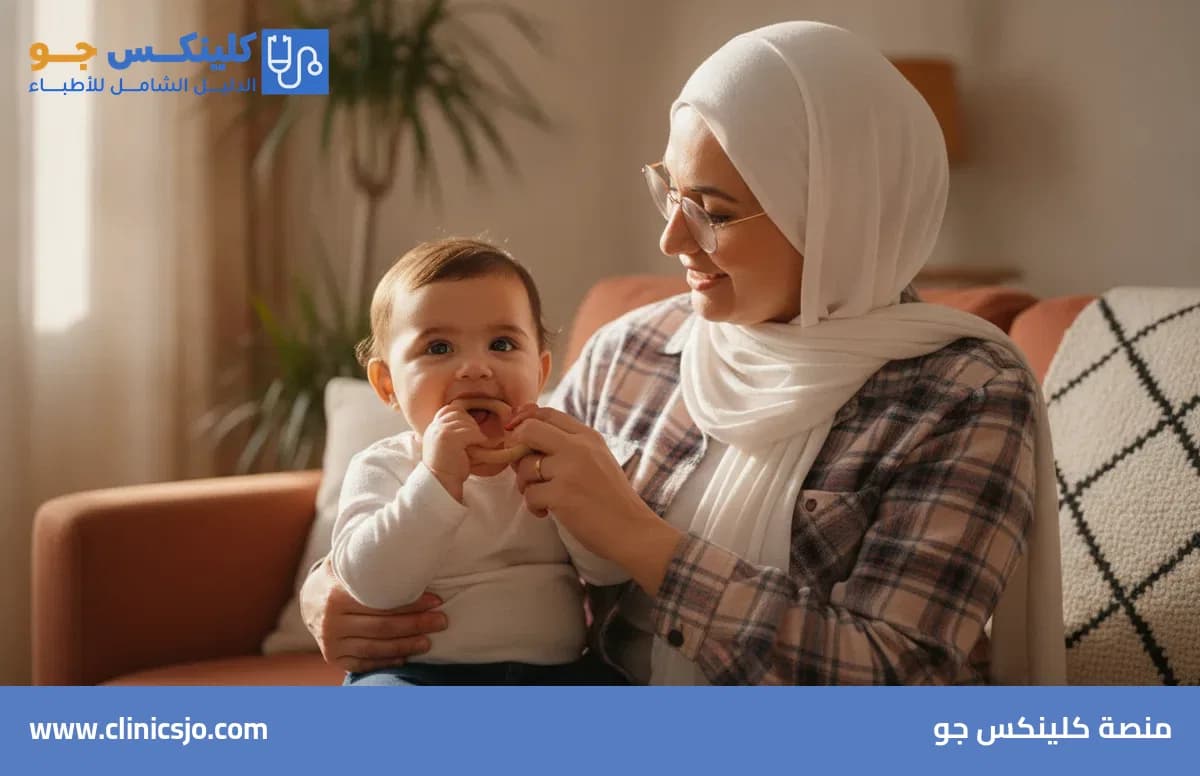

Teething is the eruption of the first baby teeth through the gums. It begins in most infants around the sixth month [1]. It may pass without pain or with mild symptoms such as gum redness, extra drooling, and irritability. A fever of 38°C or higher is not a usual symptom of teething, and there is no evidence that teething causes diarrhea [1]. Cold teething rings and gentle gum massage can relieve discomfort [2].
Many parents blame the teeth for every bout of crying, sleepless night, or rise in a baby's temperature. This is understandable, but it can delay the detection of an illness that needs treatment. In this article we separate what is truly linked to tooth eruption from what is common but untrue, explain safe ways to ease discomfort, and describe when to see a doctor.
When does teething start, and in what order do the teeth appear?
Most children begin to get their teeth around the sixth month. Some start before the fourth month, some after the twelfth month, and a few are born with teeth [1]. The timing of teething varies from child to child, and being a few weeks early or late does not by itself indicate a problem.
The following table gives an approximate guide to the order in which teeth appear [1]:
| Tooth type | Approximate age of eruption |
|---|---|
| Central incisors (front middle teeth) | About 6 months |
| Lateral incisors (beside the front teeth) | About 8 months |
| First molars (back teeth) | About 12 months |
| Canines (pointed teeth between the lateral incisors and first molars) | About 18 months |
| Second molars | About 24 months |
Lower teeth often appear before their upper counterparts, so the lower front incisors usually come before the upper ones. Most children have a full set of baby teeth between the ages of two and three years [1].
If you are concerned about the pattern of your child's tooth eruption, you can have them seen by a pediatrician or a pediatric dentist.
What are the real symptoms of teething?
Teeth may come through without pain or discomfort, or with mild symptoms that last a few days [1]. When symptoms do occur, the ones mentioned in the source we relied on are:
- Pain and redness of the gums where the tooth is coming through.
- A slight rise in temperature, but one that is below 38°C.
- Redness on one cheek.
- A rash on the face.
- Rubbing the ear.
- More drooling than usual.
- Frequent biting and chewing on objects.
- More fussiness and irritability than usual.
- Sleep disturbance [1].
Note that the fever mentioned here is "slightly raised" and stays below 38°C. You know your child better than anyone, so if any symptom worries you, seek medical advice without hesitation [1].
Does teething cause fever or diarrhea? The most common myths
High fever
The source notes that teething may be accompanied by a slight rise in temperature that does not reach 38°C [1]. In practice, this means that a temperature of 38°C or higher is not considered a usual sign of teething and calls for looking for another cause, such as an infection. Do not simply attribute it to "teeth."
A high temperature in young children may sometimes be accompanied by febrile seizures, which is an additional reason to see a doctor early.
Diarrhea
Some people believe that teething causes diarrhea, but the source states that there is no evidence to support this [1]. Repeated diarrhea in an infant may be an intestinal infection, and the most serious risk is dehydration. Read about diarrhea in children, and see a doctor if it occurs.
Ear rubbing
Rubbing the ear may happen when teeth are coming through [1]. However, it can also indicate an ear infection, especially if it is accompanied by intense crying or fever. Learn about symptoms of middle ear infection in young children. If you are unsure, an examination is the safer option.
Other myths
- "Every cry is caused by teething": Hunger, tiredness, stomach pain, and illness can all also cause crying.
- "A necklace relieves the pain": We do not recommend placing any necklace around an infant's neck, as explained further below.
- "The more pain, the stronger the tooth": There is no basis for this in the sources we relied on.
How can I relieve my child's gum pain safely?
Every child is different, and you may need to try more than one method before you find what suits your child [2]. Non-drug methods are the first choice.
Teething rings
A teething ring gives the child something safe to chew on, which eases their discomfort and distracts them from the pain. Some rings can be chilled in the refrigerator to soothe the gums, and the product instructions will state how long to chill them [2].
- Never put the ring in the freezer, as it may injure a child's gums if it freezes [2].
- Do not hang the ring around the child's neck, as this is a choking hazard [2].
Foods to chew once solid food has started
If the child is 6 months or older and has started solid food (weaning), you can give them raw fruits and vegetables to chew on. Soft fruit such as melon soothes the gums. Always supervise the child while they eat to guard against choking [2].
It is best to avoid teething biscuits (rusks), because most types contain sugar, as do other sugary foods. These cause tooth decay even if the child has only a few teeth [2].
Rest and massage
- Hold your child and play with them, as this distracts them from gum pain [2].
- Gently massage their gums with a clean finger [2].
- If drooling increases and causes a rash, gently wipe their face to reduce the rash [2].
Should I give paracetamol or ibuprofen? What about teething gels?
If your child is in pain, a sugar-free painkiller may be used. Paracetamol is given to relieve teething symptoms in infants and children from 2 months of age and older, and ibuprofen is given from 3 months of age [2]. Aspirin should not be given to anyone under 16 years old [2].
A child's dose should always be based on weight and given on a doctor's prescription or on a pharmacist's advice. Follow the package instructions, and if you have doubts, ask your doctor or pharmacist [2]. Do not give medicine to an infant below the ages mentioned without medical consultation.
What about teething gels?
There is a lack of evidence for the effectiveness of teething gels. For this reason, it is recommended to try teething rings or simple sugar-free painkillers first [2]. These gels contain a mild local anesthetic [2].
If you decide to use a gel, it must be specifically made for young children. General mouth pain gels are not suitable for children [2]. Ask your pharmacist, and buy from a licensed pharmacy, as medicines and their general prices are regulated by the Jordan Food and Drug Administration (JFDA).
We do not recommend using a gel containing benzocaine for infants. If you are not sure about the ingredients of a product, ask your pharmacist before using it.
What should be avoided? Necklaces, popular products, and unsafe solutions
The following table summarizes the most common remedies and our position on them:
| Remedy | Position | Reason |
|---|---|---|
| Teething ring chilled in the refrigerator | Suitable | Soothes the gums, provided product instructions are followed [2] |
| Teething ring in the freezer | Avoid | May injure the gums if frozen [2] |
| Teething ring hung around the neck | Avoid | Choking hazard [2] |
| Amber necklace or any necklace or thread around the neck | Not recommended | Anything hung around an infant's neck may cause choking, and we found no evidence in approved sources to support its benefit |
| Gel containing benzocaine | Not recommended for infants | Ask the pharmacist about age-appropriate alternatives |
| General mouth gels | Not suitable for children | Only gels made specifically for young children, if needed [2] |
| Unknown herbal or homeopathic products | Not recommended | Some unlicensed products sold online have been linked to serious side effects [2] |
| Biscuits and sweetened foods | Avoid | Cause tooth decay [2] |
How do I care for new teeth? Brushing and the first dental visit
Start brushing your child's teeth with a fluoride toothpaste as soon as the first baby tooth appears [2]. Ask the dentist about the right amount of toothpaste and the correct technique for your child's age.
It is recommended to register your child with a dentist when their teeth begin to appear [2]. In other words, the first visit should not wait until the teeth are complete or a problem appears. It is helpful to see a pediatric dentist, as they are experienced in treating young children.
At this visit, you can ask about:
- Brushing technique and the appropriate amount of toothpaste.
- Diet that protects the teeth, and reducing sugar.
- The timing of the next routine visits.
When should I see a doctor, and when should I go to the emergency room?
Because teething symptoms are usually mild, any severe symptom warrants looking for another cause.
See a doctor if you notice:
- A temperature of 38°C or higher [1].
- Repeated diarrhea or vomiting.
- Refusal to feed or eat, or reduced urination.
- Intense crying that does not settle, or ear rubbing with fever.
- A widespread rash outside the face.
- Any symptom that worries you, as you know your child better than anyone else [1].
Call 911 or go to the nearest emergency room if:
- The child is choking, or their breathing becomes difficult or very rapid.
- The child has a seizure, loses consciousness, or becomes extremely lethargic and hard to wake.
- Their lips or face turn blue or gray.
- Signs of severe dehydration appear, such as a dry mouth, no tears, and clearly reduced urination along with diarrhea or vomiting.
If you are not sure how serious the situation is, it is safest to contact a doctor or go to the emergency room, and do not wait for it to improve.
How do I find the right doctor or clinic in Jordan?
A pediatrician can assess symptoms and rule out other conditions, and a pediatric dentist can monitor baby teeth and provide preventive care. They can also offer practical guidance to parents. In addition, health centers and Mother and Child Care Centers run by the Ministry of Health are available in various governorates to monitor children's health.
You can browse directories by specialty and governorate:
- Pediatricians: Pediatrics in Amman, Pediatrics in Irbid, Pediatrics in Zarqa.
- Pediatric dentistry: Pediatric dentistry in Amman, Pediatric dentistry in Irbid, Pediatric dentistry in Zarqa.
What to check in a doctor's profile
- The listed specialty (pediatrics or pediatric dentistry) and the clinic's location in your governorate.
- Working hours and the contact or booking methods available in the profile.
- The listed services and whether they suit your child's age.
Useful questions for the doctor
- Are my child's symptoms due to teething, or could they be a different illness?
- What pain reliever is suitable for my child's age and weight, and how do I give it safely?
- Is there a gel or product suitable for their age, and are there particular products I should avoid?
- When is the next dental visit, and how should I brush their teeth?
This article is for health education and does not replace an examination and assessment of your child's condition by a doctor.
Frequently asked questions
At what age does teething begin in infants?
It begins in most children around the sixth month. Some start before the fourth month, some after the twelfth month, and a few are born with teeth. Every child is different, and the baby teeth are usually complete between the ages of two and three years. If you are concerned about the timing, ask your pediatrician or dentist.
Does teething cause a fever?
It may be accompanied by a slight rise in temperature, but it stays below 38°C. If your child's temperature reaches 38°C or higher, do not attribute it to teething. See a doctor to look for an infection or another illness, especially if other symptoms appear, such as lethargy or refusal to feed.
Is diarrhea a symptom of teething?
No. Some people believe it is, but there is no evidence to support this. Diarrhea in infants may be an intestinal infection and can lead to dehydration, so it deserves medical review, especially if it recurs or is accompanied by vomiting, fever, or reduced urination. Do not ignore it on the grounds that teeth are coming through.
What is the safest way to relieve gum pain?
Start with simple methods: a teething ring chilled in the refrigerator rather than the freezer, gently massaging the gums with a clean finger, and holding and playing with your child. If your child is 6 months or older and eating solid food, you can give them soft fruit such as melon while supervising them. Never hang anything around their neck.
Does an amber necklace help with teething?
We do not recommend it. Any necklace or thread around an infant's neck may cause choking, and we found no evidence in the medical sources we relied on to support its benefit. It is better to rely on safe teething rings and gentle massage, and to ask a doctor or pharmacist if your child is in pain.
When should I start brushing my child's teeth and when is the first dental visit?
Brushing should start with a fluoride toothpaste as soon as the first baby tooth appears, and the dentist will advise on the right amount. Your child should be registered with a dentist when their teeth begin to appear, without waiting for a problem. A pediatric dentist is preferred for this visit.
Sources and references
- Baby teething symptoms — NHS (UK National Health Service). Accessed: 2026-10-26.
- Tips for helping your teething baby — NHS (UK National Health Service). Accessed: 2026-10-26.