
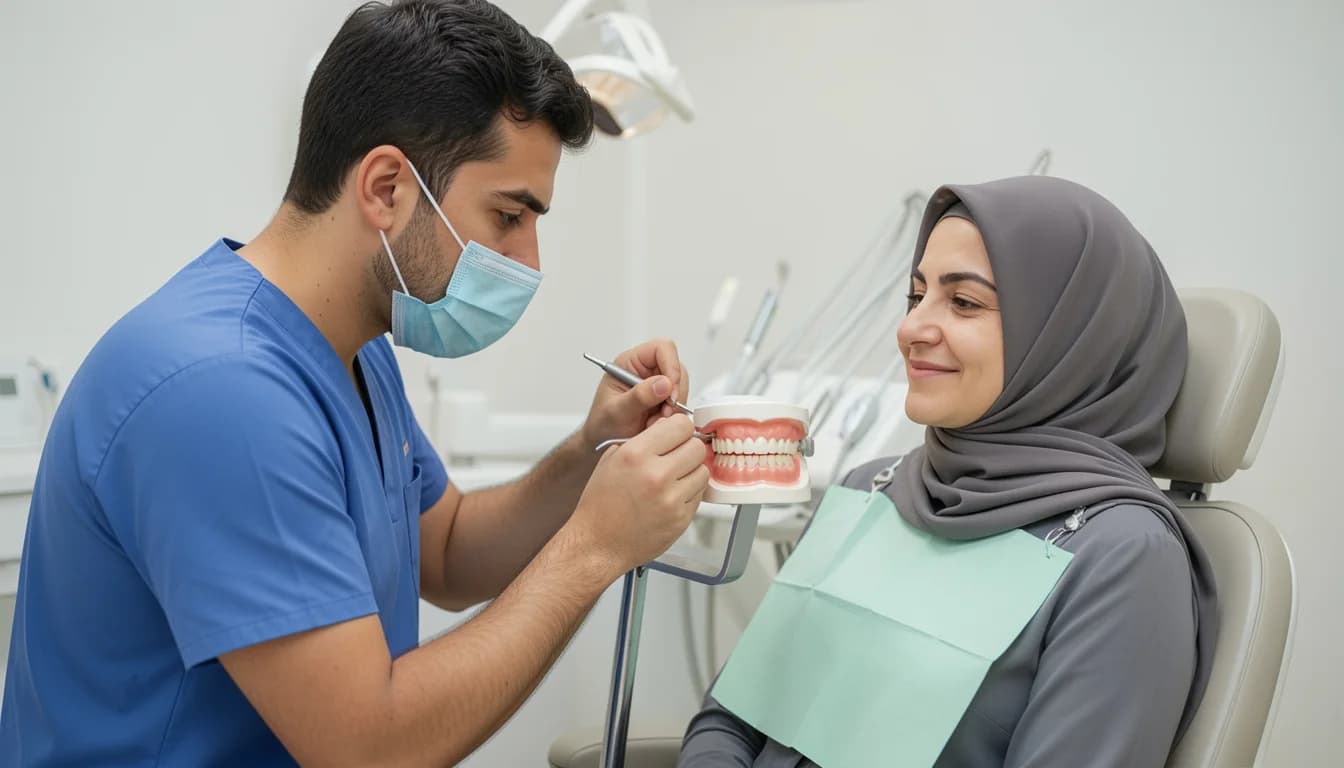
Dental fillings are one of the most common and essential dental treatments to protect your teeth from decay and wear, using safe filling material to seal gaps created by removing the damaged portion of a tooth. In Tafilah Governorate, you can access this service from reliable dental clinics available in the main city and nearby medical centers, saving you long travel distances and treatment delays.
About Dental Fillings and Their Importance
Dental fillings are not merely cosmetic—they are a crucial health necessity to treat cavities and prevent progression toward pulp (nerve) inflammation that may require tooth extraction. Common conditions requiring fillings include:
- Mild to moderate cavities: Holes and voids caused by bacteria and acids
- Tooth wear: From aging or incorrect brushing practices
- Minor fractures: Small chips or cracks on the tooth surface
- Replacement treatment: Replacing old fillings that have lost effectiveness
Available filling types include silver (amalgam) fillings, tooth-colored composite fillings that match enamel, and glass ionomer fillings. Your dentist will select the appropriate type based on tooth location and your health status.
Healthcare Context in Tafilah
Tafilah Governorate, Jordan's least populous with around 120,000 residents, enjoys unique geographic and health characteristics. The mountainous terrain and relatively cold, dry climate affect dental health in various ways—some areas benefit from mineral-rich natural waters (such as the renowned Afra hot springs), yet socioeconomic challenges may contribute to higher cavity rates, especially among children.
Towns and districts under Tafilah, including Busaira, Al-Hasa, Al-Eis, and Ain Al-Baida, depend heavily on the central hub (Tafilah city) for specialized medical services, including dentistry. Tafileh Government Hospital and Prince Zaid bin Al-Hussein Military Hospital are the primary healthcare anchors providing comprehensive dental care.
How to Choose the Best and Most Skilled Dental Filling Dentist in Tafilah
Selecting a trusted dentist in Tafilah requires clear criteria:
Qualifications and Credentials: - Verify the dentist holds a Bachelor's degree in Dentistry from a recognized university (University of Jordan, Tafila Technical University, or accredited foreign institutions) - Additional specialized certificates in restorative or preventive dentistry reflect advanced expertise - Registration with the Jordanian Dental Surgeons Association
Experience and Track Record: - Seek a dentist with years of clinical practice (preferably 5+ years) - Ask about case volume handled and rare complications encountered - Inquire about ongoing training courses and professional development
Equipment and Materials: - The clinic should be equipped with modern devices such as LED curing lights and high-level sterilization protocols - Multiple filling material options (amalgam and composite at minimum) to suit diverse needs - Use of digital X-ray imaging for accurate diagnosis
Reviews and Reputation: - Ask family and friends about their experiences with the dentist - Search for reviews on trusted medical booking platforms - Contact the clinic to inquire about patient satisfaction rates and filling warranty policies
Location and Accessibility: - Choose a clinic near your home for convenient follow-up (especially for remote areas like Busaira and Al-Eis) - Verify office hours and availability of emergency appointments - Confirm the clinic accepts health insurance if you are insured
Pricing and Health Insurance Coverage
Dental filling costs in Tafilah generally range between 40 to 120 Jordanian Dinars (JOD) depending on filling type and tooth location:
- Silver (amalgam) fillings: 40–60 JOD (most affordable, durable, but does not match tooth color)
- Tooth-colored composite fillings: 70–120 JOD (match tooth shade, more aesthetic)
- Glass ionomer fillings: 60–90 JOD (middle option)
Most Jordanian health insurance plans cover a portion of dental filling costs:
- Globemed: Covers 50–70% of basic filling costs
- MetLife: Offers limited coverage, typically with annual caps
- Allianz: Covers fillings under comprehensive dental packages
- NextCare (نكست كير): Provides flexible plans with variable coverage rates
- Arab Orient (المشرق العربي): Includes fillings in basic packages
- Jordan Insurance (الأردنية): Offers limited coverage for preventive dental work
Tip: Check your insurance card before your visit and ask the clinic about expected coverage percentage.
What to Expect During a Dental Filling Visit
Understanding the treatment steps helps you prepare and feel reassured:
Examination and Diagnosis (10–15 minutes): - The dentist visually examines the tooth and uses a small probe to assess cavity depth - X-rays may be requested to evaluate decay extent - The dentist discusses options and answers questions
Anesthesia (5 minutes): - Local anesthetic is typically applied via a small injection around the tooth - Wait 2–3 minutes for the anesthetic to take full effect
Decay Removal (10–20 minutes): - The dentist uses a drill (bur) to remove the damaged tooth portion - You may feel pressure and vibration and hear noise, but no pain due to anesthesia - The cavity is cleaned thoroughly and dried
Filling Placement (5–10 minutes): - The dentist fills the gap with the chosen filling material - For composite (white) fillings, a UV light hardens the material - The filling is shaped to match the natural tooth contour
Completion and Check (5 minutes): - The dentist tests your bite and makes adjustments if needed - The mouth is cleaned and dried - You receive post-treatment care instructions
Total Duration: 30–60 minutes depending on the number of fillings and case complexity.
After Treatment: - You may experience mild sensitivity to heat and cold for several days—this is normal - Avoid chewing on the filled tooth for several hours post-treatment - Eat soft, lukewarm foods initially - Continue brushing and flossing carefully - If pain or sensitivity persist beyond one week, contact your clinic
Choosing Dental Fillings clinics in Tafilah
Use the profiles on this page to compare relevant practices in Tafilah, read the published qualifications and locate a suitable appointment. Start with the clinical problem or service you need, then compare the practice location and contact options. The directory reflects listed platform profiles, rather than a census of every provider in the region.
“Best” is a search and comparison term: there is no single doctor who is the best for every patient. Featured placement is not proof of superior clinical outcomes. Choose according to your needs and the qualifications shown in each profile.
Location, appointment and fees
Confirm the exact branch address in Tafilah, access instructions and appointment time before travelling. A governorate-level result may cover more than one district; an area-specific page keeps its area filter. A provider practising at several clinics may have a different schedule at each branch.
Ask whether the first visit is an assessment, a consultation or a planned procedure. Confirm the consultation charge, any investigation fees and what is included in the quoted price. If a profile does not publish a fee, request it directly rather than assuming a typical market price.
For insurance, confirm your insurer, policy, branch and requested service with the practice. A listed insurer does not establish coverage for every procedure or every policy. Ask about referrals, prior authorization and your share of the cost.
Explore matching directories
Preparing for your first visit
Write down the main reason for the appointment, when the problem started and how it affects your daily activities. Bring the reports and images you already have, along with a list of current medicines and known allergies. Ask the practice which documents it needs before the visit; a directory listing does not mean that additional tests are necessary.
If you are arranging an appointment for someone else, confirm the patient's age and whether the practice sees that age group. Ask about access needs, companions and the expected visit duration. At the end of the consultation, ask how to obtain the written recommendations, who to contact with follow-up questions and whether another appointment is needed.