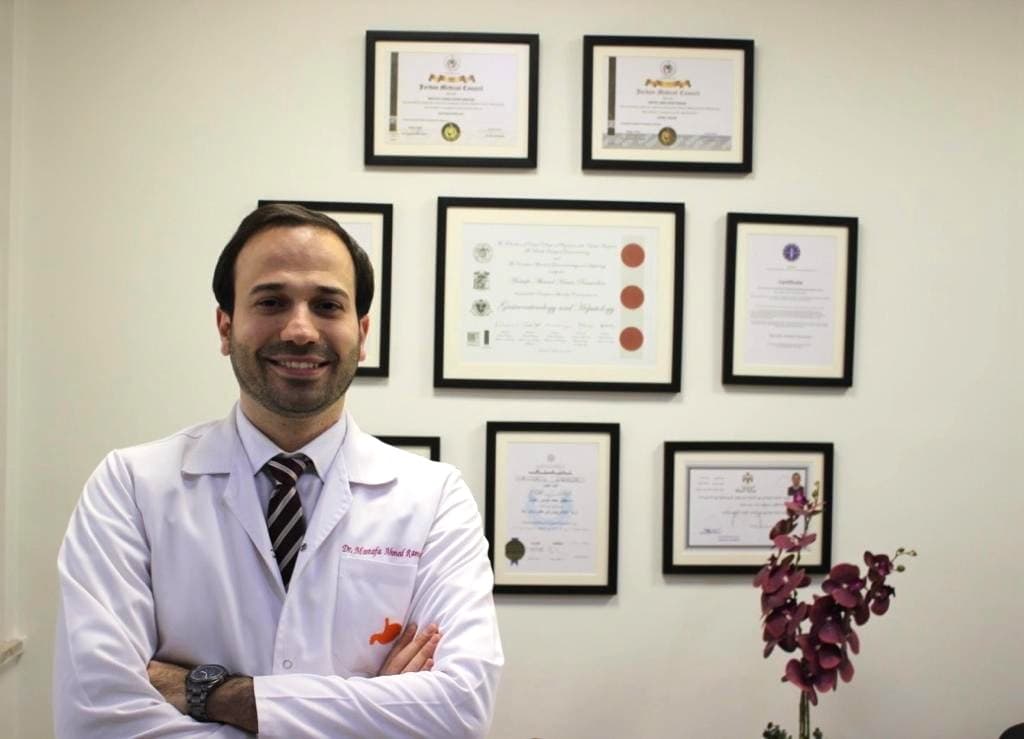
Dr. Mustafa Ramadan Clinic
Dr. Mustafa Ramadan specializes in gastroenterology, hepatology and endoscopy. His practice includes assessment of abdominal pain and stomach and bowel disorder…
Hours not listedInsurance not specified5 views
Trusted medical platform in Jordan

Colon cancer screening means testing people who have no symptoms at all, in order to find polyps or early tumours before they cause trouble. The reasoning behind it is simple: most cancers of the colon and rectum do not appear out of nowhere. They usually begin as a benign polyp that grows slowly over years, and removing that polyp interrupts the sequence before it can turn into cancer. Screening is therefore not a treatment for existing disease; it is a way of buying time before disease begins. When to start depends on age and personal risk. People at average risk generally begin in their fifth decade of life, while earlier and more frequent screening is advised for anyone with a first-degree relative who had colorectal cancer, a family history of multiple polyps or a recognised hereditary syndrome, or long-standing chronic bowel inflammation. The starting age, the test chosen and the interval between tests are decided through clinical assessment and a careful review of family history with your physician, not from reading a web page. Several accepted methods exist, each with its own trade-off. A faecal immunochemical test for hidden blood is easy, needs no bowel preparation and no sedation, but it is only a signal: it must be repeated at short regular intervals, and any positive result obliges a full colonoscopy. Colonoscopy, on the other hand, inspects the lining directly, removes a polyp in the same session and sends it for pathology, at the cost of bowel preparation and light sedation. In selected people for whom colonoscopy is unsuitable, alternative imaging methods may be used at the physician's discretion. The limits of screening matter as much as its benefits. A negative stool test does not clear you for life, which is exactly why the test is repeated on a schedule rather than done once. More importantly, screening is designed for people without symptoms. Anyone with rectal bleeding, a persistent change in bowel habit, unexplained weight loss or unexplained anaemia is not a candidate for routine screening; that person needs prompt diagnostic evaluation instead. One widespread myth deserves correction: feeling perfectly well does not mean nothing is growing. Most polyps develop in complete silence, and that silence is the whole reason screening programmes exist.
Your physician begins by reviewing your age, any symptoms, and a detailed family history of colorectal cancer, polyps or hereditary syndromes, along with any history of chronic bowel inflammation. This review determines whether you fall into the average-risk or higher-risk group, and from it the starting age and the interval between tests are set.
The available options are explained with their differences: a stool test repeated at short intervals, colonoscopy at longer intervals, or an imaging alternative in selected cases. The choice balances your level of risk against your ability to complete bowel preparation and your likelihood of sticking to repeated testing.
If a stool test is chosen, you provide a sample at home following precise instructions, with no fasting or preparation. If colonoscopy is chosen, the bowel is cleansed using a preparation solution prescribed by your physician, and the examination is carried out in an equipped unit under light sedation so that it is not painful.
A positive stool test is not a cancer diagnosis, but it does oblige a full colonoscopy to identify the source of the blood. If a polyp is found during colonoscopy, it is removed in the same session and sent for histological examination, and the pathology result determines the next step.
The date of your next test is set according to the method used, its findings, and the type and number of any polyps removed. People who had certain polyps removed move to a closer surveillance schedule, while a completely normal result returns you to the standard interval. Keeping the next appointment is what makes the whole programme work.
Tell your physician your age, any family history of colorectal cancer or polyps, and any symptoms you actually have, even if they seem minor, because the presence of symptoms shifts you from routine screening to direct diagnostic work-up. List all your medications, in particular blood thinners, iron supplements and diabetes treatments, and do not stop anything on your own. If a stool test is chosen you do not need to fast, but follow the sample-collection and delivery-timing instructions exactly, since delay invalidates the result. If colonoscopy is chosen, follow the bowel-preparation solution and its timing precisely, keep to a clear-liquid diet the day before, and arrange for someone to take you home, because light sedation means you must not drive.
After a stool test you return to your day immediately; your only task is to wait for the result and not to ignore it if it comes back positive. After colonoscopy you may feel bloating, wind and mild cramps that ease gradually as you move about; start with fluids and then light food as advised, and do not drive on the day of sedation. If a polyp was removed, you may be told to avoid heavy exertion for a short period specified by your physician. **Seek care immediately if you have heavy or repeated rectal bleeding, severe or worsening abdominal pain, marked distension with no passage of wind, fever and chills, or dizziness and fainting.** Never ignore new bleeding or a persistent change in bowel habit that appears later, because a normal screening result does not remove the need to assess new symptoms.
A stool test takes no clinic time and is collected at home, with results usually available within a few days. Colonoscopy itself typically takes twenty to forty-five minutes, followed by one to two hours of recovery and observation before you leave, and it requires a full day of bowel preparation beforehand.
Dr. Mustafa Ramadan specializes in gastroenterology, hepatology and endoscopy. His practice includes assessment of abdominal pain and stomach and bowel disorder…
Dr. Mahmoud Khalil Al Sheikh practices gastroenterology, hepatology and endoscopy. His clinic’s published scope includes stomach and bowel assessment, liver dis…
There are currently 2 doctor profiles linked to Colon cancer screening on ClinicsJo. Review the listed services and contact the practice to confirm availability with the doctor and branch you choose.
Start with an available doctor's profile and use the contact or booking options shown there. Confirm the service, practice location and appointment time with the clinic. If this list is empty, broaden your search using the directory links on this page.
Ask the practice for the current price and what it includes. A consultation fee shown on a profile is not necessarily the price of a procedure, tests or follow-up. Confirm any additional charges and insurance arrangements before your visit.