Helalat Clinic
Dr. Mohammad Helalat is a consultant dermatologist and venereologist practicing at Helalat Clinic in Dabouq. He assesses acne and acne scarring, pigmentation, d…
Hours not listedInsurance not specified4 views
Trusted medical platform in Jordan
Psoriasis is a chronic immune-mediated skin disease in which skin cells renew too quickly and accumulate on the surface as thickened red plaques covered with silvery scale, most often over the elbows, knees, scalp and lower back, and sometimes affecting the nails, body folds, palms and soles. It is **not contagious in any way**, has nothing to do with hygiene, and does not spread through handshakes, shared food or swimming pools. Expectations must be realistic: psoriasis is a chronic condition that is **controlled rather than permanently cured**. Correct treatment can clear the skin and extend quiet periods to months or years, but it cannot guarantee that the disease will never flare again, and a relapse does not mean the treatment failed or the doctor erred. Psoriasis also carries associations beyond the skin, the most important being psoriatic arthritis, which causes pain, morning stiffness and swollen fingers. For that reason joints are examined and asked about at every visit, alongside monitoring of blood pressure, blood sugar, lipids, fatty liver and the psychological and sleep impact of the disease. Treatment is selected according to severity, surface area and site. Topical therapy is the foundation for mild to moderate disease and includes vitamin D analogues, topical corticosteroids of a potency appropriate to the site, tar preparations and scale-removing agents, all with generous use of emollients. Narrowband ultraviolet phototherapy is used for widespread disease in multiple sessions per week. Moderate to severe disease, or disease with joint involvement, may require conventional systemic medicines or modern biologic agents; all of these require baseline tests and regular monitoring, some are contraindicated in pregnancy, and latent tuberculosis and hepatitis must be excluded before starting certain agents. **An important warning about topical steroids:** using potent ointments for long periods without medical supervision thins the skin, dilates surface vessels and causes permanent stretch marks, and abrupt withdrawal can trigger a more severe flare. Potent preparations must not be applied to the face, body folds or nappy area. Do not use a compounded cream of unknown contents, or a mixture given to you by another person, do not reuse an old ointment on a new area without examination, and never stop an oral psoriasis medicine on your own, because sudden withdrawal of some agents can markedly worsen the disease. As for the limits: no medicine prevents recurrence permanently, topical treatment alone does not protect the joints or prevent psoriatic arthritis, and diet is not a cure, although weight reduction and stopping smoking and alcohol genuinely improve treatment response. Trigger control also matters: stress, streptococcal throat infection, skin cuts and scratches, and certain medicines. Suitability for any line of treatment is decided by clinical examination and laboratory tests, not by reading.
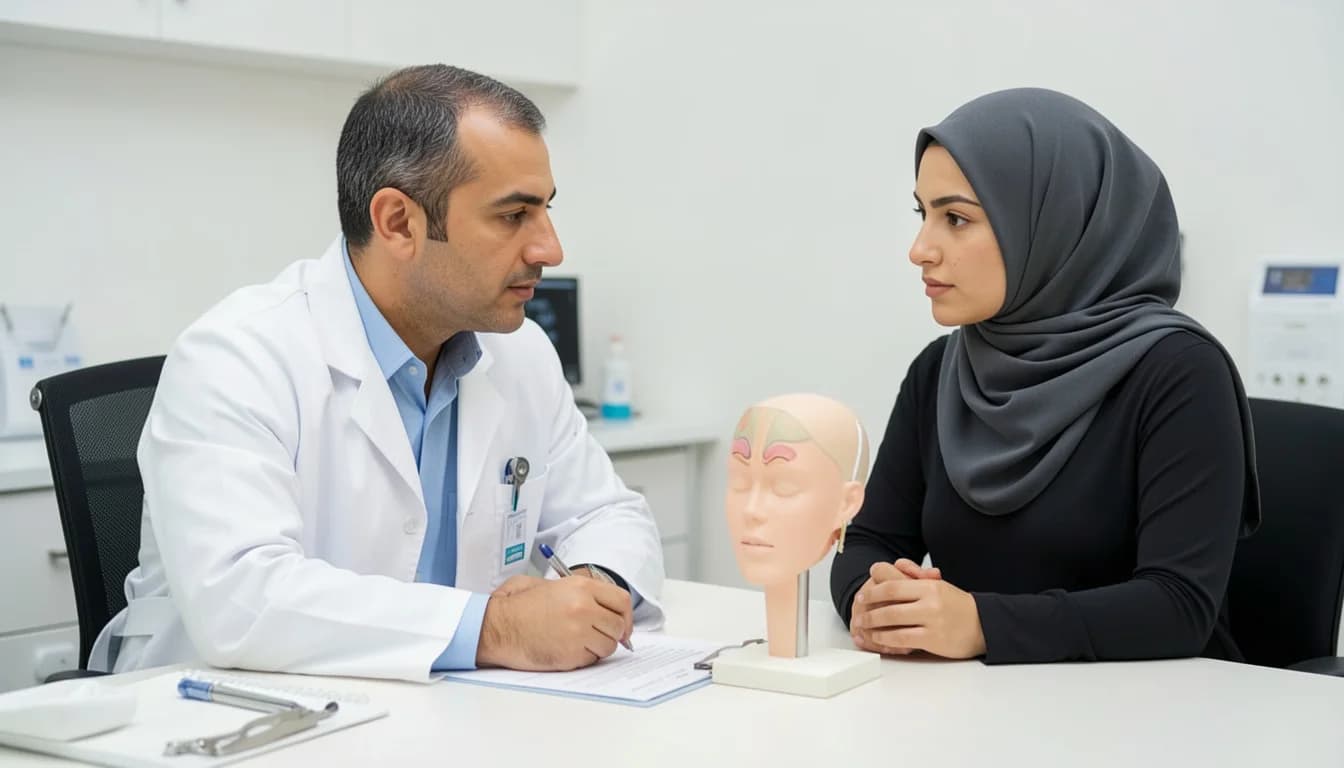
The diagnosis is clinical, based on the appearance and distribution of the plaques, with deliberate examination of the scalp, nails, body folds and soles because these sites are frequently overlooked. The affected surface area and the severity of redness, thickness and scaling are assessed and documented photographically for comparison, and a small biopsy may be taken when other skin conditions look similar.
The patient is asked about joint pain, morning stiffness, swollen fingers and pain in the lower back or heel tendon, because psoriatic arthritis needs early treatment to prevent damage. Blood pressure and weight are recorded, and glucose, lipids, liver and kidney function and a blood count are requested; latent tuberculosis and hepatitis are excluded before certain medicines.
A topical regimen is tailored to each site: lower potency for the face and folds and stronger preparations for thick plaques, together with a vitamin D analogue, a descaling preparation for the scalp and suitable products for the nails. The quantity, duration of use and stopping point are explained, and generous daily moisturising is emphasised because it reduces cracking and itch and improves how well the active treatment works.
If disease is widespread or has not responded to topical therapy, narrowband ultraviolet phototherapy is offered over several sessions per week for a number of weeks, or treatment is escalated to a conventional systemic or biologic medicine according to severity, joint involvement, general health and reproductive plans, after the benefits, risks and required monitoring have been explained.
Follow-up visits are scheduled to measure response and adjust potency and duration, with periodic blood tests for anyone on systemic therapy. Trigger control is discussed: treating throat infection, managing stress and sleep, stopping smoking, weight reduction, avoiding scratching and skin trauma, and awareness of medicines that can aggravate the disease.
Do not apply any ointment or oil to the affected areas on the morning of your appointment, so the doctor can see the true appearance of the plaques and scale. Bring everything you have already used in its original packaging: creams, medicated shampoos, oral medicines, herbal mixtures and any compounded product from a pharmacy or given to you by someone else, and state how long you used each and what happened, particularly if you used a potent topical steroid for a long period. Write down when the disease started and what triggers your flares: throat infection, stress, a new medicine, an injury, or seasonal change. Tell the doctor about any joint pain or stiffness, about chronic conditions such as hypertension, diabetes or liver disease, and about all your medicines including beta blockers, lithium and antimalarials, since some of these aggravate psoriasis. Report if you are pregnant, breastfeeding or planning pregnancy, or if you have an active infection or a history of tuberculosis, as this fundamentally changes the treatment options. Bring photographs of your skin at its worst.
Use the ointment at exactly the potency and for exactly the duration prescribed, do not extend the course or move it to the face or body folds on your own, and never stop systemic or biologic treatment without your doctor. Moisturise daily and immediately after bathing, even during quiet periods, bathe in lukewarm rather than hot water, and use a gentle cleanser. Do not scrub or pick off the scale with a tool, because trauma and scratching provoke a new plaque at that very site. Treat any throat infection early, stop smoking, reduce alcohol, work on weight and physical activity, and regulate sleep and stress because their effect is real. Keep your phototherapy sessions and monitoring blood tests, and photograph your skin monthly to judge progress objectively. Seek care promptly if there is: **generalised redness covering most of the body with shivering, fever or feeling systemically unwell**; **widespread pustules with fever, which requires urgent assessment**; **joint pain, swelling or morning stiffness, or swelling of a whole finger**; **fever, persistent cough, night sweats or weight loss while on immunosuppressive treatment**; **signs of infection in the plaques such as increasing pain, pus or red streaks**; **skin thinning, ulceration or stretch marks after topical steroid use**; **yellow eyes or persistent nausea while taking systemic medicines**.
The assessment visit usually takes 20 to 40 minutes, topical therapy typically needs four to eight weeks before response is judged, and phototherapy sessions last a few minutes each, several times a week for several weeks.
Dr. Mohammad Helalat is a consultant dermatologist and venereologist practicing at Helalat Clinic in Dabouq. He assesses acne and acne scarring, pigmentation, d…
Dr Reem Mahmoud Al Awadi is a dermatologist and venereologist with the Jordanian Board in the specialty. At her Shmeisani practice, she assesses skin and hair c…
Dr Huda Al Qudah is a consultant dermatologist and venereologist, a Jordan University of Science and Technology graduate and holder of the Jordanian Board. Her …
There are currently 3 doctor profiles linked to Psoriasis Treatment on ClinicsJo. Review the listed services and contact the practice to confirm availability with the doctor and branch you choose.
Start with an available doctor's profile and use the contact or booking options shown there. Confirm the service, practice location and appointment time with the clinic. If this list is empty, broaden your search using the directory links on this page.
Ask the practice for the current price and what it includes. A consultation fee shown on a profile is not necessarily the price of a procedure, tests or follow-up. Confirm any additional charges and insurance arrangements before your visit.