

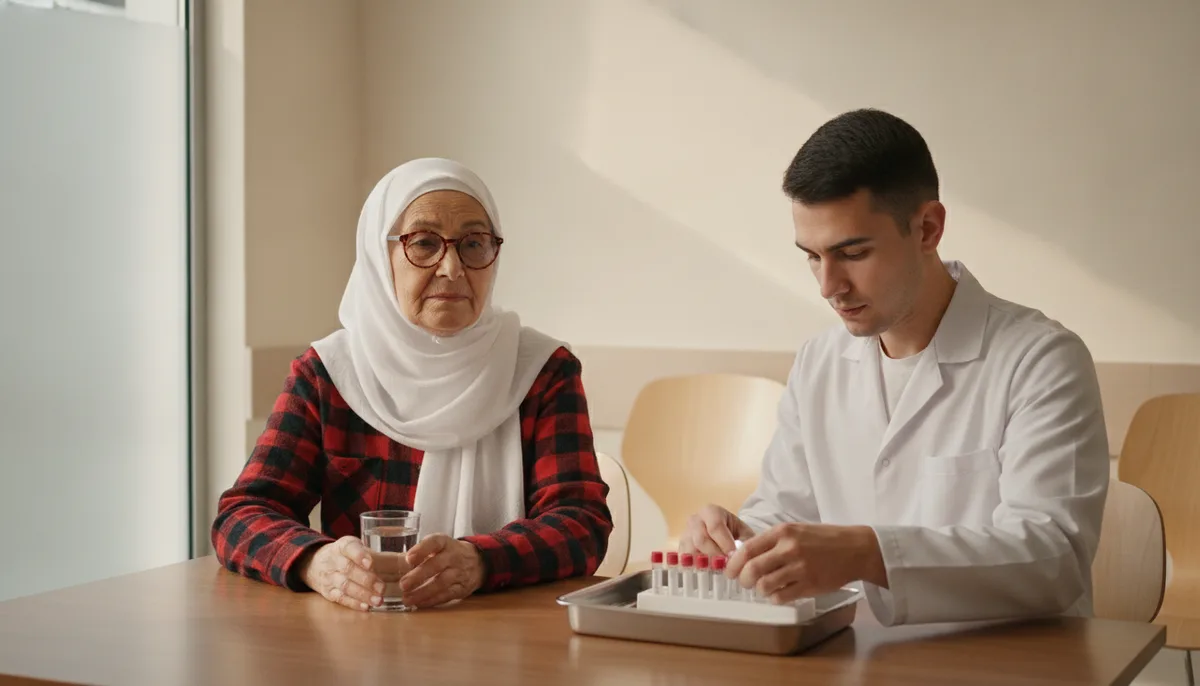
Fasting before blood tests means avoiding food and all drinks except plain water for several hours before the blood draw, usually 8 to 12 hours depending on the test [1]. It is commonly requested for blood sugar and lipids, and may be requested for other tests too. Do not stop your medications on your own. Follow the instructions of the laboratory and the doctor who ordered the test.
What does fasting before blood tests mean?
If your doctor asks you to fast before blood tests, it means you should not eat or drink anything except plain water for several hours before the blood draw [1]. It is not the same as religious fasting. Here, you only need to avoid food and other drinks, along with a few additional habits.
During this period, it is also advised to avoid:
- Chewing gum.
- Smoking.
- Exercising [1].
Your doctor or laboratory will usually give you written instructions. If you still have a question that has not been answered, ask at least one full day before the test so you have enough time to prepare properly [1].
Why does a doctor ask for fasting before blood tests?
When you eat and drink, your blood absorbs sugar, fats, protein and other nutrients. These substances may change the levels of some components in the blood and affect the accuracy of the result [1]. An inaccurate result gives the doctor a wrong picture of your health and may lead to an incorrect diagnosis [1].
The effect is not limited to food. Test results are influenced by several factors, including what you eat and drink, the medications you take, and how closely you follow the instructions given before the test [2]. Therefore, good preparation is part of the test itself, not a minor detail.
Which tests require fasting?
Not all tests require fasting. Common examples that usually do require it are:
- Blood sugar test (glucose): Used to help diagnose and monitor diabetes, prediabetes and gestational diabetes. Not all glucose tests require fasting, so ask your doctor [1].
- Lipid test (cholesterol and triglycerides): Helps estimate the risk of heart disease and is used to monitor the condition after a cardiac event such as a heart attack or stroke [1].
- Basic metabolic panel (BMP): A group of tests that gives an idea of how organs such as the heart, kidneys and liver are working [1].
In some cases, fasting may also be requested for liver function and kidney function tests. This depends on several factors. Some liver tests require fasting only if they are ordered as part of a comprehensive metabolic panel [1]. Other tests not mentioned here may also require fasting, so always ask if you are not sure [1].
| Type of test | Is fasting required? | Note |
|---|---|---|
| Blood sugar | Often, but not always | Ask your doctor which type of test is required [1] |
| Lipids (lipid panel) | Often | Follow the instructions of your doctor and laboratory [1] |
| Basic metabolic panel (BMP) | Often | Assesses the heart, kidneys and liver [1] |
| Liver function | Sometimes | Depends on whether it is part of a comprehensive metabolic panel [1] |
| Kidney function | Sometimes | Depends on what your doctor orders [1] |
| Urinalysis | Usually not | Check the laboratory instructions |
What about urine tests and others?
Urine tests usually do not require fasting, but some specialized urine tests have different instructions, so follow what the laboratory says. You can read Can I eat or drink before a urinalysis? as well as A Complete Guide to Urinalysis and Understanding Its Results.
If your doctor suspects a kidney problem, they may order both urine and blood tests together. You can find an explanation of this in our article on kidney tests. For a complete blood count (CBC), read What is a CBC and what does it reveal?, and confirm with the laboratory whether it needs any special preparation.
Other tests, such as semen analysis, stool tests or prostate-specific antigen (PSA), have their own preparation requirements. You can find information about them in articles such as Male Infertility and Semen Analysis, Food Poisoning, Diarrhea and Fluid Replacement, and Elevated PSA Test Result. In all cases, follow the instructions of your doctor and laboratory.
How many hours should I fast before a blood test?
Fasting usually lasts between 8 and 12 hours before the test. Your doctor determines the exact duration based on the test ordered [1]. Some tests may come with additional instructions, such as avoiding alcohol for a longer period [1].
A practical tip is to book your blood test early in the morning. This way, most of the fasting period passes while you are asleep [1].
- Ask how long the fast should be when the test is ordered.
- Calculate the time of your last meal so that it ends the required number of hours before the appointment.
- Book a morning appointment if possible.
- Write down the instructions so you do not forget them.
Remember that you should not fast unless your doctor tells you to. Fasting may affect the results of some tests and give an inaccurate picture of your health [1].
What is allowed and what is not allowed during fasting before blood tests?
The only thing allowed is plain water. Juice, coffee, soft drinks and other beverages enter the bloodstream and may change the results [1]. Avoid sparkling or flavored waters, including lemon-flavored ones, as they may contain sugars or artificial sweeteners [1].
Drinking water is also beneficial, as it keeps more fluid in the veins and makes sample collection easier [1].
| Allowed | Not allowed |
|---|---|
| Plain water [1] | Juice, coffee and soft drinks [1] |
| Staying calm and relaxed | Chewing gum [1] |
| Asking about medications before the appointment [1] | Smoking and exercising [1] |
Should I take my medications during fasting? What about people with diabetes?
Ask your doctor whether you may take your usual medications, whether prescribed or bought without a prescription. For some tests, you may be asked to stop a specific medication, but do not stop any medication unless your doctor tells you to [1]. Also tell your doctor about any vitamins and supplements you use so they can avoid anything that may affect the results [1].
Do not set your own dose or timing for any medication. Medications affect test results [2], and the decision rests with the doctor who knows your condition.
Special warning for people with diabetes
People who use insulin or diabetes medications need a clear plan before the day of the test, because not eating combined with some medications may cause low blood sugar. Ask your doctor well before the appointment about:
- Whether you should take your diabetes medications on the morning of the test or after it.
- What to do if you feel symptoms of low blood sugar while fasting.
- Whether an earlier appointment can be arranged to reduce the waiting time.
Bring a light snack to eat as soon as the test is finished, since dizziness after a blood test while fasting is common [1]. If you develop symptoms such as tremors, heavy sweating or confusion, tell the laboratory staff immediately and do not wait.
What if I ate or drank by mistake? When can I eat after the test?
Tell the doctor or laboratory if you ate or drank anything other than water before the test. You may need to reschedule the test for a time when you have actually fasted to ensure an accurate result [1]. Do not hide it, as an incorrect result is worse than postponing the test.
You can eat as soon as the test is over [1]. Since dizziness is common afterward, it is best to carry light food with you.
If the test is linked to a surgical procedure, remember that fasting instructions before surgery and anesthesia are different and are determined by the surgical and anesthesia team. You can find a general explanation in our patient guide to anesthesia before and after surgery.
When should I consult a doctor, and when should I go to the emergency room?
Contact your doctor or the laboratory before the appointment if:
- You did not understand the instructions or no one has told you how many hours of fasting are required.
- You take medications and do not know whether they should be taken before the test.
- You have diabetes or a chronic illness and are worried about fasting.
- You ate or drank something by mistake before the appointment [1].
- The test is for a child or a pregnant woman, as instructions are set according to the individual case.
In emergencies, do not wait for the test appointment. Call 911 or go to the nearest emergency department if you experience:
- Fainting, loss of consciousness or inability to wake up.
- Severe confusion or seizures, especially in a person with diabetes.
- Chest pain or severe shortness of breath.
- Any condition you feel is serious and not just simple dizziness.
How do I find the right doctor or laboratory in Jordan?
If you do not know who should order or interpret your test, start by identifying the specialty that fits your complaint: internal medicine or family medicine for general tests, endocrinology and diabetes specialists for monitoring blood sugar, or another specialty depending on the illness. ClinicsJo allows you to search for doctors and clinics by specialty and governorate, read their profiles, and contact or book where the profile allows it. There are also health centers affiliated with the Ministry of Health across the governorates of the Kingdom.
When reading a doctor's profile, check:
- The listed specialty and experience.
- The clinic location and working hours.
- The available method of contact or booking.
No profile replaces asking the doctor directly. Useful questions to ask when ordering a test:
- Does this test require fasting, and exactly how many hours?
- Should I take my medications and supplements on the morning of the appointment?
- Can it be done at a specific time or in the morning?
- When will the result be available, and how do I get it?
After the result comes out, you may need related follow-up tests, such as the liver tests explained in our article on metabolic dysfunction-associated fatty liver disease. If you are planning a pregnancy, see What is preconception care and why is it important?, and for tests during pregnancy, read about prenatal genetic testing.
Remember that the instructions of the laboratory where you will have the test are the final reference. Keep them and give them to whoever accompanies you if the fasting is for a child or an elderly person. Medical references confirm that following the correct steps before a test helps ensure accurate results [1].
This article is for general awareness and does not replace the instructions of your doctor or laboratory.
Frequently asked questions
How many hours should I fast before a blood test?
The fasting period is usually between 8 and 12 hours, but the doctor or laboratory determines the exact duration based on the test ordered. Ask when the test is requested, and book a morning appointment if possible so that most of the fasting period passes while you sleep.
Can I drink water before the test?
Yes, plain water is allowed and may make sample collection easier because it helps keep your body hydrated. Avoid juice, coffee and soft drinks, as well as sparkling or flavored waters, since they may contain sugars or sweeteners that affect the result.
Should I take my medications on the morning of the test?
Ask your doctor or the laboratory before the appointment. For some tests, the doctor may ask you to stop a specific medication, but do not stop any medication on your own. Also tell the doctor about any vitamins and supplements you take so they do not affect the results.
Does a urine test require fasting?
Urine tests usually do not require fasting, but some specialized tests may have different instructions. Follow the laboratory's instructions, and if you are not sure, ask the doctor who ordered the test before the appointment.
What should I do if I ate by mistake before the test?
Tell the doctor or the laboratory what happened. The accuracy of the result may be affected, and the appointment may need to be rescheduled so you can fast properly beforehand. Do not try to hide it, because an inaccurate result may give a wrong picture of your health.
What should a person with diabetes do when fasting before a test?
Consult your doctor before the appointment to find out whether you should take your medication or insulin before or after the test, and what to do if you feel symptoms of low blood sugar. Bring a light snack to eat as soon as the test is over, and tell laboratory staff if you feel dizzy or confused.
Sources and references
- Fasting for a Blood Test: MedlinePlus Medical Test — MedlinePlus — U.S. National Library of Medicine. Accessed: 2026-10-26.
- Laboratory Tests: MedlinePlus — MedlinePlus — U.S. National Library of Medicine. Accessed: 2026-10-26.