

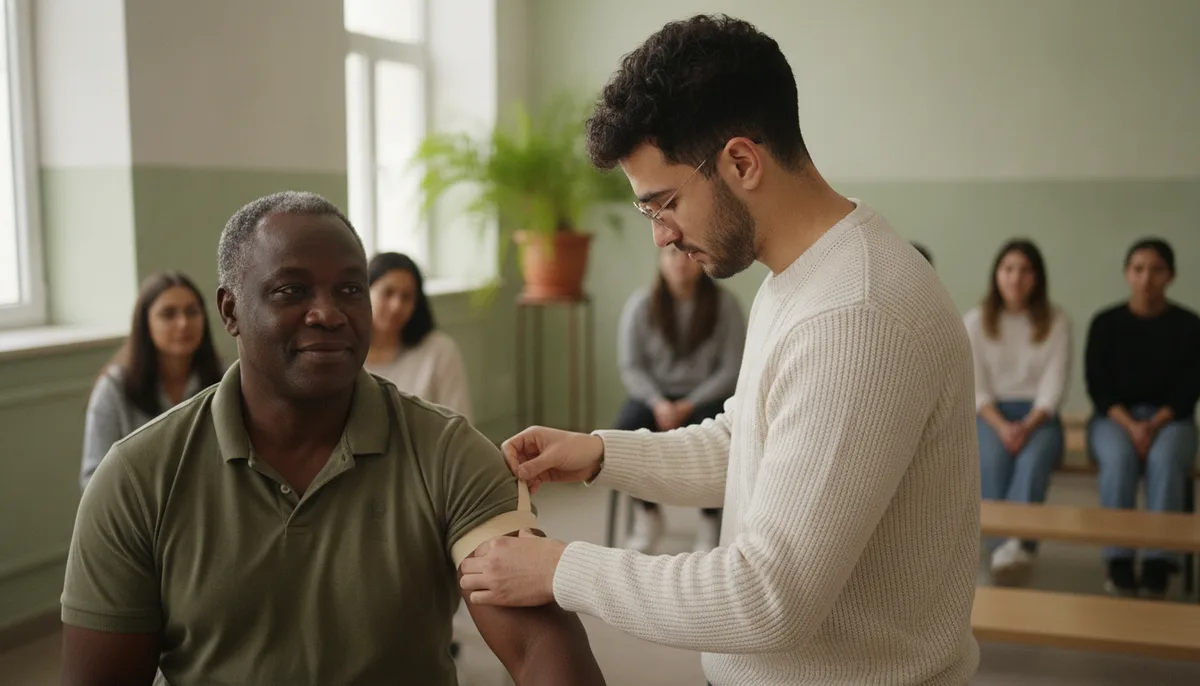
A tourniquet is a life-saving device for severe, life-threatening bleeding in an arm or leg. It is used when bleeding does not stop with continuous direct pressure [3]. It is applied about 5 to 7.7 cm above the wound, avoiding the joint. The time of application is recorded, it is not loosened, and 911 is called immediately. Direct pressure on the wound is always the first step.
What is a tourniquet, and why does direct pressure come before it?
Bleeding is the loss of blood. It may be external, as with cuts and lacerations, or internal, caused by an injury to an internal organ [1]. A tourniquet is a band tightened around an arm or leg to stop blood flow to the wound, and it comes second after direct pressure.
Medical references state that the most important step in external bleeding is direct pressure on the wound, which will most likely stop most cases of external bleeding [3]. For this reason, you should not start with a tourniquet for every wound. Its use is limited to cases of severe, life-threatening bleeding.
Some minor injuries can bleed heavily, such as a scalp wound [3]. The risk is higher for people who take anticoagulant (blood-thinning) medications or who have a bleeding disorder such as hemophilia. These people need immediate medical care [3].
What should I do first with severe bleeding? Direct pressure and calling 911
In life-threatening situations, call emergency services immediately. First aid is the care you provide before medical help arrives [2]. In Jordan, the number is 911, and you can find details in the unified emergency services number in Jordan. If someone else is present, ask them to call, so that you do not have to leave the wound.
Then follow these steps in order:
- Reassure and calm the injured person, because the sight of blood is frightening [3].
- Lay them down to reduce the risk of fainting, and raise the bleeding part if possible [3].
- Apply direct pressure to the wound with a sterile dressing, a clean piece of cloth, or even a piece of clothing. If nothing is available, use your hand. The only exception is an eye injury [3].
- If the dressing becomes soaked with blood, do not remove it. Place another piece on top of it and continue to apply pressure [2].
- Do not uncover the wound to check whether the bleeding has stopped, because the less the wound is disturbed, the better the chance of controlling it [3].
- Once the bleeding stops, wrap the dressing firmly with adhesive tape or a clean piece of cloth [3].
Wear gloves if available, because contact with the injured person's blood can transmit infections such as viral hepatitis or HIV if it enters an open wound, even a small one [3]. For the general concept, see the glossary entry on First Aid.
When should a tourniquet be used?
A tourniquet is used when bleeding is very severe and life-threatening and has not stopped despite continuous pressure. It should stay in place until medical help arrives [3]. This means both conditions must be present: dangerous bleeding, and direct pressure has failed to stop it.
Situations where a tourniquet is not suitable
A tourniquet is applied to limbs only [3]. Wounds to the abdomen, pelvis, groin (upper thigh), neck, or chest may appear minor but can hide severe internal bleeding. For these, seek medical care immediately, cover the wound with a damp cloth, apply gentle pressure, and do not push any visible organ back into place [3].
To learn more about the limits of using a tourniquet, read Can a tourniquet be used in all cases of severe bleeding?.
How is a tourniquet applied safely, step by step?
If a ready-made tourniquet is in your first aid kit, use it [3]. References outline the following rules for applying a tourniquet safely:
- Choose the location: on the same limb, above the wound by 2 to 3 inches (5 to 7.7 cm) toward the trunk. Avoid the joint. If necessary, place it above the joint toward the trunk [3].
- Protect the skin: if possible, do not place it directly on the skin, because this may pinch or injure the skin and underlying tissues. Use padding, or place it over trousers or a sleeve [3].
- Tighten it: tighten until the bleeding stops. This may be painful for the injured person, so reassure them and tell them that pain is expected.
- Record the time: write down the time of application if possible. If not, keep it in your memory and tell the emergency team [3].
- Keep the wound covered with the dressing, and keep the limb still [3].
- Do not loosen or remove the tourniquet. The decision to loosen or remove it belongs to the medical team.
Recording the time does not replace getting to the hospital quickly. Leaving a tourniquet on for a long time can damage nerves and tissues [3].
Can an improvised tourniquet be made?
Yes, if a ready-made tourniquet is not available. References describe the method as follows: use a strip of cloth 2 to 4 inches (5 to 10 cm) wide, wrap it around the limb several times, and tie a half knot or square knot, leaving two long ends long enough for a second knot. Place a stick or a rigid rod between the two knots, and turn it until the band tightens and the bleeding stops, then secure it in place [3].
Keeping to the stated width is important, as the references specify it. The same rules still apply: above the wound, away from the joint, with the time recorded and no loosening. It is best to learn this skill hands-on. References recommend attending a first aid or cardiopulmonary resuscitation (CPR) course to acquire skills used in emergencies [2].
What is right and what is wrong in each bleeding situation?
| Situation | What to do | What to avoid |
|---|---|---|
| Superficial wound bleeding slowly | Wash it with water and warm soap, and pat it dry [3] | Excessive pressure when it is not needed |
| Heavy bleeding in an arm or leg | Continuous direct pressure, and call 911 | Lifting the dressing to check whether the bleeding has stopped [3] |
| Life-threatening limb bleeding that has not stopped with pressure | Tourniquet above the wound, and record the time [3] | Applying it over the joint or loosening it yourself |
| Wound to the abdomen, chest, neck, pelvis, or groin | Immediate medical care, gentle pressure, and covering with a damp cloth [3] | Pushing any visible organ back into place |
| Embedded object in the body (knife or stick) | Place dressings around it and secure it with tape [3] | Pulling out the embedded object |
| Dressing soaked with blood | Place a new piece on top of it [2] | Removing the soaked dressing |
What comes next after applying a tourniquet?
After the tourniquet is applied and the bleeding stops, the priority shifts to preventing shock and waiting for the ambulance. Keep the injured part completely still, lay the injured person flat, raise their legs about 12 inches (30 cm), and cover them with a coat or blanket [3]. If you suspect an injury to the head, neck, back, or leg, do not move the person if possible, because movement may worsen the injury [3].
Do not try to clean or examine a large wound, as this may increase bleeding. Wait for the medical team [3]. Even if the bleeding has completely stopped, the injured person needs an immediate medical evaluation, because the use of a tourniquet by itself is a reason to see a doctor [3].
When the paramedics arrive, tell them what happened and the time the tourniquet was applied. To learn how specialists handle these cases, see the page on Acute hemorrhage treatment.
Warning signs: when to go to emergency services and when to see a doctor
Call 911 or go to the nearest emergency department immediately if:
- The bleeding cannot be controlled, a tourniquet was needed, or the injury is serious [3].
- Signs of shock appear after bleeding: confusion or reduced alertness, cold clammy skin, dizziness, pallor, rapid pulse, shortness of breath, or weakness [3].
- You suspect internal bleeding, whose signs include abdominal pain and swelling, chest pain, or blood in the stool, urine, or vomit [3].
- The injury was to the abdomen, pelvis, groin, neck, or chest [3].
- The injury was accompanied by a blow to the head. In this case, first aid for a head injury will be helpful.
See a doctor in the following cases:
- Bleeding continues after 10 minutes of steady direct pressure, or the wound is deep, open, or caused by a dirty or rusty object [2].
- The wound needs stitches, or dirt and debris cannot be removed by gentle cleaning [3].
- Signs of infection appear: increasing pain, redness, or swelling, yellow or brown fluid, fever, or red streaks extending toward the heart [3].
- The wound was an animal or human bite. For details, read Animal bites: first aid and when to seek help.
- More than 10 years have passed since your last tetanus vaccine, and this also applies to puncture wounds, which may bleed only a little but are more prone to infection [3].
There are other types of bleeding that do not require a tourniquet but still need evaluation, such as Epistaxis (nosebleeds) and Abnormal uterine bleeding. Anyone who bleeds frequently or develops bruises for no clear reason may benefit from reading about platelet disorders, as there may be a problem with blood clotting [1].
How do you find the right doctor or clinic in Jordan after an injury?
Emergency services are your first destination for severe bleeding, and a clinic directory does not replace calling 911. However, once the condition is stable, you may need wound follow-up or an evaluation of the cause of recurrent bleeding. The appropriate place depends on the case. You may need a surgeon or orthopedic specialist for limb injuries, or a hematologist if there is a bleeding disorder.
On ClinicsJo, you can browse by specialty and governorate, then read the doctor's profile. Useful pages include Treatment for bleeding disorders and Acute hemorrhage treatment.
What to check in the profile
- The specialty and areas of clinical interest, and how closely they relate to your condition.
- The clinic's location and governorate, working hours, and whether it allows booking or contact.
- The contact method listed in the profile.
Questions to ask the doctor
- Does the wound need follow-up or a dressing change, and when?
- Do I need a tetanus vaccine?
- What signs of infection should prompt a return visit?
- If I take a blood thinner, how should I manage this in the future? (Do not change or stop your medication on your own.)
How should you prepare at home and in the car?
It is recommended to keep a first aid kit at home and in the car. The basic kit should include medical adhesive plasters, sterile gauze dressings, adhesive tape, disinfectant wipes, disposable gloves, scissors, and a first aid manual explaining how to use each item. Check it periodically to replace expired items [2]. If your kit includes a tourniquet, make sure you know how to use it [3].
Keep emergency numbers and any important medication information for family members in the kit [2]. Remember that hands-on training increases your confidence in critical moments, that a tourniquet is used after direct pressure, not before it, and that calling 911 is the step you should never delay.
Frequently asked questions
Do I use a tourniquet for every wound that bleeds?
No. Direct pressure on the wound with a dressing or clean cloth is the first step, and it will often stop most external bleeding. A tourniquet is only used for severe, life-threatening bleeding of an arm or leg that does not stop with continuous pressure, and you must call emergency services on 911.
Where exactly do I place the tourniquet?
It is placed on the same limb above the wound, about 5 to 7.7 cm toward the trunk, avoiding the joint. If the wound is near a joint, place it above the joint toward the trunk. It is preferable not to touch the skin directly, but to place it over clothing or padding, then tighten it until the bleeding stops.
Should I loosen the tourniquet after some time to let blood reach the limb?
No. Do not loosen or remove it yourself. Leave it in place, record the time it was applied, and tell the ambulance crew. Leaving a tourniquet on for a long time can damage nerves and tissues, which is why medical care must be reached as quickly as possible. The medical team decides when to loosen it.
What if a ready-made tourniquet is not available?
An improvised one can be made from a wide strip of cloth 5 to 10 cm wide. Wrap it around the limb several times and tie a knot, then place a rigid stick between two knots and turn it until the bleeding stops, and secure it. The same rules apply: above the wound, away from the joint, and record the time. Hands-on training is helpful.
Is a tourniquet suitable for wounds to the abdomen, neck, or chest?
No. A tourniquet is applied to limbs only. Wounds to the abdomen, pelvis, groin, neck, and chest may cause severe internal bleeding despite their simple appearance, and they require immediate medical care. Cover the wound with a damp cloth, apply gentle pressure, and do not push any visible organ back into place.
What number should I call in Jordan for severe bleeding?
Call 911 immediately for severe bleeding, or if signs of shock appear, such as pallor, dizziness, rapid pulse, or confusion. Tell the operator your location and the type of injury, and continue to apply pressure to the wound or keep the tourniquet in place until the ambulance arrives.
Sources and references
- Hemorrhage | Bleeding — MedlinePlus — U.S. National Library of Medicine. Accessed: 2026-10-26.
- First Aid: MedlinePlus — MedlinePlus — U.S. National Library of Medicine. Accessed: 2026-10-26.
- Bleeding: MedlinePlus Medical Encyclopedia — MedlinePlus — U.S. National Library of Medicine. Accessed: 2026-10-26.