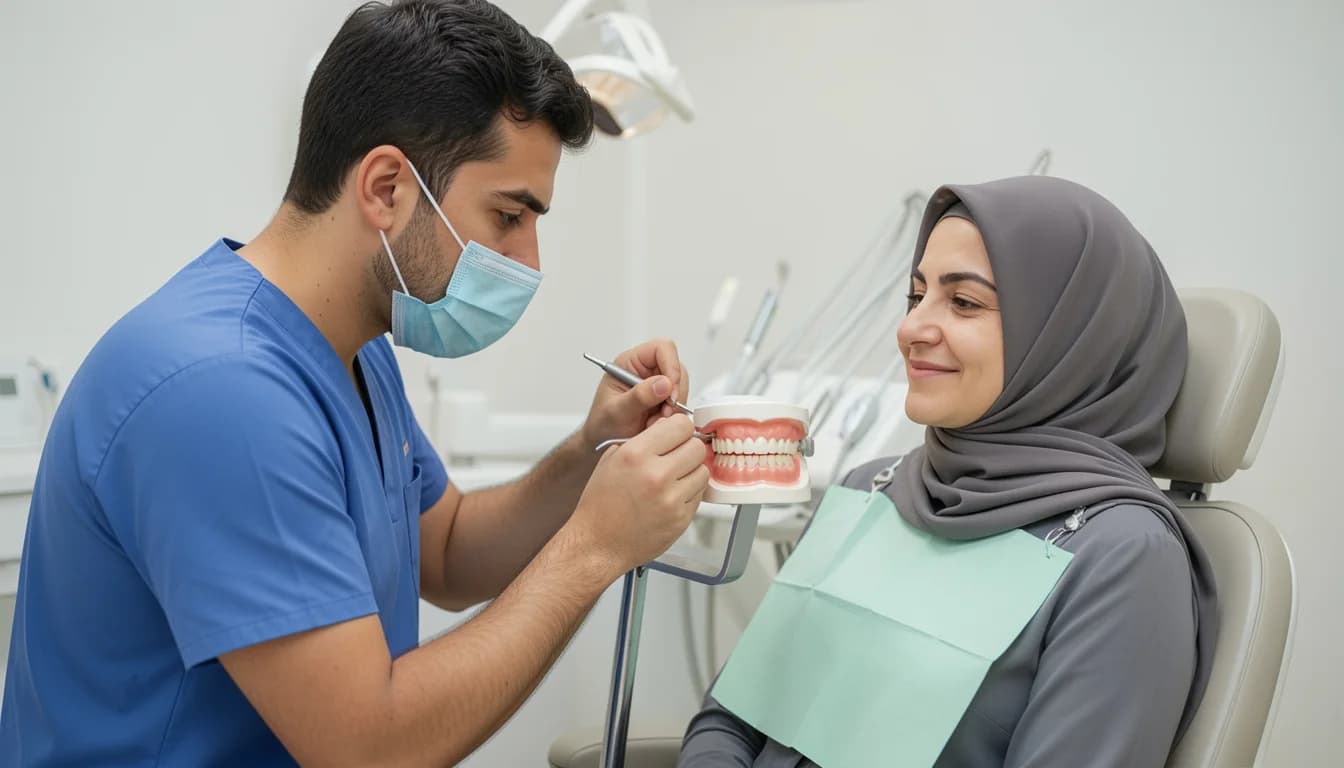
Deep Scaling and Root Planing Treatment Doctors in Jordan
التنظيف العميق للأسنان وتنعيم الجذر السني
Deep scaling and root planing is treatment aimed below the gum line: removing calculus and bacterial plaque from inside the periodontal pocket around the root, and smoothing the roughened, contaminated root surface so that tissue can reattach to it. It differs from a routine scale and polish, which addresses only the visible surface above the gum, and it usually requires local anaesthesia and several appointments.
It is indicated once periodontitis is diagnosed: pockets deeper than normal when measured with a graduated probe, bleeding on probing, and bone loss visible on radiographs, often accompanied by exposed roots, persistent bad breath, tooth mobility or pus discharge. Measurement and imaging determine the need, not the way the gums look in a mirror or in a phone photograph. Many people who assume they need deep cleaning in fact need only supragingival cleaning and better home care.
The work is carried out quadrant by quadrant, or half a mouth per session, with fine hand instruments alongside an ultrasonic scaler. In selected cases a laser or a locally delivered antimicrobial may be added inside the pocket as an adjunct, never as a replacement for mechanical removal. Measurements are then repeated at a reassessment visit, typically four to eight weeks later, to identify which pockets have responded and which remain deep.
Honest expectations matter. Bleeding, inflammation and odour will decrease, but the gums may look shorter and the roots longer afterwards, because the inflammatory swelling that was masking existing recession subsides. Cold sensitivity may increase for some weeks, and spaces between the teeth may widen so that interdental brushes become necessary rather than floss alone.
The limits are explicit. Deep cleaning does not regrow lost bone or the ligament fibres that have broken down, and on its own it will not close very deep pockets, some of which need subsequent periodontal surgery. It is not tooth whitening and not a treatment for decay, and it will not halt the disease if smoking continues, if diabetes stays poorly controlled, or if daily brushing and flossing are neglected. Results are held by regular maintenance visits, not by a single appointment.
4 specialists
Procedure steps
1
Diagnosis and pocket charting
Pocket depth is recorded around every tooth with a graduated probe, along with bleeding on probing, tooth mobility and root exposure, supported by radiographs to assess bone level. The plan is built on these recorded numbers rather than a general impression.
2
Session planning and local anaesthesia
The mouth is divided into sections and the section being treated is anaesthetised locally so that subgingival work can be done painlessly and precisely. The number of sessions depends on how many areas are involved, pocket depth and how long a visit you tolerate.
3
Subgingival calculus removal
Hard deposits and the bacterial film are removed from inside the pocket using fine hand instruments and an ultrasonic scaler with water irrigation, and the pockets are flushed. The aim is to remove the source of inflammation, not merely to polish the crown.
4
Root surface planing
The root surface is carefully planed to remove the contaminated layer and reduce roughness, making it harder for bacteria to adhere and easier for tissue to reattach. Excessive instrumentation is avoided because root structure does not regenerate.
5
Reassessment and maintenance visits
After four to eight weeks the measurements are repeated. Pockets that have shallowed and stopped bleeding enter a maintenance programme every few months, while pockets that remain deep or keep bleeding are referred for surgical assessment. Maintenance is what preserves the long-term result.
Before the procedure
Tell your dentist about all your medicines, particularly anticoagulants, antiplatelet drugs and bone-density medication, and do not stop any of them yourself. Mention diabetes and how well controlled it is, along with any heart condition, prosthetic valve, joint replacement or immune deficiency, since some of these require specific arrangements before subgingival work. Report any allergy to local anaesthetic and your previous experience with it. Eat before the appointment, because your lip and tongue will stay numb for some hours afterwards, and avoid scheduling pressing commitments straight after. Bring a written medication list and any earlier radiographs, and ask in advance how many sessions are expected and how they will be spaced.
After the procedure
Do not eat or drink anything hot until the anaesthetic has fully worn off, so you do not bite your lip or tongue. Resume brushing when your dentist advises, using a soft brush with gentle strokes along the gum margin, and use the floss or interdental brushes you were shown every day, because most of the outcome is produced at home rather than in the clinic. Eat soft food for the first two days, and expect slight bleeding and cold sensitivity that ease over some weeks; a desensitising toothpaste may be recommended. Stop smoking, as it is the single strongest factor that undermines treatment, and keep blood sugar controlled if you are diabetic. **Seek care immediately if swelling increases in the gum, face or under the jaw, if you develop a high fever, throbbing pain with a taste of pus, bleeding that will not stop with pressure, difficulty swallowing or opening your mouth, or sharp pain when biting on one particular tooth.**
Expected duration
Usually 45 to 90 minutes per session, with the plan commonly divided into two to four visits depending on how many areas are affected.
تُعد د. يولا كوفالينكا من الكفاءات الطبية المتميزة في مجال طب الأسنان. تخرجت من جامعة لوغانسك الطبية الحكومية عام 2007، وكانت ضمن أوائل خمسة طلاب على دفعتها، وه…
يمتلك د. معتصم ارديسات خبرة مهنية واسعة في مجال طب الأسنان بدأت منذ عام 2007. تمتد مسيرته بين العمل الأكاديمي والممارسة السريرية في أوروبا والشرق الأوسط، مما من…
الدكتور محمد عرفات حسن هو طبيب أسنان وصاحب خبرات متقدمة في طب وجراحة الفم والأسنان، خرّيج جامعة دمشق العريقة في طب وجراحة الفم والأسنان (بكالوريوس)، وحاصل على ع…
الدكتور محمد أحمد علي الطراونة جرّاح فم ووجه وفكين، ومستشار في زراعة الأسنان وتجميل الوجه غير الجراحي. حاصل على البورد الأردني في جراحة الفم والوجه والفكين (201…
Finding Deep Scaling and Root Planing Treatment services in Jordan
Which doctors are listed for Deep Scaling and Root Planing Treatment in Jordan?
There are currently 4 doctor profiles linked to Deep Scaling and Root Planing Treatment on ClinicsJo. Review the listed services and contact the practice to confirm availability with the doctor and branch you choose.
How can I find an appointment for Deep Scaling and Root Planing Treatment?
Start with an available doctor's profile and use the contact or booking options shown there. Confirm the service, practice location and appointment time with the clinic. If this list is empty, broaden your search using the directory links on this page.
What does Deep Scaling and Root Planing Treatment cost in Jordan?
Ask the practice for the current price and what it includes. A consultation fee shown on a profile is not necessarily the price of a procedure, tests or follow-up. Confirm any additional charges and insurance arrangements before your visit.
Explore related Periodontics (Gum Disease) doctor directories