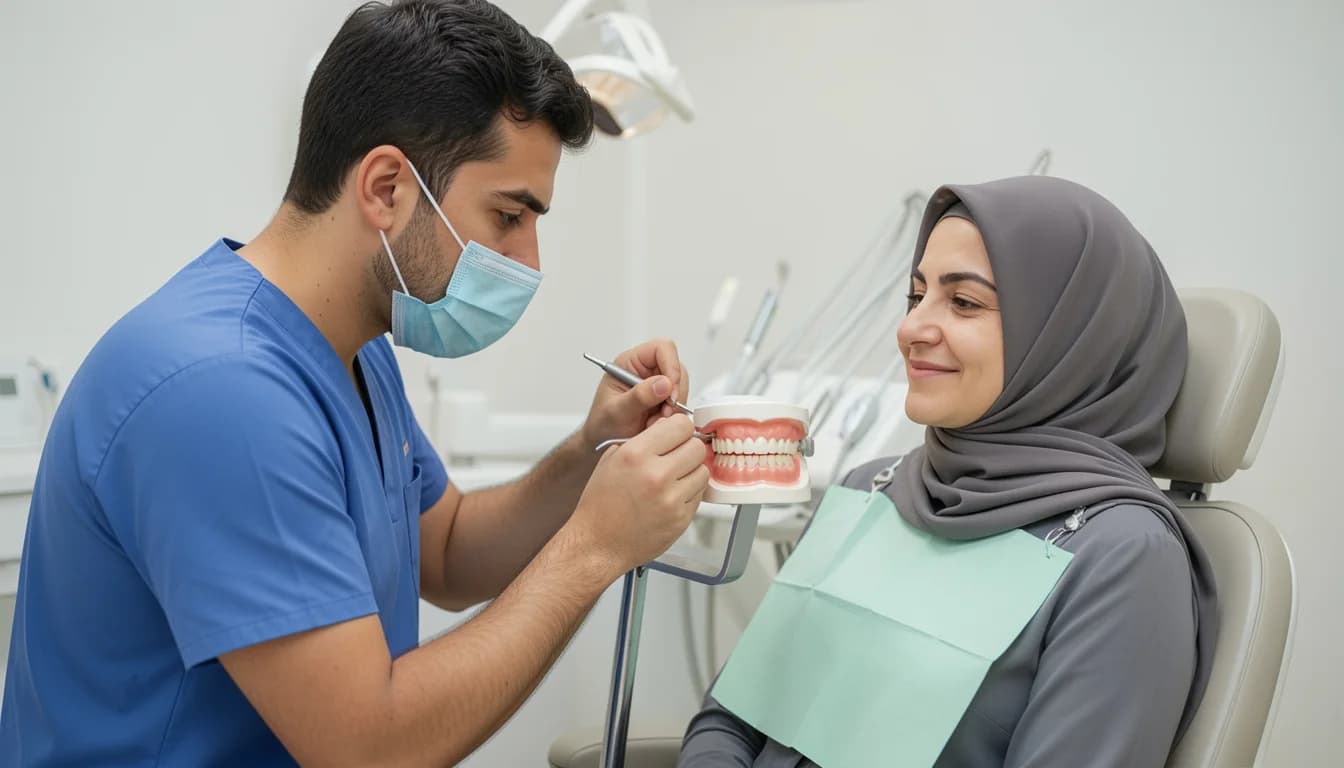
An oral cancer examination is a systematic clinical inspection of the whole mouth — tongue, floor of the mouth, lips, gums, palate and throat — together with palpation of the neck lymph nodes, looking for suspicious changes before they become an obvious complaint. It relies on looking under good light and feeling with the fingers, takes only a few minutes, and can be built into a routine dental visit.
What makes this examination valuable is that oral cancers begin in a place that can be seen and touched, yet they are still frequently found late because the earliest changes usually do not hurt. A small ulcer that fails to heal, or a persistent white or red patch, may be a pre-cancerous lesion that is comparatively straightforward to manage, whereas delay means wider treatment and greater impact on speech, swallowing and appearance.
It is particularly advised for anyone with risk factors: smoking in all its forms including waterpipe, chewed or placed smokeless tobacco, alcohol and especially alcohol combined with smoking, prolonged sun exposure of the lips, a history of oral lesions or head and neck cancer, human papillomavirus infection, immune suppression, and chronic friction from an ill-fitting denture or a sharp tooth edge.
The limits must be stated plainly: this examination **detects, it does not diagnose**. The eye and the hand identify what is suspicious, but a definitive diagnosis rests only on a biopsy of the tissue examined under the microscope. No light, dye or saliva test replaces biopsy when a lesion persists. And a reassuring examination today does not license ignoring a new complaint tomorrow: any lesion still present after about two weeks warrants review, however reassuring the previous check was. What follow-up, biopsy or referral is required is decided by direct clinical examination, not by a description over the phone or a photograph sent by message.
4 specialists
Procedure steps
1
History and risk factors
The patient is asked about the complaint and its duration, about smoking, waterpipe, smokeless tobacco and alcohol, about immunosuppressive medicines, about previous lesions or a family history of head and neck cancer, and about a denture or tooth edge that keeps traumatising the tissue.
2
External examination and neck palpation
The face and lips are inspected externally for colour change, scaling, induration or asymmetry, then the lymph nodes under the jaw, along both sides of the neck and beneath the chin are palpated for any hard, fixed or tender mass.
3
Systematic intraoral examination
The mouth is examined in a fixed sequence: the inner lips, cheeks, gums, palate, tonsils and throat, then the tongue including its dorsum, both borders, its underside and the floor of the mouth — the sites most often missed and among the most important — using gauze to hold and move the tongue.
4
Documenting findings and short-interval review
Any abnormality is described by site, size, borders and texture, photographed, measured and recorded in the file; obvious sources of friction are eliminated, and a short-interval review is arranged to distinguish a transient lesion from a persistent one.
5
Referral for biopsy and counselling
If the lesion persists or is concerning from the outset, the patient is referred for biopsy or to oral and maxillofacial surgery, with a clear explanation that neither alarms nor minimises, alongside support for quitting smoking and waterpipe use and for protecting the lips from sun.
Before the procedure
Remove removable dentures and any removable orthodontic appliance before the examination, since inspecting the tissue underneath is essential and cannot be replaced by looking from outside. Do not use coloured mouthwash, dye, lipstick or tinted lip balm on the same day, as these mask colour change. Before the visit, note when the ulcer or patch began, whether it comes and goes or is continuous, and whether it has grown. Bring phone photographs of the lesion if it fluctuates, as they are very useful. Be candid about smoking, waterpipe, smokeless tobacco and alcohol, including amount and duration — this is medical information, not a moral judgement. Mention immunosuppressive medicines, any previous chemotherapy or radiotherapy, and any head and neck cancer in the family.
After the procedure
The clinical examination itself needs no aftercare and you return to eating and normal activity at once. If a biopsy was taken, follow the site instructions you were given, and do not forget the appointment to collect the result — never assume that no phone call means a normal result; ask. Deal with any source of friction such as an ill-fitting denture or a sharp tooth edge, and examine your own mouth monthly in front of a mirror with good light, checking the borders and underside of the tongue. Quitting smoking and waterpipe genuinely reduces risk at whatever age you stop. **Seek review without waiting for a routine appointment if an ulcer or sore has not healed after about two weeks**, **a white or red patch persists**, **a lump or hardening appears in the mouth, tongue or neck**, **hoarseness or altered speech continues**, **swallowing becomes painful or difficult or something feels stuck**, **the tongue or lip becomes numb**, **unexplained oral bleeding occurs**, **a tooth loosens without clear cause**, **weight falls unintentionally**, or **mouth opening becomes restricted**.
Expected duration
The examination itself usually takes 5 to 10 minutes, while the whole visit including history, documentation and counselling normally takes 15 to 25 minutes, and it is often integrated into a routine dental appointment with little added time.
تُعد د. يولا كوفالينكا من الكفاءات الطبية المتميزة في مجال طب الأسنان. تخرجت من جامعة لوغانسك الطبية الحكومية عام 2007، وكانت ضمن أوائل خمسة طلاب على دفعتها، وه…
يمتلك د. معتصم ارديسات خبرة مهنية واسعة في مجال طب الأسنان بدأت منذ عام 2007. تمتد مسيرته بين العمل الأكاديمي والممارسة السريرية في أوروبا والشرق الأوسط، مما من…
الدكتور محمد عرفات حسن هو طبيب أسنان وصاحب خبرات متقدمة في طب وجراحة الفم والأسنان، خرّيج جامعة دمشق العريقة في طب وجراحة الفم والأسنان (بكالوريوس)، وحاصل على ع…
الدكتور محمد أحمد علي الطراونة جرّاح فم ووجه وفكين، ومستشار في زراعة الأسنان وتجميل الوجه غير الجراحي. حاصل على البورد الأردني في جراحة الفم والوجه والفكين (201…
Finding Oral Cancer Examination services in Jordan
Which doctors are listed for Oral Cancer Examination in Jordan?
There are currently 4 doctor profiles linked to Oral Cancer Examination on ClinicsJo. Review the listed services and contact the practice to confirm availability with the doctor and branch you choose.
How can I find an appointment for Oral Cancer Examination?
Start with an available doctor's profile and use the contact or booking options shown there. Confirm the service, practice location and appointment time with the clinic. If this list is empty, broaden your search using the directory links on this page.
What does Oral Cancer Examination cost in Jordan?
Ask the practice for the current price and what it includes. A consultation fee shown on a profile is not necessarily the price of a procedure, tests or follow-up. Confirm any additional charges and insurance arrangements before your visit.