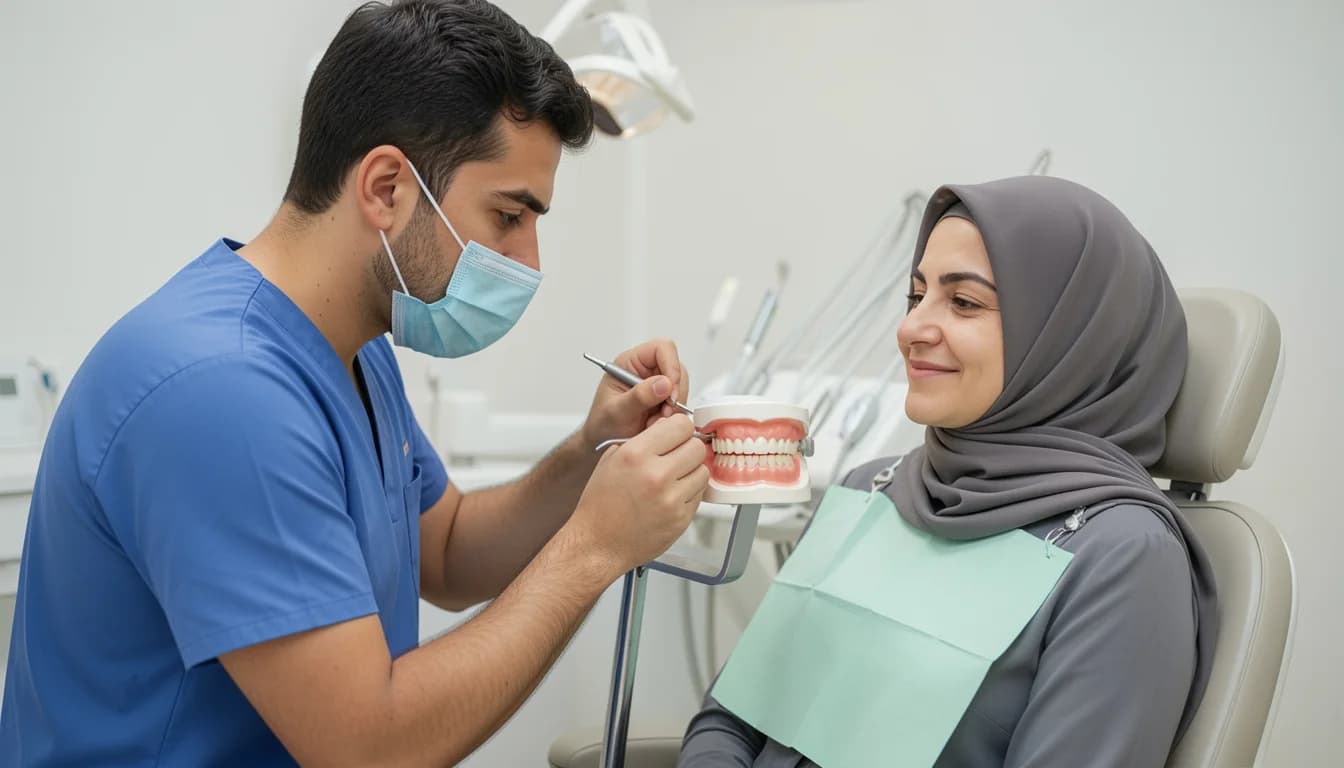
Dental splinting stabilises one or more mobile teeth by joining them to stronger neighbouring teeth, so that biting forces are shared across a group instead of loading a single tooth. Movement is reduced and the discomfort many patients feel while chewing settles. It is usually done with a fibre ribbon or a fine wire bonded to the inner surfaces of the teeth, with a laboratory-made splint, or with composite that connects the teeth from behind.
Common indications include mobility caused by bone loss in periodontitis, once the inflammation is under control; stabilising a tooth after a traumatic concussion, partial luxation or root fracture; supporting front teeth before or after periodontal surgery; and preventing movement of weakened teeth during restorative treatment. After an injury, splinting is urgent and time-limited; in periodontal disease it may stay in place much longer depending on the case.
In most situations splinting requires no tooth reduction and no anaesthesia, and it can be adjusted or removed later. What it does change is cleaning. The splinted teeth become a single unit that ordinary floss cannot pass through, so a floss threader, interdental brushes or a water flosser becomes necessary. Neglecting this allows calculus to accumulate under the splint and accelerates the very disease whose symptom the splint was placed to relieve.
The limits must be stated plainly. Splinting does not treat the cause of mobility, does not grow bone, and does not restore lost periodontal attachment. It is a mechanical support that preserves function and comfort while the disease is brought under control or an injured tissue heals. It cannot rescue a hopeless tooth, and masking its movement may delay a necessary decision to extract and replace. It does not prevent decay, and it is no substitute for managing bruxism or correcting a high bite if either is the underlying cause.
Candidacy and splint design are determined by clinical examination: the mobility grade of each tooth, the remaining bone level on radiographs, the condition of the neighbouring teeth that will carry the extra load, and the bite pattern and contact points. Regular review is essential, because the bond can partially fail without the patient noticing, creating a site where plaque and calculus collect.
4 specialists
Procedure steps
1
Examination and mobility assessment
The mobility of each tooth is graded and its direction recorded, radiographs are read to assess remaining bone, and the bite is examined for a tooth receiving excessive load. The purpose is to identify the cause of the looseness before treating the symptom.
2
Controlling inflammation or managing the injury
In periodontal disease the drivers of inflammation are removed first through scaling and root planing; after trauma the tooth is repositioned and the pulp and root are assessed for follow-up. Splinting over inflamed gums hides the problem rather than solving it.
3
Splint selection and tooth preparation
A fibre ribbon, a wire or a laboratory splint is selected according to the number and position of the teeth and the biting forces involved. The inner surfaces are cleaned, isolated and conditioned for bonding, usually without any tooth reduction and without anaesthesia.
4
Bonding the splint and adjusting the bite
The ribbon or wire is bonded with light-cured composite, the edges are polished so they cannot irritate the tongue, and the bite is then checked with articulating paper and any high spot reduced, since a single premature contact defeats the purpose of the splint.
5
Hygiene coaching and periodic review
You are taught to use a floss threader, interdental brushes or a water flosser to clean beneath the splint, and review appointments are scheduled to check that the bond is intact, to re-measure mobility, and to revisit the decision to keep or remove the splint.
Before the procedure
Tell your dentist the history: did the looseness start gradually or after a blow or accident, and does it worsen when you eat. List all your medicines, especially anticoagulants, antiplatelet drugs and bone-density medication, and do not stop any of them on your own; mention diabetes and any immune deficiency. If you clench or grind at night, or feel jaw joint pain, say so, because a splint alone is not enough in that situation. Complete any scaling appointments needed before splinting, and bring earlier radiographs if you have them. If the problem followed an injury, attend as soon as possible, do not move the tooth with your tongue or fingers, and keep to soft food until your appointment.
After the procedure
Keep to soft food in the first days, avoid biting hard items such as nuts, ice or dry bread with the splinted teeth, and never use your teeth to open anything. Clean beneath the splint every day using the method you were shown, whether a floss threader, interdental brushes or a water flosser, because the main risk after splinting is calculus building up where ordinary floss cannot reach. You will feel the bulk of the ribbon or wire on the inner surfaces at first, and your tongue will adapt. Do not attempt to adjust the splint or pick at a protruding edge yourself. Keep your review appointments even if nothing feels wrong, and continue the planned periodontal, orthodontic or restorative treatment. **Seek care immediately if you develop throbbing pain, swelling of the gum or face or a taste of pus, a clear increase in tooth movement after splinting, a detached piece of splint leaving a sharp edge that cuts the tongue or lip, sharp pain on biting that suggests a high contact, persistent bleeding around the splinted teeth, or a colour change in a tooth that was injured.**
Expected duration
Usually 20 to 60 minutes depending on the number of teeth and the type of splint, most often in a single visit and without anaesthesia.
تُعد د. يولا كوفالينكا من الكفاءات الطبية المتميزة في مجال طب الأسنان. تخرجت من جامعة لوغانسك الطبية الحكومية عام 2007، وكانت ضمن أوائل خمسة طلاب على دفعتها، وه…
يمتلك د. معتصم ارديسات خبرة مهنية واسعة في مجال طب الأسنان بدأت منذ عام 2007. تمتد مسيرته بين العمل الأكاديمي والممارسة السريرية في أوروبا والشرق الأوسط، مما من…
الدكتور محمد عرفات حسن هو طبيب أسنان وصاحب خبرات متقدمة في طب وجراحة الفم والأسنان، خرّيج جامعة دمشق العريقة في طب وجراحة الفم والأسنان (بكالوريوس)، وحاصل على ع…
الدكتور محمد أحمد علي الطراونة جرّاح فم ووجه وفكين، ومستشار في زراعة الأسنان وتجميل الوجه غير الجراحي. حاصل على البورد الأردني في جراحة الفم والوجه والفكين (201…
Which doctors are listed for Splinting of Teeth in Jordan?
There are currently 4 doctor profiles linked to Splinting of Teeth on ClinicsJo. Review the listed services and contact the practice to confirm availability with the doctor and branch you choose.
How can I find an appointment for Splinting of Teeth?
Start with an available doctor's profile and use the contact or booking options shown there. Confirm the service, practice location and appointment time with the clinic. If this list is empty, broaden your search using the directory links on this page.
What does Splinting of Teeth cost in Jordan?
Ask the practice for the current price and what it includes. A consultation fee shown on a profile is not necessarily the price of a procedure, tests or follow-up. Confirm any additional charges and insurance arrangements before your visit.
Explore related Periodontics (Gum Disease) doctor directories