
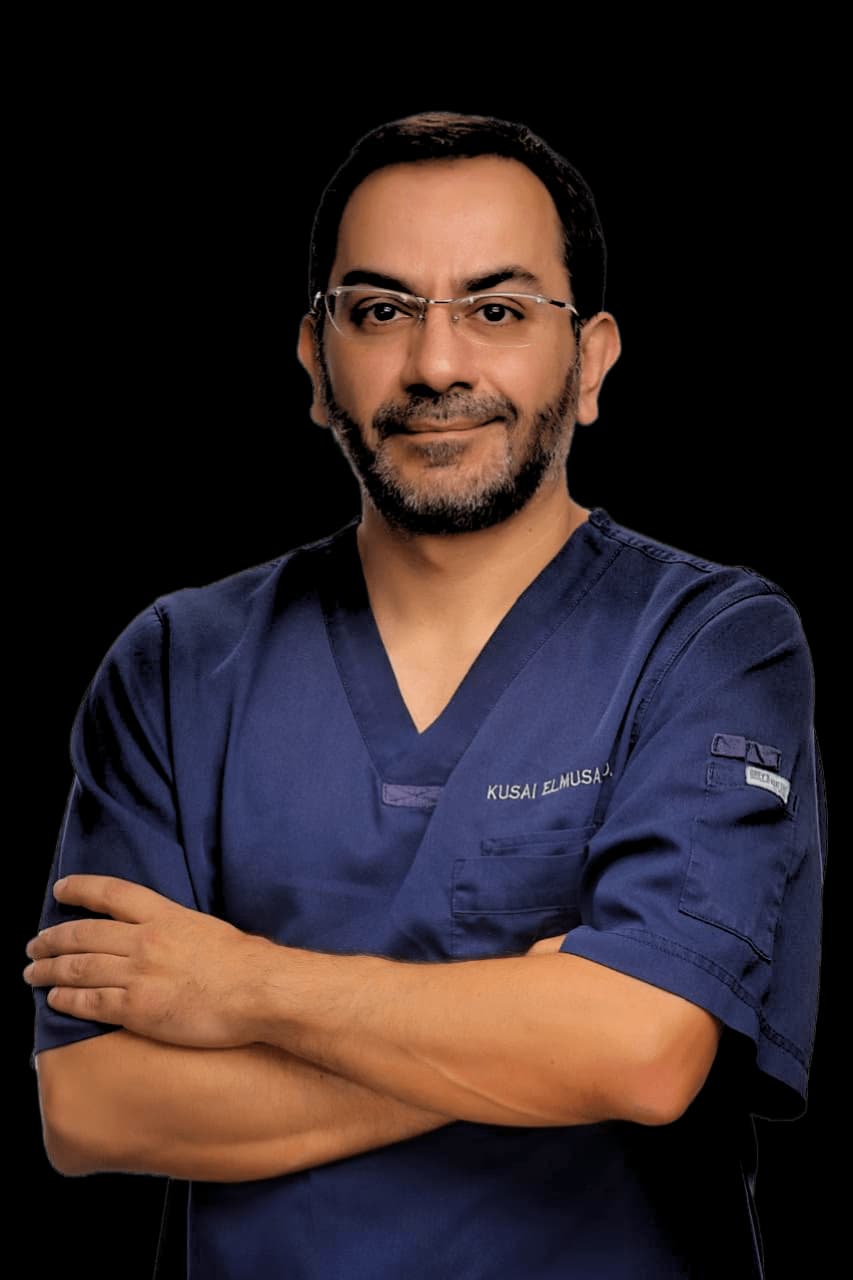
Dr. Kusai Awni Ibrahim El Musa Clinic
Dr. Kusai Awni Ibrahim El Musa is a plastic and reconstructive surgeon. He studied medicine at the University of Jordan, trained at the American University of B…
Hours not listedInsurance not specified7 views
Trusted medical platform in Jordan

A brow lift, also called an eyebrow or forehead lift, repositions a descended brow above the orbital rim, relieves the weight of skin gathering over the upper eyelid, and softens a permanently tired expression. It can be performed in several surgical ways, including an endoscopic lift through small incisions within the hair, a lift through an incision along the hairline, or a limited temporal lift. The approach is chosen according to forehead height, hair density and how much the brow has dropped. Everything begins with accurate diagnosis, because a heavy-looking eye has three causes that look alike but are treated differently: descent of the brow itself, excess skin of the upper eyelid, and true eyelid ptosis from a weak levator muscle. Confusing them is the commonest reason for a disappointing outcome, and a patient whose real need is an eyelid procedure will not be satisfied by even a technically perfect brow lift. Suitability is decided by clinical examination. The surgeon measures brow position and excess skin, lifts the brow manually to demonstrate the expected change, tests levator strength, and checks eyelid closure, tear film and peripheral vision. Chronic dry eye, previous eye surgery, or active thyroid eye disease all alter the decision. The limits are explicit. A brow lift does not itself remove redundant upper-eyelid skin, so a separate eyelid procedure is sometimes needed alongside it. It does not treat fatty eyelid bulges, does not erase dark circles or pigmentation, and does not fully abolish deep static wrinkles, only softens them. It also does not stop ageing, so gradual descent returns over the years. Non-surgical brow elevation with injections or threads is modest and temporary, cannot correct significant descent, and must be repeated to maintain the appearance. Confirm that the facility is licensed and that the doctor is certified in plastic surgery or oculoplastic surgery through the official Jordanian authorities. The area around the eye leaves no room for unqualified hands, and an over-elevated or asymmetric brow is far harder to correct than to avoid in the first place.
The doctor assesses brow position, eyelid skin and levator strength, and lifts the brow by hand to demonstrate the achievable change. Dry eye, eyelid closure and peripheral vision are evaluated, and it is decided whether the answer is a brow lift, an eyelid procedure, or both together.
The approach is selected according to forehead height, hair density, degree of descent and asymmetry: endoscopic within the hair, an incision at the hairline, or a limited temporal lift. Incision sites and the target amount of elevation are marked separately for each side.
Local anaesthesia with sedation or general anaesthesia is given, the planned incisions are opened, and the tissues are elevated in a safe plane while the sensory nerves and the motor branch to the forehead are identified and protected to reduce the risk of lasting numbness or weakness.
The tissue is released from the orbital rim, the brow is raised to the planned position and secured with sutures or an internal fixation device. The muscles that pull the brow down may be carefully weakened. Symmetry is measured repeatedly, and the patient may be sat up, to avoid over-elevation or a startled appearance.
Incisions are closed with sutures or clips, and a small drain or dressing may be used. Instructions on sleeping with the head raised, cooling the area and recognising warning signs are explained, and follow-up visits are arranged to assess brow position, sensation and symmetry over the first weeks.
Tell your surgeon about all medicines and supplements you use, especially blood thinners, anti-inflammatory drugs and herbal products, and stop a long-term medicine only on medical advice. Report any dry eye, use of eye drops or contact lenses, previous eye or laser refractive surgery, thyroid disease, uncontrolled blood pressure or clotting disorder. Stop smoking before and after surgery, since it impairs scalp healing and increases the risk of hair loss around the incisions. Postpone if you have a skin infection or any inflammation of the eye or eyelid. Wash your hair the day before with plain shampoo and avoid oils or styling products, and do not colour your hair in the days just before surgery. Follow the anaesthetist's fasting instructions and arrange someone to drive you home. Prepare cold compresses, pillows for sleeping with your head raised and the prescribed painkiller, and avoid planning travel or an event for two to three weeks.
Sleep on your back with your head elevated for about two weeks, cool the forehead gently in the first days without pressing on the incisions, and avoid bending forward, lifting weights or strenuous exercise for as long as your surgeon advises. Expect swelling that spreads to the eyelids, bruising, tightness, scalp numbness and itching along the incisions; most of this settles over two to four weeks, though numbness can persist for months. Handle your hair gently, do not colour or pull it until permitted, and protect the incisions from sun. **Go to emergency care immediately for any change or loss of vision, severe eye pain, rapid painful swelling around the eye, or bleeding that will not stop; these cannot wait.** **Seek care immediately for fever, purulent discharge, or spreading redness around the incisions.** Report obvious asymmetry, inability to raise the brow, incomplete eye closure, or troublesome persistent dryness of the eye.
Usually one to two hours, a little longer if combined with eyelid surgery, with same-day discharge in most cases. Return to work is commonly after seven to ten days, most swelling settles within two to four weeks, and the final result stabilises after roughly three months.
Dr. Kusai Awni Ibrahim El Musa is a plastic and reconstructive surgeon. He studied medicine at the University of Jordan, trained at the American University of B…
There are currently 1 doctor profiles linked to Eyebrow Lift on ClinicsJo. Review the listed services and contact the practice to confirm availability with the doctor and branch you choose.
Start with an available doctor's profile and use the contact or booking options shown there. Confirm the service, practice location and appointment time with the clinic. If this list is empty, broaden your search using the directory links on this page.
Ask the practice for the current price and what it includes. A consultation fee shown on a profile is not necessarily the price of a procedure, tests or follow-up. Confirm any additional charges and insurance arrangements before your visit.