
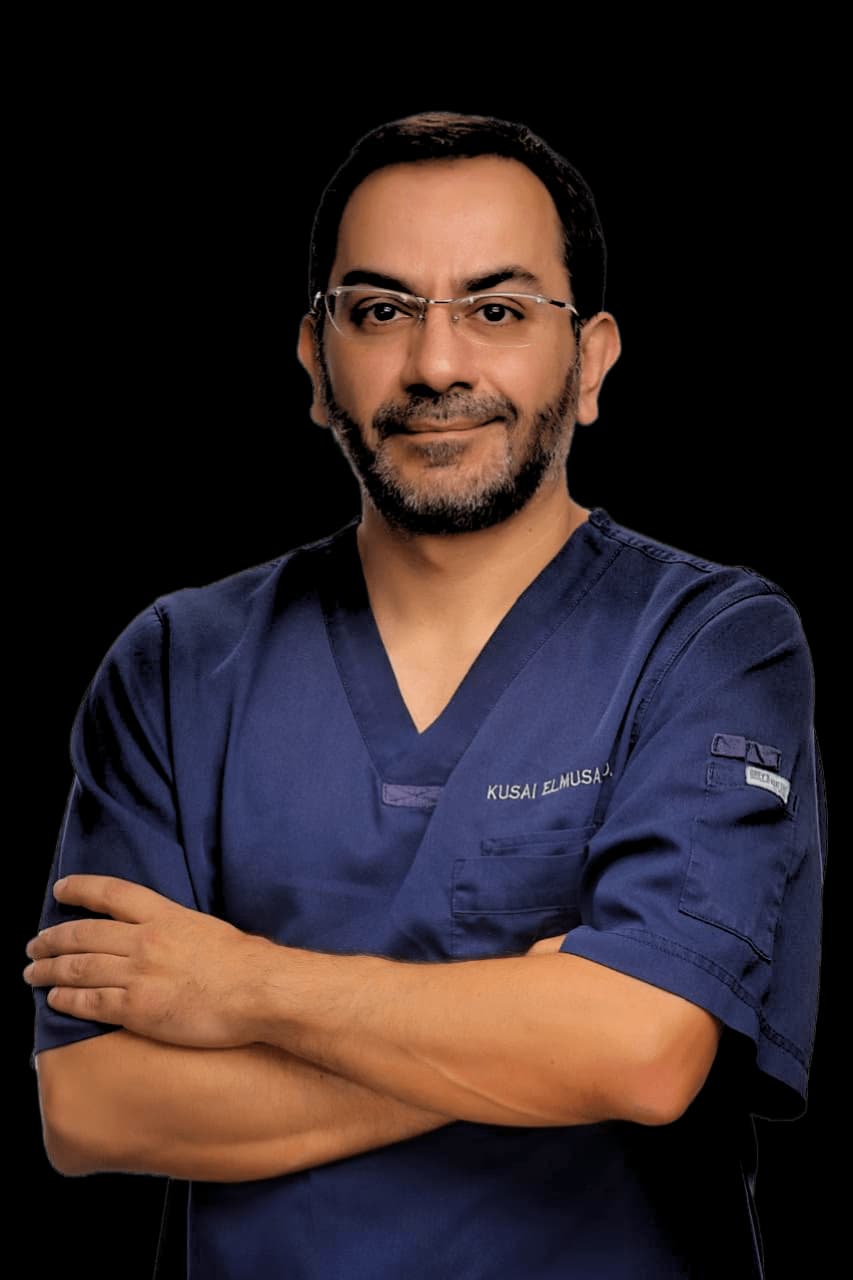
Dr. Kusai Awni Ibrahim El Musa Clinic
Dr. Kusai Awni Ibrahim El Musa is a plastic and reconstructive surgeon. He studied medicine at the University of Jordan, trained at the American University of B…
Hours not listedInsurance not specified7 views
Trusted medical platform in Jordan

Blepharoplasty is a surgical procedure that removes or redistributes excess skin, fat and muscle in the upper eyelid, the lower eyelid, or both. It is usually performed under local anaesthesia with light sedation, and occasionally under general anaesthesia when combined with another operation. What it corrects is redundant, drooping tissue and the position of the lid crease, not the shape, colour or size of the eye itself. One distinction matters more than anything else before deciding. Skin that hangs over the lashes and blocks the upper part of the visual field is a functional problem: it is documented with formal visual-field testing and standardised photographs, and many insurers assess coverage on that basis. Removing mild puffiness or refining the look of the lid with no effect on vision is purely cosmetic and is self-funded. The difference changes both the decision and the insurance coverage, and it cannot be settled by reading or by photographs online. A clinical examination is what determines which situation applies, and whether the cause is excess skin, a weak levator muscle, or a descended eyebrow. The limits of the operation should be stated plainly. It does not lift a drooping eyebrow, does not erase the fine radiating lines around the eye, does not lighten dark circles caused by pigmentation or by thin translucent skin, and does not correct a droop caused by levator weakness, which needs a different procedure on the muscle itself. It also does not stop ageing; the tissues keep changing over the years. No one should promise a specific result. Mild asymmetry between the two eyes exists in most people before surgery and remains visible afterwards, and dry eye may appear or worsen for some weeks, more so if you already have dry eye, have had laser vision correction, or wear contact lenses. Tell your surgeon about all of this before the plan is drawn.
The surgeon checks visual acuity, the ocular surface, levator strength and brow position, measures the redundant skin, and orders visual-field testing with standardised photographs when the droop obstructs vision. This is where the functional and the cosmetic components are separated, and both the surgical plan and the insurance question follow from that separation.
The markings are drawn while you sit upright with your eyes open, because the skin shifts with posture. Local anaesthetic is then injected into the lid, with light sedation if required. The upper-lid incision stays hidden inside the natural crease; in the lower lid it lies just beneath the lashes or is made from the inner surface with no visible incision.
The marked strip of skin is excised and the fat is reduced or repositioned rather than fully removed, because emptying the lid leaves a hollow appearance that is hard to correct later. If levator weakness or brow descent is confirmed, the appropriate additional step is carried out, with your prior consent.
The incision is closed with fine sutures, then the surgeon confirms that the lid closes completely and the ocular surface is protected, because removing too much skin prevents closure and leads to dryness and corneal breakdown. Ointment and cold compresses are applied and you are observed before discharge.
Sutures are usually removed within a week, swelling and bruising settle over several weeks, and the final lid contour and scar appearance mature over months. Follow-up visits assess lid closure, dryness and symmetry, and a minor adjustment may be suggested later if residual excess or troublesome asymmetry remains.
Tell your doctor about every medicine you take, especially blood thinners, anticoagulants and herbal supplements, and never stop any of them on your own; the timing is decided by the doctor who prescribed them. Mention any dry eye, allergy, previous laser vision correction or contact-lens use, and also thyroid disease, high blood pressure, diabetes or any clotting disorder. Stop smoking before and after the appointment, because it delays skin healing. Remove make-up and contact lenses on the morning of the procedure, wear a shirt that opens at the front, and arrange for someone to drive you home, since the ointment blurs vision. If general anaesthesia is planned, fast for exactly as long as the anaesthetic team instructs.
Apply cold compresses to the lids intermittently for the first two days and sleep with your head raised on an extra pillow to limit swelling. Use the drops and ointment exactly as prescribed, and do not rub or press on the eye. Postpone strenuous exercise, heavy lifting, bending forward, swimming and saunas until your doctor allows them, and postpone contact lenses and make-up until the wounds have been reviewed. Expect swelling, bruising, a tight sensation, dryness and light sensitivity that improve gradually over several weeks. **Seek care immediately if you develop severe worsening pain that painkillers do not relieve, any loss or doubling of vision, rapidly increasing firm swelling around the eye, bleeding that does not stop with gentle pressure, pus with fever and spreading redness around the wound, or an inability to close the eyelid fully.** These need urgent assessment rather than waiting for the next appointment.
Usually 45 to 90 minutes for the upper lids, and up to about two hours when the lower lids or an additional procedure are included; most patients go home the same day.
Dr. Kusai Awni Ibrahim El Musa is a plastic and reconstructive surgeon. He studied medicine at the University of Jordan, trained at the American University of B…
There are currently 1 doctor profiles linked to Eyelid surgery (blepharoplasty) on ClinicsJo. Review the listed services and contact the practice to confirm availability with the doctor and branch you choose.
Start with an available doctor's profile and use the contact or booking options shown there. Confirm the service, practice location and appointment time with the clinic. If this list is empty, broaden your search using the directory links on this page.
Ask the practice for the current price and what it includes. A consultation fee shown on a profile is not necessarily the price of a procedure, tests or follow-up. Confirm any additional charges and insurance arrangements before your visit.