
Istiklal Hospital Outpatient Clinics
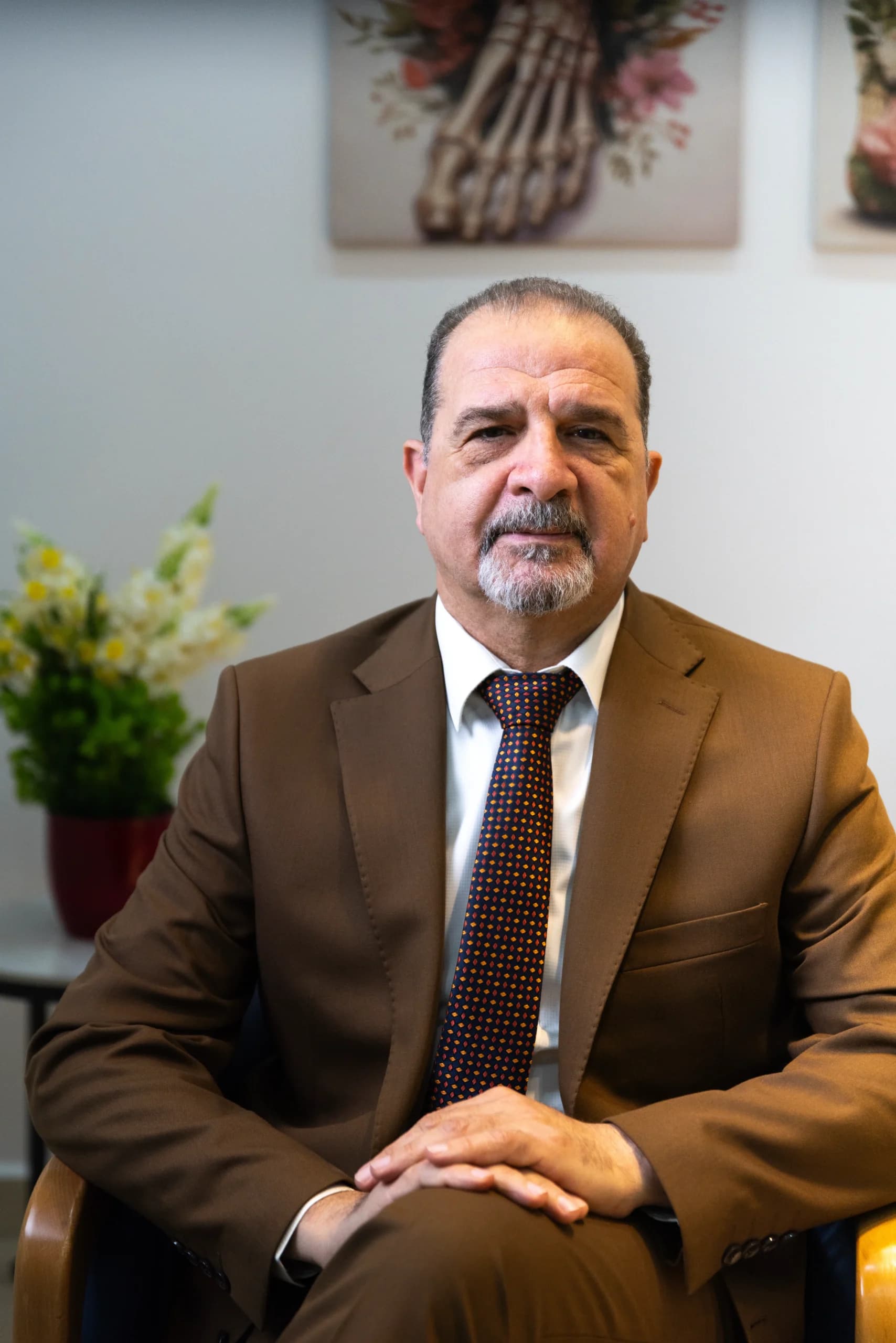
Dr Malik Abu Al-Nadi is an orthopaedic consultant with a focus on foot and ankle disorders. He holds the Jordanian orthopaedic board; his official biography des…
Hours not listedInsurance not specified3 views
Trusted medical platform in Jordan

علاج القدم المسطحة أو تبسط القدم (الفلات فوت)
Flat foot is a lowering of the longitudinal arch, so that the inner border of the foot comes close to or touches the ground on standing, usually accompanied by outward tilting of the heel and rotation of the forefoot. The description alone is not a disease: many people have flat feet and never have a complaint in their lives, and treatment is directed at pain, function and progressive deformity, not at the shape of the foot on an image. The fundamental distinction is between a flexible flat foot, in which the arch reappears when standing on tiptoe or when sitting, and a rigid flat foot, in which the flattening is fixed. In children the arch is not fully formed in the early years, and a painless flexible flat foot in a child needs no treatment. A myth worth correcting here is that insoles somehow build an arch in a healthy child's foot or prevent a future problem; they do not, and they are used when there is pain, deformity or repeated fatigue. In adults, the important entity is acquired flat foot, most often caused by weakness or tearing of the posterior tibial tendon that supports the arch. The picture is progressive flattening of a foot that used to be normal, with pain on the inner side of the ankle and lower leg, difficulty standing on tiptoe on the affected side, and outward tilting of the heel. Left alone this condition progresses from flexible to rigid and eventually to arthritis of the joints, which is why early diagnosis matters. Other causes include rheumatoid arthritis, diabetes, neurological disease, and fusion between foot bones in adolescents. Treatment starts conservatively: an arch-supporting insole or an ankle brace where needed, footwear with a stiff sole, an exercise programme focused on strengthening the posterior tibial tendon and calf muscles, Achilles stretching, activity modification and weight reduction. The limits are explicit: an insole does not anatomically rebuild the arch and does not correct a fixed deformity; it reduces pain, improves tolerance and may slow progression. Surgery is considered for painful resistant or advanced cases and includes tendon repair or transfer and bone cuts to realign the foot, with joint fusion in rigid, arthritic feet. Suitability is decided by clinical examination and weight-bearing X-rays, not by reading.
The shape of the foot is examined standing and from behind to assess heel tilt, then you are asked to stand on tiptoe to see whether the arch reappears, which separates a flexible from a rigid deformity. The posterior tibial tendon is tested with a single-leg heel raise, Achilles flexibility is measured, and sensation, pulses and the wear pattern of your shoes are checked.
Weight-bearing X-rays are ordered because, unlike films taken lying down, they show the true collapse of the arch and its angles. MRI may be added to assess the posterior tibial tendon and ligaments, or CT when a bony coalition is suspected in an adolescent. Not every painless flat foot needs imaging at all.
An insole is prescribed to support the arch and partly correct heel tilt, or an ankle brace in more severe cases, together with a shoe that has a stiff sole which does not bend in the middle. It is explained that the aim is to reduce pain and redistribute load rather than to change bone shape, and that the device must be worn whenever you are walking, not only when it hurts.
Progressive exercises are prescribed to strengthen the posterior tibial tendon and the muscles of the sole and calf, to stretch the Achilles tendon whose tightness worsens flattening, and to retrain balance. This programme is the effective treatment for a painful flexible flat foot, requires daily commitment over weeks, and is supervised by a physiotherapist in more advanced cases.
The condition is followed to judge pain, walking capacity and whether the deformity is becoming fixed. If deformity progresses or disabling pain persists despite adequate conservative care, surgery is discussed: tendon repair or transfer with realigning bone cuts in a flexible foot, or joint fusion in a rigid, arthritic one. It is explained that recovery extends over months and includes a period of non-weight-bearing.
Bring the shoes you actually wear, since wear on the inner side of the sole is important evidence of how you load the foot, and bring any insoles you have already tried. Before the visit, establish whether your feet have been flat since childhood or have flattened recently, as this distinction fundamentally changes the diagnosis, and note whether one or both feet are affected. Tell the doctor exactly where the pain is, whether on the inner side of the ankle or under the sole, about any previous injury or sprain, your weight and any recent gain, and the nature of your work and standing hours. Mention diabetes, rheumatoid arthritis, neurological disease or arterial disease. If the patient is a child, note the age of walking, whether there is pain, fatigue or tripping, and bring any previous X-rays.
Wear the insole or brace whenever you are walking, including indoors, and break it in gradually over several days so the foot can adapt. Do your strengthening and stretching exercises daily, as they are what genuinely changes the outcome, build up walking and activity progressively, and reduce excess weight, since it adds load to the arch with every step. **See your doctor if a previously normal foot is progressively flattening, if pain on the inner side of the ankle is increasing, if you cannot perform a single-leg heel raise, or if new stiffness prevents the foot from moving, as these signal progression that needs early intervention.** **Seek prompt review for painful warm swelling, fever, numbness or colour change, and if you have diabetes, any wound or ulcer on the inner border of the foot must be seen the same day.** If your child has no pain, periodic review is enough.
The assessment visit usually takes 20 to 40 minutes. A prefabricated insole is dispensed the same day, while a custom device needs several days to two weeks. The effect of insoles and exercises is judged after several weeks up to three months. Reconstructive surgery involves casting and non-weight-bearing for weeks, with recovery from six months to about a year.
Dr Malik Abu Al-Nadi is an orthopaedic consultant with a focus on foot and ankle disorders. He holds the Jordanian orthopaedic board; his official biography des…
There are currently 1 doctor profiles linked to Flat foot treatment on ClinicsJo. Review the listed services and contact the practice to confirm availability with the doctor and branch you choose.
Start with an available doctor's profile and use the contact or booking options shown there. Confirm the service, practice location and appointment time with the clinic. If this list is empty, broaden your search using the directory links on this page.
Ask the practice for the current price and what it includes. A consultation fee shown on a profile is not necessarily the price of a procedure, tests or follow-up. Confirm any additional charges and insurance arrangements before your visit.