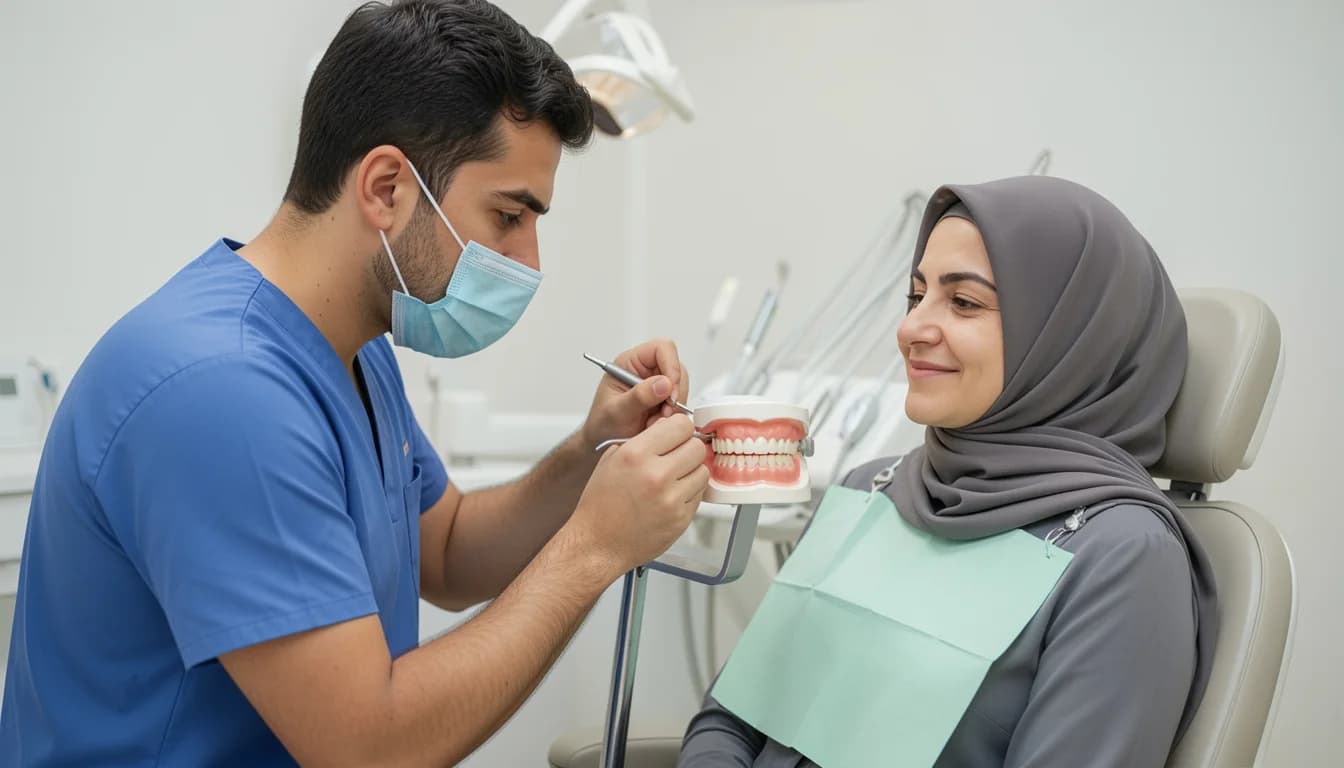
An implant-supported complete denture restores an entire jaw of teeth using titanium implants anchored in the jawbone, onto which a full denture is attached: either a removable overdenture that clips onto the implants through attachments or locators, or a fixed full-arch bridge that only the dentist can remove. The essential difference from a conventional denture is that chewing forces are carried by bone rather than gum tissue, so the denture stops sliding, biting power and speech clarity improve, and the soreness caused by a plate pressing on the gums is reduced.
Treatment starts with a full assessment: three-dimensional imaging to measure bone volume and density and to map nerves and maxillary sinuses, an examination of the gums and any remaining teeth, then digital planning of how many implants are needed, where they sit, and how load will be distributed. Some patients need preparation first, such as removing unsalvageable teeth, treating gum disease, or bone grafting and sinus lifting where bone is deficient. In selected cases a temporary denture can be loaded early, close to the surgery date, while other cases require waiting for the implants to integrate with bone.
The procedure has limits that should be clear from the outset. An implant does not recreate a natural tooth with its root, ligament and sensation, and a fixed denture is not a solution that excuses its owner from cleaning: peri-implant inflammation is driven above all by plaque and neglected hygiene, and it can end in loss of the implant. Implants slow jawbone resorption but do not stop it completely, and the phrase teeth in one day refers to a temporary restoration on the day of surgery, not the final denture. Smoking, uncontrolled diabetes, poor oral hygiene, certain bone-density medicines and previous head and neck radiotherapy all raise the risk of failure and may make the procedure unsuitable.
Candidacy, the number of implants, and whether the denture is fixed or removable are decided by clinical examination and imaging with a qualified dentist, not by another person's experience or an article. After delivery, regular reviews remain necessary to adjust the bite, provide professional cleaning, and replace plastic attachment parts as they wear.
4 specialists
Procedure steps
1
Full assessment and digital planning
The mouth, gums and remaining teeth are examined, three-dimensional imaging is taken to measure bone and locate nerves and sinuses, and impressions or a digital scan are recorded. The number and position of implants and the type of denture are planned, and your medical conditions and medicines are reviewed to weigh risk factors.
2
Preparing the mouth before surgery
Gum infection is treated and unsalvageable teeth are removed, diabetic control is improved and smoking cessation is strongly encouraged. Where bone is insufficient, bone grafting or a sinus lift may be performed first, and healing time is required before implants can be placed.
3
Implant placement surgery
Surgery is usually performed under local anaesthesia, with intravenous sedation added for longer cases. The gum is reflected or a digitally produced surgical guide is used, implants are inserted at the planned sites with a calculated depth and angle, the area is closed, and primary stability is checked.
4
Osseointegration and the temporary denture
Bone needs time to integrate with the implant surface, typically several months depending on the jaw and bone quality. During this period a temporary denture maintains appearance and function, supported by dietary instructions, careful cleaning and review visits to adjust pressure over the surgical sites.
5
Fabricating and delivering the final denture
Once integration is confirmed, implants are exposed, abutments are connected, and precise impressions are taken to build the definitive denture, with trials of its dimensions, bite and tooth shade. The denture is then fixed in place or clipped on as a removable overdenture, and the patient is trained in cleaning around the implants and in the review schedule.
Before the procedure
Tell your dentist about every medical condition and medicine you take, especially blood thinners and anticoagulants, bone-density medicines, corticosteroids and immune-suppressing drugs, and never stop any medicine on your own; changes must be coordinated between your dentist and your treating physician. Mention any previous radiotherapy to the head or neck. Bring your blood sugar under control before surgery, and start quitting smoking weeks in advance if possible, since smoking is one of the strongest causes of implant failure. Clean your teeth and gums thoroughly in the preceding days and attend any professional cleaning session your dentist requests. If intravenous sedation is planned, ask how long you must avoid food and drink beforehand and arrange someone to drive you home. At home, prepare soft foods, cold packs and an extra pillow, set aside a couple of quiet days, and avoid scheduling travel or an important event immediately afterwards.
After the procedure
Apply cold packs to the face intermittently on the first day to limit swelling, and sleep with your head slightly raised. Keep to soft, cool or lukewarm foods, and avoid vigorous rinsing, drinking through a straw and forceful spitting for the first day. Do not smoke at all during healing, because smoking disrupts the bond between bone and implant. Clean your mouth exactly as instructed using a soft brush and the implant-specific aids provided, and keep every review appointment for bite adjustment and professional cleaning. Expect swelling, bruising and discomfort that ease gradually after the first two days. **Contact your dentist or emergency care immediately if you have bleeding that does not stop with gentle pressure, increasing swelling with fever or difficulty swallowing or breathing, pain that worsens after the third day instead of easing, purulent discharge or a foul smell, persistent numbness of the lip, chin or tongue, or any sense of movement in an implant or in the denture.**
Expected duration
Surgery usually takes one to three hours, while the full pathway to the final denture commonly spans three to six months
تُعد د. يولا كوفالينكا من الكفاءات الطبية المتميزة في مجال طب الأسنان. تخرجت من جامعة لوغانسك الطبية الحكومية عام 2007، وكانت ضمن أوائل خمسة طلاب على دفعتها، وه…
يمتلك د. معتصم ارديسات خبرة مهنية واسعة في مجال طب الأسنان بدأت منذ عام 2007. تمتد مسيرته بين العمل الأكاديمي والممارسة السريرية في أوروبا والشرق الأوسط، مما من…
الدكتور محمد عرفات حسن هو طبيب أسنان وصاحب خبرات متقدمة في طب وجراحة الفم والأسنان، خرّيج جامعة دمشق العريقة في طب وجراحة الفم والأسنان (بكالوريوس)، وحاصل على ع…
الدكتور محمد أحمد علي الطراونة جرّاح فم ووجه وفكين، ومستشار في زراعة الأسنان وتجميل الوجه غير الجراحي. حاصل على البورد الأردني في جراحة الفم والوجه والفكين (201…
Finding Total Denture Over Implants services in Jordan
Which doctors are listed for Total Denture Over Implants in Jordan?
There are currently 4 doctor profiles linked to Total Denture Over Implants on ClinicsJo. Review the listed services and contact the practice to confirm availability with the doctor and branch you choose.
How can I find an appointment for Total Denture Over Implants?
Start with an available doctor's profile and use the contact or booking options shown there. Confirm the service, practice location and appointment time with the clinic. If this list is empty, broaden your search using the directory links on this page.
What does Total Denture Over Implants cost in Jordan?
Ask the practice for the current price and what it includes. A consultation fee shown on a profile is not necessarily the price of a procedure, tests or follow-up. Confirm any additional charges and insurance arrangements before your visit.
Explore related Dental Implants doctor directories