Top 5 Cornea Specialists in Amman — Glasses and eye drops beside a computer screen — directory of the best Cornea doctors in Amman

Top 5 Cornea Specialists in Amman 2026

If you are looking for the best cornea specialists in Amman, this page lists five ophthalmologists who include cornea work in their published profiles. They were chosen from seven profiles on the platform. The order reflects how complete and checkable each profile is, not clinical skill. Compare qualifications, corneal services, clinic locations and hours here, then confirm the details directly with the clinic.

5 of 7 doctors on ClinicsJoUpdated 18 October 2026How we chose

At a glance

#DoctorAreaSuitsProfile score
1Muataz Mohammad HararaMecca StreetCorneal transplant or cross-linking enquiries, plus retina care, Mecca Street40/100
2Mohammad Akram HawariMecca StreetCorneal care alongside children's eye and squint services40/100
3Yazan Abdulkarim Shabaneh Al Tamimi7th CircleDry eye, corneal imaging, glaucoma or cataract checks at 7th Circle40/100
4Khaled SharifJabal AmmanKeratoconus, corneal transplant or LASIK enquiries, with evening hours40/100
5Lana HubaishyJabal AmmanCorneal assessment before laser correction for short-sight or astigmatism38/100
  1. 1Muataz Mohammad Harara

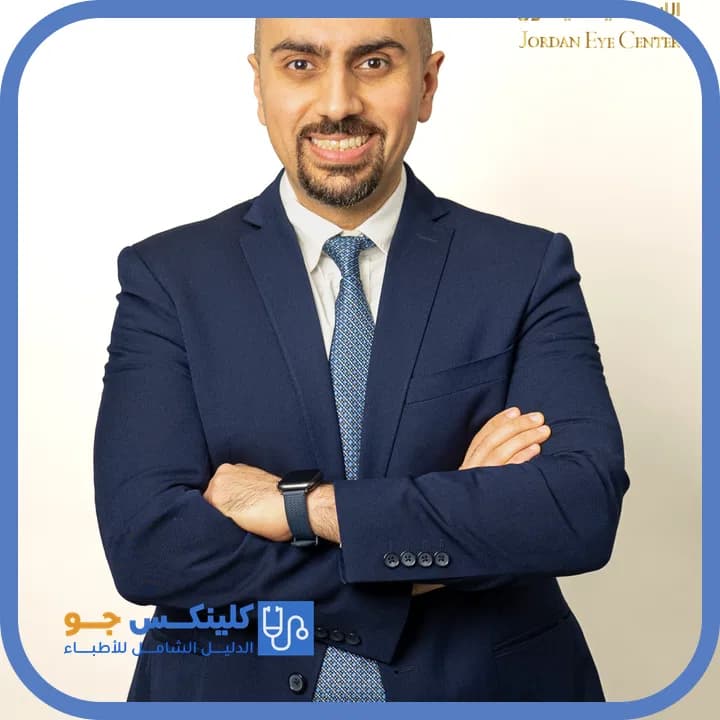
    Dr. Muataz Mohammad Harara is a consultant ophthalmologist and vitreoretinal surgeon at Jordan Eye Center on Mecca Street. He holds the Arab Board and the Jordanian Board in Ophthalmology, plus an International Council of Ophthalmology qualification. His published corneal services include corneal transplantation (keratoplasty), corneal cross-linking, laser vision correction and implantable vision-correction lenses. He also offers retinal assessment and treatment, intravitreal injections, and cataract surgery with lens implantation. His biography notes that examination guides the choice of treatment. Confirmed hours are Saturday to Wednesday 08:00–19:00 and Thursday 08:00–16:00.

    Suits: Corneal transplant or cross-linking enquiries, plus retina care, Mecca Street

  2. 2Mohammad Akram Hawari

    Dr. Mohammad Akram Hawari is an ophthalmic surgeon at Jordan Eye Center on Mecca Street. He holds the Arab Board in Ophthalmology, Membership of the Royal College of Surgeons of Edinburgh and an International Council of Ophthalmology qualification (FICO). His biography also notes membership of the European refractive surgery society. His published services cover corneal cross-linking and corneal transplantation (keratoplasty), cataract surgery and lens implantation. He also lists children's eye examinations and vision tests, and strabismus treatment and surgery. Confirmed hours are Saturday to Wednesday 08:00–19:00 and Thursday 08:00–16:00.

    Suits: Corneal care alongside children's eye and squint services

  3. 3Yazan Abdulkarim Shabaneh Al Tamimi

    Dr. Yazan Abdulkarim Shabaneh Al Tamimi practises at Shami Eye Center — Seventh Circle. He completed a medicine and surgery degree (2008) and higher specialty training in ophthalmology (2013) at Jordan University of Science and Technology. He holds the Jordanian Board in Ophthalmology (2013) and FRCS Glasgow (2019). He also completed fellowship training at King's College Hospital in anterior segment and cataract surgery (2021) and in glaucoma surgery (2022). His published services include corneal topography and imaging, dry eye treatment, astigmatism treatment, laser vision correction, phacoemulsification cataract surgery, glaucoma treatment and surgery, and diabetic eye screening. Confirmed hours are Saturday to Wednesday 09:00–17:00 and Thursday 09:00–14:00.

    Suits: Dry eye, corneal imaging, glaucoma or cataract checks at 7th Circle

  4. 4Khaled Sharif

    Dr. Khaled Sharif is a consultant ophthalmologist and medical director of Sharif Eye Centers, seeing patients at the Amman branch in Jabal Amman. He holds FRCS Glasgow and the Fellowship of the Royal College of Ophthalmologists, London. His biography notes that he co-authored an atlas of corneal dystrophies and degenerations with T. A. Casey and has trained ophthalmic surgeons in refractive procedures. His published services include corneal cross-linking for keratoconus, keratoconus treatment, keratoplasty, corneal topography, LASIK and other laser vision correction, permanent lens implantation and cataract surgery. Confirmed hours are Saturday to Thursday 09:00–22:00. Individual clinic sessions are confirmed through the centre.

    Suits: Keratoconus, corneal transplant or LASIK enquiries, with evening hours

  5. 5Lana Hubaishy

    Dr. Lana Hubaishy is an ophthalmology specialist on the Sharif Eye Centers team at the Amman branch in Jabal Amman. She holds a medical degree from the University of Jordan, the Jordanian Board in Ophthalmology and fellowship training in refractive laser surgery. Her published services focus on corneal examination, corneal topography and imaging, LASIK and other laser vision correction, and correction of myopia and astigmatism. Her biography notes that options are based on the patient's examination and corneal condition. Confirmed hours are Saturday to Thursday 09:00–22:00, and appointments should be confirmed through the centre.

    Suits: Corneal assessment before laser correction for short-sight or astigmatism

This shortlist covers 5 of the 7 matching doctors on ClinicsJo. Browse the full list and filter it.

How we chose this list

Every matching doctor profile in this area was scored out of 100 for how complete and checkable its published information is, and the highest scores appear here in order. Featured placement does not change a profile's score, and the score does not measure treatment quality or outcomes — it tells you how much you can check before you call.

  • Profile verified by the platform15
  • Approved reviews (number and average)20
  • Published years of experience (up to 25)15
  • Published qualifications10
  • Written professional biography8
  • Profile photo5
  • Published services8
  • Listed insurers7
  • Confirmed opening hours6
  • Published consultation fee3
  • Map location3

Ties are broken by the number of approved reviews, then published years of experience. Confirm the service, branch, appointment, fees and insurance coverage with the practice before visiting.

When do you need a cornea specialist?

The cornea is the clear, dome-shaped window at the front of the eye. It focuses light and protects the inner eye, so even small changes in its shape or clarity can blur vision. A cornea specialist is an ophthalmologist with particular experience in conditions such as:

  • Keratoconus, where the cornea thins and bulges into a cone shape. It is often first noticed in the teens or twenties.
  • Corneal scarring after an infection or injury.
  • Corneal dystrophies and degenerations, which are often inherited and slowly progressive.
  • Persistent dry eye and surface inflammation.
  • Assessment before laser vision correction, where the cornea must be healthy and thick enough.
  • Assessment for corneal transplantation (keratoplasty) when the cornea is badly damaged or cloudy.

Some signs are worth a routine appointment:

  • A glasses prescription that keeps changing, especially rising astigmatism
  • Distorted or ghosted images
  • Glare and halos around lights at night
  • Gritty or burning eyes that do not settle
  • Contact lenses that no longer fit comfortably

A family history of keratoconus is also a good reason to ask about corneal topography.

Warning signs that need urgent care

Some eye symptoms should not wait for a routine clinic slot. Seek same-day care, or call 911 in an emergency, if you have:

  • A chemical splash in the eye. Rinse immediately with plenty of clean running water for at least 15 minutes, then get urgent help.
  • A painful red eye with sensitivity to light, especially if you wear contact lenses. Remove the lenses and do not put them back in.
  • A sudden drop in vision, or a white spot visible on the cornea.
  • An injury from a sharp object or high-speed particle. Do not rub or press on the eye.
  • New symptoms after a corneal transplant, such as redness, light sensitivity, reduced vision or pain. These can signal graft rejection and need prompt attention.

How to choose among the doctors here

All five listed doctors are ophthalmologists who include cornea among their sub-specialties, but their published scopes differ. Lists of the best cornea specialists in Amman rarely explain this, so match the doctor to your situation.

  • Keratoconus: look for corneal topography, cross-linking and keratoconus treatment. Dr. Khaled Sharif lists cross-linking for keratoconus specifically. Dr. Harara and Dr. Hawari list corneal cross-linking.
  • Corneal transplant: keratoplasty appears in the profiles of Dr. Harara, Dr. Hawari and Dr. Sharif.
  • Laser vision correction: Dr. Harara, Dr. Al Tamimi, Dr. Sharif and Dr. Hubaishy list it. Dr. Hubaishy's profile centres on refractive assessment and corneal imaging.
  • Several eye problems at once:
  • Dr. Harara also covers retinal disease.
  • Dr. Hawari also covers children's eyes and strabismus.
  • Dr. Al Tamimi also covers glaucoma, dry eye and diabetic eye screening.
  • Timing: if you can only attend after work, the Sharif Eye Center Amman branch lists hours until 22:00 from Saturday to Thursday.

Think about follow-up as well. Cross-linking and transplantation involve several check-ups over months, and grafts need long-term monitoring, so a clinic you can reach easily matters. Ask the clinic how often the doctor performs the procedure you are considering, and who covers follow-up if the doctor is away.

The ranking reflects profile completeness only. A higher position means more checkable information was published, not better outcomes.

What to expect at the first visit

A first cornea consultation usually takes longer than a standard eye check. Expect:

  • A vision test and refraction
  • A slit-lamp examination of the front of the eye
  • Often corneal topography or tomography, which maps the shape and thickness of the cornea

Some visits also include eye pressure measurement or dilating drops.

How to prepare

  • Ask the clinic whether to stop wearing contact lenses before the visit, and for how long. Lenses can alter corneal measurements.
  • Bring your current glasses, contact lenses and their details.
  • Bring previous scans, topography printouts, prescriptions and reports from earlier eye doctors.
  • List your medicines, eye drops, allergies, and any past eye surgery or injuries.
  • If drops may be used, arrange not to drive afterwards. Vision can stay blurred for some hours.

Questions to ask

  • What is the diagnosis, and is the condition stable or progressing?
  • Which tests confirmed it, and when should they be repeated?
  • What are the options, including watching and waiting, and what are their risks?
  • How many follow-up visits would treatment involve?
  • What should make me contact the clinic urgently?

A good consultation leaves you with a clear explanation, not pressure to decide on the spot. For a planned procedure, it is reasonable to take time or seek a second opinion.

Insurance, fees and booking: what to ask before the appointment

Fees and insurance arrangements vary by clinic and by procedure, so confirm them directly before you go. Useful questions:

  • Is the consultation fee separate from diagnostic tests such as corneal topography?
  • Does the clinic work with my insurer?
  • Does my policy cover corneal procedures, or does it treat laser vision correction as cosmetic?
  • Is pre-approval needed for cross-linking or keratoplasty, and who arranges it?
  • Are follow-up visits after a procedure included or charged separately?
  • For transplantation, how is donor tissue arranged, and what waiting time should I expect?
  • At centres with several doctors, such as Jordan Eye Center and Sharif Eye Center, is my appointment confirmed with the named doctor and session?

Ask for any quotation in writing so you can compare like with like.

Getting there

Amman has around 5 million residents, and journeys across the city can take time at peak hours. The listed doctors practise in three places:

  • Jordan Eye Center on Mecca Street: Dr. Harara and Dr. Hawari
  • Shami Eye Center at the 7th Circle: Dr. Al Tamimi
  • Sharif Eye Center in Jabal Amman: Dr. Sharif and Dr. Hubaishy

You may be coming from Khalda, Dabouq, Tla' Al-Ali, Sweifieh, Abdoun, Shmeisani, Gardens, Jubeiha or another district. Check the route and travel time for the hour of your appointment rather than assuming one centre is closer.

Plan for parking or a taxi. Bring a companion if dilating drops or a procedure is expected, since you should not drive with blurred vision. If you are referred to a hospital such as Jordan University Hospital, Al-Bashir Hospital or Specialty Hospital for further care, ask the clinic to send your reports ahead.

Checklist before you book

  • Match your problem (keratoconus, transplant, dry eye or laser correction) to the doctor's published services.
  • Confirm the session with the named doctor, not just the centre.
  • Ask whether to stop contact lenses before the visit, and for how long.
  • Gather old prescriptions, scans and a list of your medicines and eye drops.
  • Confirm the consultation fee, test charges and follow-up costs.
  • Check that the clinic accepts your insurer and whether pre-approval is needed.
  • Plan transport, and bring a companion if drops may be used.
  • Know the urgent warning signs, and that 911 is the emergency number in Jordan.

How much do Cornea doctors in Amman charge for a consultation?

Consultation fees of Cornea doctors in Amman published on ClinicsJo: Mohammad Abu Samak (30 JOD). They are the fees the doctors' profiles show, for the consultation only; tests and procedures depend on your case.

What clinics and doctors have published on ClinicsJo

What sets the price with Cornea doctors?

  • The consultation fee and follow-up visits
  • Tests and investigations needed
  • The chosen treatment approach and its duration
  • Medicines or supplies
  • Insurance coverage and your share of the cost

How to ask about the price

Before booking, ask the clinic for the all-inclusive price and what it covers, any extra tests or scans, how many follow-up visits are included, the payment options, and whether your insurance is accepted. You can reach them through the contact details on the profiles on this page.

The figures above are the ones the profiles on ClinicsJo show and may change. We do not estimate prices. Confirm the price with the clinic before booking. Offers on ClinicsJo

Frequently asked questions

How was this list of cornea specialists in Amman chosen?
The five doctors come from seven profiles on the platform that include cornea work in Amman. They are ordered by a 100-point score of how complete and checkable their published information is. The score covers verification, reviews, experience, qualifications, biography, photo, services, insurers, hours, fee and map location. Featured placement does not change the score. The order does not measure treatment quality or outcomes.
What is corneal cross-linking?
Corneal cross-linking uses riboflavin (vitamin B2) eye drops and controlled ultraviolet light to strengthen the collagen fibres in the cornea. It is mainly used to slow or halt the progression of keratoconus. It does not usually reverse changes that have already happened, so glasses or special contact lenses may still be needed. Only an eye examination can show whether it is appropriate for a particular person.
What are the signs of keratoconus?
Common signs include blurred or distorted vision, glasses prescriptions that change often (especially rising astigmatism), glare, halos and ghosting around lights. It often begins in the teens or twenties and may run in families. Frequent eye rubbing is linked to it, so avoiding rubbing is widely advised. Corneal topography is the usual test to detect it, so ask an ophthalmologist if you notice these changes.
What is a corneal transplant (keratoplasty)?
A corneal transplant replaces damaged or cloudy corneal tissue with healthy donor tissue. Depending on the problem, the surgeon may replace the full thickness or only certain layers. Recovery takes months and needs regular follow-up. Contact your eye doctor promptly if redness, light sensitivity, reduced vision or pain develop after surgery, as these can be signs of graft rejection.
Is a cornea specialist the same as a LASIK surgeon?
Not always. Laser vision correction reshapes the cornea, so many refractive surgeons are also trained in corneal assessment. Cornea care is broader, though: it also covers keratoconus, infections, scarring, dystrophies, dry eye and transplantation. On this page, some doctors list both laser correction and corneal procedures. Dr. Hubaishy's published services focus on refractive assessment and corneal imaging.
When is an eye problem an emergency in Jordan?
Call 911 or seek immediate care in these cases: a chemical splash (rinse with clean running water first), a penetrating or high-speed injury, or sudden loss of vision. A very painful red eye with light sensitivity also needs urgent care, especially in contact lens wearers. Contact lens wearers should remove their lenses and not wait for a routine appointment.
Which listed clinics have evening hours?
Sharif Eye Center's Amman branch in Jabal Amman, where Dr. Khaled Sharif and Dr. Lana Hubaishy practise, lists confirmed hours of 09:00–22:00 from Saturday to Thursday. Jordan Eye Center on Mecca Street lists 08:00–19:00 from Saturday to Wednesday and 08:00–16:00 on Thursday. Individual doctors' sessions may differ, so confirm your appointment with the centre.

This page helps you compare published profiles; it is not medical advice and does not rank clinical skill. In an emergency call 911 or go to the nearest emergency department.