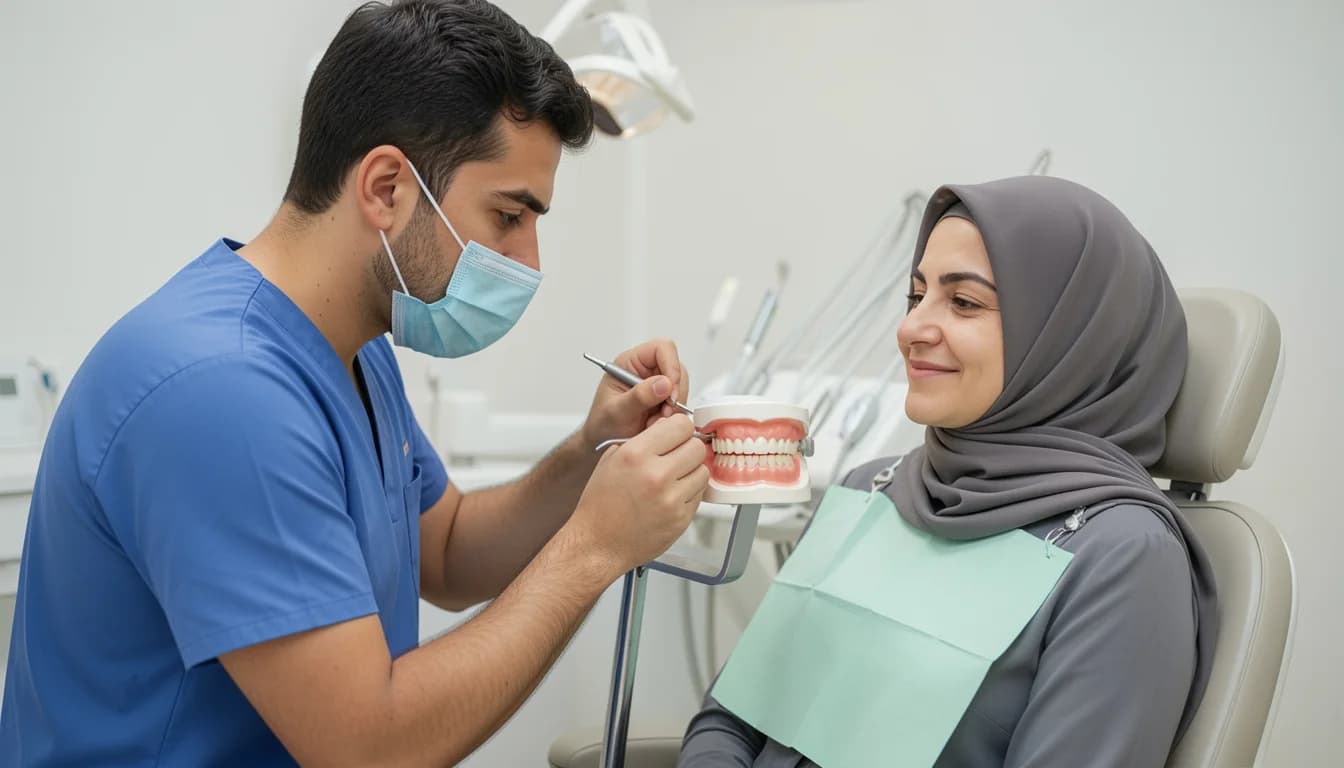
A dental crown is a custom-made cover that fits over a tooth and encloses it on all sides to restore its shape, size and ability to withstand biting. It is used when a tooth loses its strength: a wide fracture, a large filling with no sound wall left around it, a tooth that has become brittle after root canal treatment, heavy wear from grinding or repeated acid exposure, or a tooth that will carry a bridge.
Crowns come in several types, each with situations that suit it. Metal-ceramic has a metal base covered with porcelain: strong and long-established, though a dark line may show at the gum if it recedes. Zirconia is a high-strength ceramic with no metal, suitable for molars and for front teeth depending on its grade. Glass ceramic reproduces translucency most closely and is generally preferred at the front and where load is lower. Full metal needs less tooth reduction and is used on back molars where appearance matters least. Preformed stainless steel crowns are used on children's primary teeth. No single type is best for everyone; the choice is clinical and balances your bite force, appearance and the tissue thickness available.
A crown differs from the other restorations: it repairs a tooth that is still present, whereas a bridge, a denture or an implant-supported restoration replaces a tooth that is missing. Crowns are fixed restorations that only the dentist removes, unlike removable prostheses that the patient takes out to clean. Choosing between a large filling and a crown depends on how much sound tissue remains and where the tooth sits in the jaw.
Crowning is the stage that follows treatment of the cause: a crown is not fitted over decay that was not fully removed, an untreated inflamed pulp, or active gum inflammation that bleeds at the margin, because covering a problem does not end it, it conceals it. The limits are explicit. A crown does not stop pain arising from the nerve, does not prevent new decay at its margin if cleaning is neglected, which is the commonest reason crowns fail, does not halt gum recession, does not replace a missing tooth, and does not make a tooth unbreakable. The belief that a restoration frees you from cleaning shortens its life, and the belief that extraction is easier and cheaper than saving a tooth is the costlier path: every extracted tooth is followed by bone loss, drifting of neighbours, and a larger replacement later. How long a crown lasts depends on your hygiene and habits, not on a promised number of years.
3 specialists
Procedure steps
1
Examination and assessing whether the tooth can be saved
The tooth, gums and bite are examined and a radiograph assesses the root, the surrounding bone and how much sound tissue remains. It is decided here whether a large filling suffices or a crown is needed, and whether the tooth can be saved at all, with the options and their limits explained to you.
2
Treating the cause first
Decay is removed completely, the root is treated if the pulp is damaged, and gum inflammation is controlled with professional cleaning and home-care instruction until bleeding stops at the tooth margin. A core build-up may be placed inside the tooth to support the crown when little structure remains.
3
Preparation, impression and temporary crown
The tooth is anaesthetised and reduced by a calculated amount that varies with the crown material, then a digital scan or impression is taken and the bite and adjacent tooth shade recorded. A temporary crown is fitted to protect the tooth, preserve the gum contour and allow limited chewing until the next visit.
4
Fabrication and try-in
The crown is made in the laboratory by digital design and milling or by conventional technique. At try-in the marginal fit is checked for any gap at the gum, the contact with adjacent teeth and your ability to pass floss are tested, and the shade is matched in natural light.
5
Cementation and care instruction
The crown is cemented with material suited to its type, residual cement is carefully cleared from below the gum margin, and the bite is adjusted in closure and side movements. You are then shown how to clean the margin daily, given a review date, and assessed for whether you need a night guard.
Before the procedure
Tell your dentist all your medicines and chronic conditions, particularly blood thinners, diabetes and heart disease, and any allergy to anaesthetic or materials. Say if you plan to whiten your teeth, since whitening must precede shade selection because a crown does not change colour once made. Mention grinding or clenching during sleep, biting ice, or opening things with your teeth, as these habits either add a night guard to the plan or change the material chosen. Clean your teeth thoroughly before the visit, because bleeding gums distort the impression. Come after a light meal and allow enough time for the first appointment, which is the longest.
After the procedure
While the temporary crown is in place, avoid sticky and hard foods on that side, and pull floss upward rather than out sideways; if the temporary comes off, contact the clinic and do not leave it for days, because the tooth moves and the gum grows in. After final cementation, do not eat until the anaesthetic has worn off, and keep to soft food on the first day. Clean twice daily with a soft brush and fluoride toothpaste and pass floss or an interdental brush once a day around the crown margin, because decay begins exactly there; a restoration does not exempt you from cleaning, it increases the need for it. Avoid biting ice, pens and nut shells, and wear a night guard if prescribed. **Seek care immediately for facial or under-jaw swelling, fever, difficulty swallowing or breathing, pus, or throbbing pain unrelieved by painkillers.** Also return if your bite still feels high, if sensitivity persists, or if the crown loosens.
Expected duration
Usually two visits over one to three weeks: 60 to 90 minutes for preparation and impression, and 30 to 45 minutes for the fitting.
تُعد د. يولا كوفالينكا من الكفاءات الطبية المتميزة في مجال طب الأسنان. تخرجت من جامعة لوغانسك الطبية الحكومية عام 2007، وكانت ضمن أوائل خمسة طلاب على دفعتها، وه…
يمتلك د. معتصم ارديسات خبرة مهنية واسعة في مجال طب الأسنان بدأت منذ عام 2007. تمتد مسيرته بين العمل الأكاديمي والممارسة السريرية في أوروبا والشرق الأوسط، مما من…
الدكتور محمد أحمد علي الطراونة جرّاح فم ووجه وفكين، ومستشار في زراعة الأسنان وتجميل الوجه غير الجراحي. حاصل على البورد الأردني في جراحة الفم والوجه والفكين (201…
Which doctors are listed for Dental Crowns in Jordan?
There are currently 3 doctor profiles linked to Dental Crowns on ClinicsJo. Review the listed services and contact the practice to confirm availability with the doctor and branch you choose.
How can I find an appointment for Dental Crowns?
Start with an available doctor's profile and use the contact or booking options shown there. Confirm the service, practice location and appointment time with the clinic. If this list is empty, broaden your search using the directory links on this page.
What does Dental Crowns cost in Jordan?
Ask the practice for the current price and what it includes. A consultation fee shown on a profile is not necessarily the price of a procedure, tests or follow-up. Confirm any additional charges and insurance arrangements before your visit.
Explore related Prosthodontics (Crowns & Bridges) doctor directories