Dr Reem Al Qudah Clinic
Dr Reem Al Qudah is a dermatologist and venereologist with the Jordanian Board in dermatology. Her practice combines care for skin, hair and nail disorders with…
Hours not listedInsurance not specified8 views
Trusted medical platform in Jordan
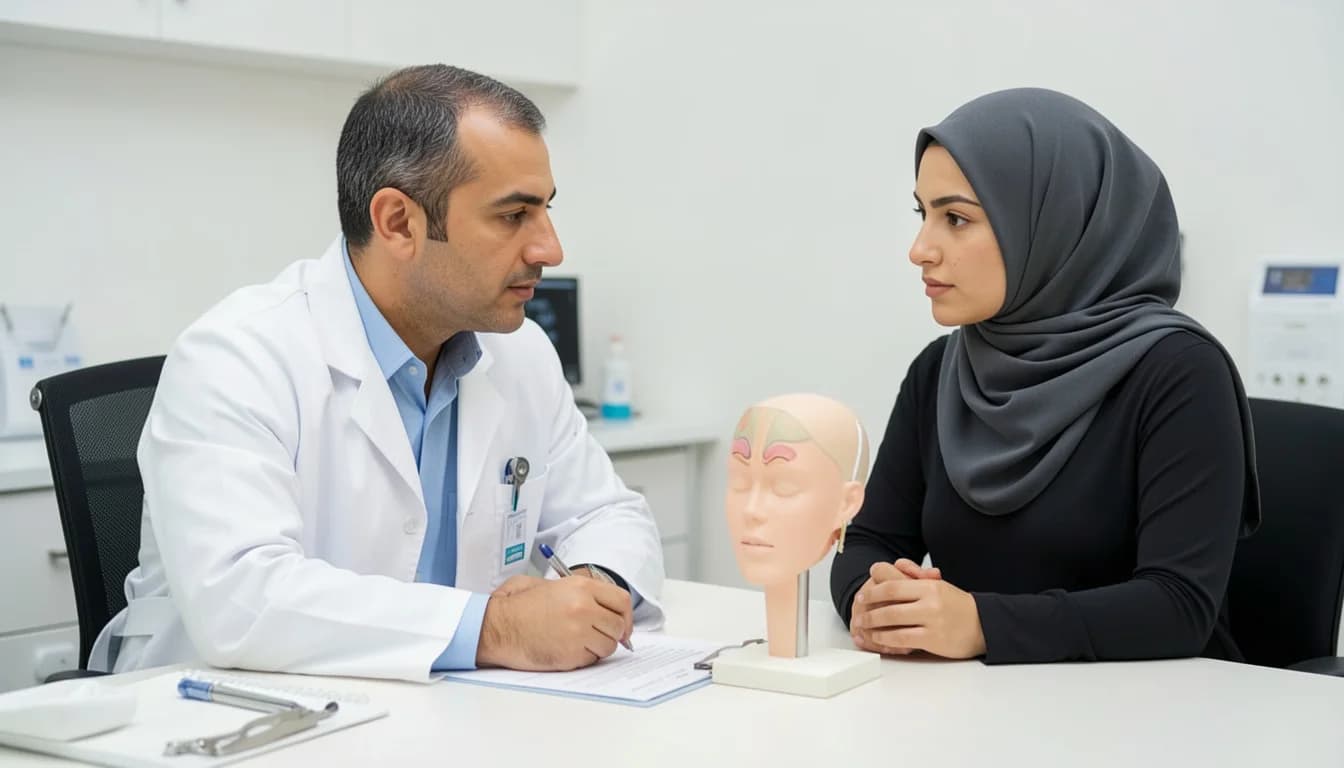
Treating hair loss is a medical pathway that begins with identifying the type and cause before prescribing any drug or procedure. Losing a limited number of hairs each day is normal, but visible thinning at the parting or crown, heavy shedding when washing or combing, smooth bald patches, or a receding hairline all call for a diagnosis, because treatment differs completely from one cause to another. Several patterns are common. Androgenetic alopecia in men and women is the most frequent and follows a characteristic pattern. Telogen effluvium follows childbirth, surgery, fever, crash dieting or severe stress; it is heavy and diffuse but usually temporary. Alopecia areata is immune-mediated and appears as smooth round patches. Iron and ferritin deficiency, thyroid dysfunction and vitamin D deficiency all contribute, as do hormonal conditions such as polycystic ovary syndrome and the effects of certain medicines. Finally there are the scarring alopecias, including traction alopecia from persistent pulling and lichen planopilaris, and this group destroys the follicle permanently. That last point carries the most important message: scarring hair loss is irreversible. Once follicular tissue has died and been replaced by fibrous tissue, no medicine, injection or oil brings it back. Early diagnosis is therefore not a luxury; it is the difference between hair that is saved and hair that is lost. Conversely, many causes respond fully once corrected: iron deficiency, thyroid disease, a drug effect, and telogen effluvium, after which hair usually regrows on its own. The limits deserve plain speech. Shampoos, oils and vitamins do not treat genetic baldness, shaving does not increase hair density, and iron should never be taken without a test proving deficiency. Effective treatments for androgenetic alopecia require sustained use, and stopping them allows shedding to resume its natural course within months. No treatment should be judged before four to six months, because the hair growth cycle is long, and standardised photographs are the proper yardstick rather than a daily impression in the mirror. Whether medication, injections or transplantation suit you is decided by clinical scalp examination and blood tests.
The clinician asks about onset, speed and pattern of shedding, about childbirth, surgery, fever, dieting, psychological stress, medicines and family history, and about styling habits, traction and heat. The thinning pattern is examined and measured, a pull test is performed, and trichoscopy is used to see follicular openings, miniaturisation and any scarring.
Tests are chosen according to what the examination suggests: ferritin and full blood count, thyroid function, vitamin D, glucose, and androgen profile in women with hirsutism or menstrual irregularity. The aim is to prove a deficiency before correcting it, rather than supplementing on suspicion.
The type is classified once findings are assembled, with a specific search for signs of scarring alopecia such as loss of follicular openings, perifollicular redness, scaling, itching and pain. Where doubt remains a small scalp biopsy is taken, because this distinction determines whether the goal is regrowth or halting further loss.
The plan follows the diagnosis: correcting a proven deficiency, stopping a causative drug in coordination with its prescriber, topical and oral therapy for androgenetic alopecia, intralesional injections for alopecia areata, or anti-inflammatory treatment in scarring alopecia to arrest progression, alongside changes to traction, heat and chemical habits and balanced nutrition.
Standardised photographs are taken with the same lighting and angles at every visit, and review every three to four months measures change objectively and adjusts the plan. Patients are told that improvement takes four to six months, that drug therapy for genetic baldness must be continued, and the role of injections or transplantation is assessed when indicated.
Come with a clean, freshly washed scalp, free of oils, styling products, thickening powder and recent dye, all of which hide what the doctor needs to see. Bring a written list of every medicine and supplement you take, including contraceptives, iron and vitamins, and bring previous blood results so tests are not needlessly repeated. Photograph your scalp at home from above, along the parting and from the front in good light, and bring older photographs from before the shedding began, since comparison can change the diagnosis. Note approximately when the loss started and what happened in the three months before it: childbirth, surgery, fever, dieting, severe stress or a new medicine. Women should mention menstrual regularity and any increase in facial hair, and everyone should report scalp itching, pain or scaling.
Follow the plan as prescribed and do not mix internet remedies with what your doctor gave you. With some topical treatments expect a temporary increase in shedding during the first weeks; this is a recognised phase, does not mean failure, and is not a reason to stop before speaking to your doctor. Change the habits that matter: reduce traction from braids, extensions and tight ties, cut back heat styling and chemical straightening, comb gently, and do not sleep with wet, tied-up hair. Eat a balanced diet with adequate protein, and never take iron supplements without a test and a prescription. Photograph your scalp every three months in the same way to measure change objectively. **Seek care urgently for patches that enlarge rapidly, severe scalp pain, itching, scaling, pustules or pus, hair loss with disappearing follicular openings and shiny skin, loss of eyebrows, eyelashes or body hair, shedding with weight loss, marked fatigue or absent periods, or rash, swelling or breathlessness after starting a new medicine.**
The first assessment usually takes 20 to 30 minutes, blood results return within days, and treatment response is judged at 4 to 6 months with review every 3 to 4 months.
Dr Reem Al Qudah is a dermatologist and venereologist with the Jordanian Board in dermatology. Her practice combines care for skin, hair and nail disorders with…
Dr Reem Mahmoud Al Awadi is a dermatologist and venereologist with the Jordanian Board in the specialty. At her Shmeisani practice, she assesses skin and hair c…
Dr Huda Al Qudah is a consultant dermatologist and venereologist, a Jordan University of Science and Technology graduate and holder of the Jordanian Board. Her …
There are currently 3 doctor profiles linked to Hair loss treatment on ClinicsJo. Review the listed services and contact the practice to confirm availability with the doctor and branch you choose.
Start with an available doctor's profile and use the contact or booking options shown there. Confirm the service, practice location and appointment time with the clinic. If this list is empty, broaden your search using the directory links on this page.
Ask the practice for the current price and what it includes. A consultation fee shown on a profile is not necessarily the price of a procedure, tests or follow-up. Confirm any additional charges and insurance arrangements before your visit.