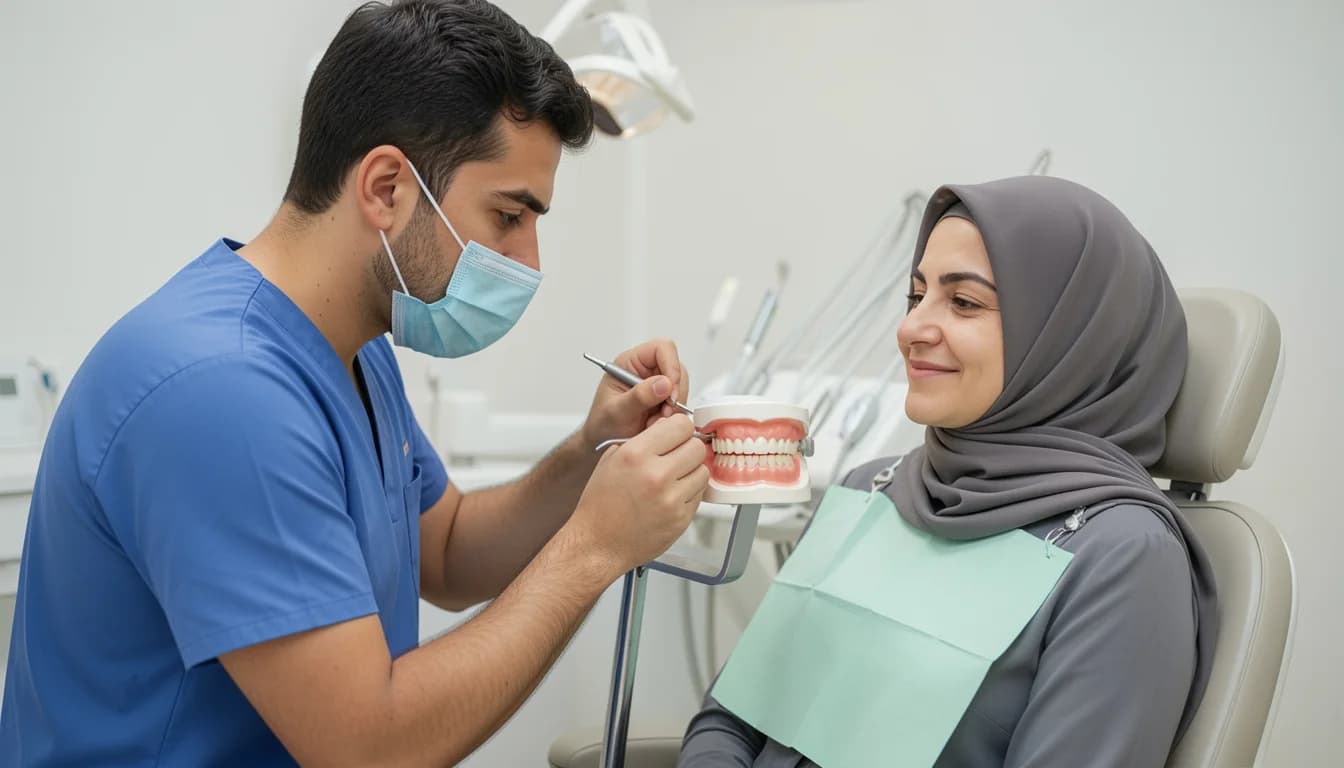
An implant-supported prosthesis is the visible part of implant treatment: the crown, bridge or denture fixed onto one or more implants after they have integrated with the bone. The implant replaces the missing root, the prosthesis replaces the part you see and bite with, and a connecting component called the abutment joins the two.
There are several forms, chosen according to how many teeth are missing and the condition of the bone and gums: a single crown on one implant; a fixed bridge carried by two or more implants that replaces several teeth without preparing neighbouring teeth; a full denture retained by implants that the patient removes for cleaning, known as an overdenture; or a screw-retained full arch that only the dentist removes. Each form has its own cleaning and maintenance requirements and its own number of visits, and the choice is based on examination and three-dimensional imaging rather than preference alone.
The prosthetic stage does not begin before the cause has been treated and the mouth prepared. A restoration is not built in a mouth with active gum inflammation, inflammation around an implant, or decay in adjacent teeth, and not before implant stability is confirmed clinically and radiographically. Inflammation left underneath a fixed restoration is difficult to detect early, so it is treated before fabrication, not after.
The limits must be stated plainly. An implant does not decay, but the tissues around it can become inflamed and lose bone if cleaning is neglected, and this is the commonest reason implant-supported restorations fail. A prosthesis on an implant does not restore the natural feel of a tooth, because an implant has no periodontal ligament; it does not prevent gum recession; and it is no substitute for controlling blood sugar or stopping smoking, both of which affect the supporting tissues. The belief that a restoration frees you from cleaning shortens its life: implants and bridges need more precise cleaning than natural teeth, with special floss or interdental brushes. And treating extraction of a remaining tooth as the easier, cheaper option than saving it leads to bone loss and a wider replacement later. How long the prosthesis lasts depends on your hygiene and habits, such as grinding or biting ice, not on a promised number of years.
3 specialists
Procedure steps
1
Assessing the implant and surrounding tissues
Implant stability is confirmed, along with the absence of pain, bleeding or discharge around it. Tissue depth is measured and a radiograph is taken to assess bone level. If inflammation around the implant or gum disease in adjacent teeth is found, it is treated first, before any prosthetic work begins.
2
Choosing the prosthesis form and abutment
Together you decide whether the restoration is a single crown, a bridge or a retained denture, whether it is cemented or screw-retained, and an abutment of suitable height and angle for the gum contour is chosen. At this step you are shown how you will clean the restoration daily, because that forms part of the decision itself.
3
Impression or digital scan and bite record
A precise impression is taken with dedicated transfer components, or an intraoral digital scan is made, and your bite, jaw relationship, and the shape and colour of neighbouring teeth are recorded. Accuracy here is what prevents gaps beneath the restoration or unbalanced loading on the implant.
4
Try-in and adjustment before fitting
The restoration is tried in to check its contact with adjacent teeth, the distribution of biting points, and your ability to pass floss or an interdental brush beneath it. Any high contact is corrected at this stage, since leaving it loads the implant beyond what it should carry.
5
Final fitting and maintenance plan
The restoration is secured with well-controlled cementation or by tightening the screw to a specified torque, and any residual cement is carefully removed because it is a known cause of tissue inflammation. A schedule of regular reviews is then set for professional cleaning, radiographic bone checks, and retightening screws if needed.
Before the procedure
Tell your dentist about every chronic condition and medicine you take, especially diabetes, blood thinners and bone-density drugs, and about smoking or any previous radiotherapy to the head and neck. Bring earlier implant reports and three-dimensional images if you have them, and say when the implant was placed and what type of surgery was done. Look after your oral hygiene in the weeks before the prosthetic stage, because bleeding gums make an accurate impression difficult and distort the margins of the restoration. Mention if you grind or clench, and if you have a strong gag reflex that makes impressions hard. Do not stop long-term medication on your own, and come after a light meal rather than after a long fast.
After the procedure
Expect a feeling of fullness and some change in speech and chewing in the first days until your tongue and cheek adapt to the new shape. Clean around the implant twice daily with a soft brush, and use special floss, an interdental brush or a water flosser every day to clean under the restoration and around the abutment; an implant cannot decay, but it loses bone if the surrounding tissue becomes inflamed, so a restoration tightens your cleaning duty rather than removing it. Start with soft food and avoid hard or sticky items in the first week, never bite ice or pens, and wear a night guard if you grind. Keep your regular review appointments for professional cleaning and radiographic checks. **Seek care immediately for increasing swelling, fever, pus or persistent foul odour, bleeding that will not stop, any sense of movement in the restoration or implant, or pain that worsens after the third day.** Also return if a screw loosens or part of the restoration comes away, and do not try to refit it yourself.
Expected duration
The prosthetic stage usually takes two to four visits spread over two to six weeks, with each visit lasting 30 to 90 minutes depending on the type of restoration.
تُعد د. يولا كوفالينكا من الكفاءات الطبية المتميزة في مجال طب الأسنان. تخرجت من جامعة لوغانسك الطبية الحكومية عام 2007، وكانت ضمن أوائل خمسة طلاب على دفعتها، وه…
يمتلك د. معتصم ارديسات خبرة مهنية واسعة في مجال طب الأسنان بدأت منذ عام 2007. تمتد مسيرته بين العمل الأكاديمي والممارسة السريرية في أوروبا والشرق الأوسط، مما من…
الدكتور محمد أحمد علي الطراونة جرّاح فم ووجه وفكين، ومستشار في زراعة الأسنان وتجميل الوجه غير الجراحي. حاصل على البورد الأردني في جراحة الفم والوجه والفكين (201…
Finding Implant Supported Prosthesis services in Jordan
Which doctors are listed for Implant Supported Prosthesis in Jordan?
There are currently 3 doctor profiles linked to Implant Supported Prosthesis on ClinicsJo. Review the listed services and contact the practice to confirm availability with the doctor and branch you choose.
How can I find an appointment for Implant Supported Prosthesis?
Start with an available doctor's profile and use the contact or booking options shown there. Confirm the service, practice location and appointment time with the clinic. If this list is empty, broaden your search using the directory links on this page.
What does Implant Supported Prosthesis cost in Jordan?
Ask the practice for the current price and what it includes. A consultation fee shown on a profile is not necessarily the price of a procedure, tests or follow-up. Confirm any additional charges and insurance arrangements before your visit.
Explore related Prosthodontics (Crowns & Bridges) doctor directories