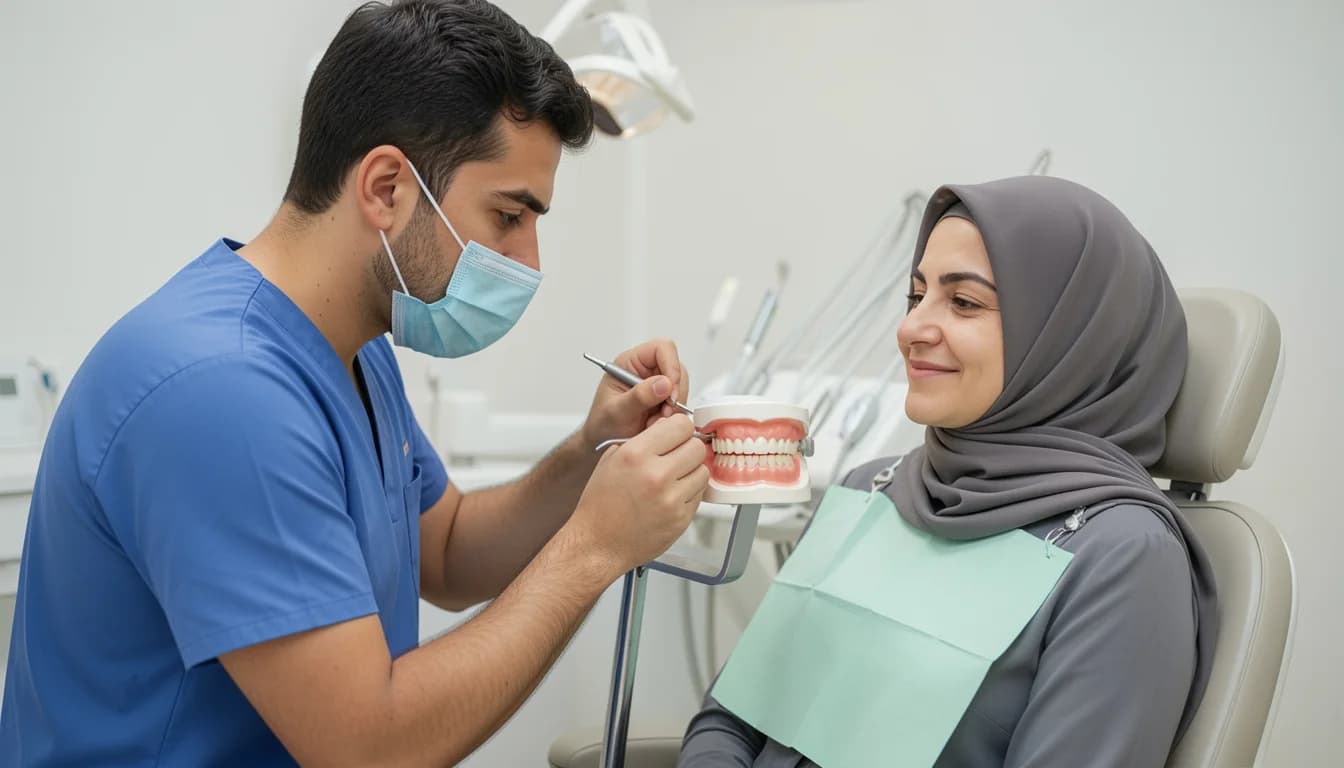
A removable partial denture replaces some of the missing teeth in a jaw, resting on both the remaining teeth and the gums, and the patient takes it out to clean it and then puts it back. It is usually retained by clasps that embrace specific teeth, called abutment teeth, and by rest seats prepared on their surfaces to distribute the biting load between tooth and gum.
The types are chosen clinically rather than by preference. A full acrylic base is the simplest and quickest, often a temporary or transitional solution, but it is bulkier and heavier. A cast metal framework is thinner and more precise and distributes load better, though its metal clasps may show depending on their position. A flexible resin base has gum-coloured clasps that are less visible, but it is harder to adjust and reline and may transmit more load to the gums. Two alternatives sit alongside the partial denture: a fixed bridge, which requires preparing neighbouring teeth, and an implant-supported restoration, which requires sufficient bone and a longer timeline. No single type suits everyone, and the decision balances how many teeth are missing and where, the condition of the remaining teeth, and your capacity for daily care.
The prosthesis is the stage that follows treatment of the cause. The remaining teeth are prepared first: decay is restored, gum inflammation is treated until bleeding stops, damaged roots are treated, and weak abutment teeth are crowned if necessary. Making a partial denture over decay or inflamed gums accelerates the loss of the very abutment teeth the prosthesis depends on, so both the denture and the teeth are lost together.
The limits must be stated plainly. It does not stop bone resorption in the empty areas, does not give the sensation and biting force of natural teeth, is not normally worn during sleep, and does not stay well-fitting forever, because tissues change and it will need relining, adjustment, or the addition of a tooth if another one is lost. The clasps collect plaque around the abutment teeth, so cleaning them daily is non-negotiable; the belief that a restoration frees you from cleaning is the fastest route to losing the abutment teeth and then the denture itself. And the belief that extracting what remains is easier and cheaper than saving it produces an empty jaw and a less stable, harder-to-use prosthesis. How long the denture serves you depends on its hygiene and your habits, not on a promised number of years, and suitability is decided by clinical examination, not by reading.
4 specialists
Procedure steps
1
Examination and selecting the abutment teeth
The remaining teeth are examined, their mobility and pocket depths measured, radiographs assess the roots and supporting bone, and the distribution of the gaps in the jaw is studied. It is decided here which teeth can serve as abutments, and the options are compared with a fixed bridge and implants according to your case.
2
Preparing the mouth before fabrication
Decay is restored, gum inflammation is treated with professional cleaning and home-care instruction, damaged roots are treated and weak abutments crowned if needed, unsalvageable teeth are extracted and the tissues allowed to heal. The definitive impression is not taken before the mouth is stable.
3
Impressions and preparing the rest seats
Small rest seats are prepared on the surfaces of the abutment teeth so the framework rests on them instead of pressing on the gum, then a precise impression records the teeth, ridges and gums together, and the bite is registered. The accuracy of this step determines the denture's stability and comfort.
4
Framework try-in and wax try-in
The metal framework or base is tried in to confirm it seats without rocking and that the clasps grip without harmful force on the abutment tooth. The teeth are then set in wax and tried in to assess shape, colour, bite height and speech, and this is your opportunity to request changes before processing.
5
Delivery and adjustment visits
The denture is delivered and you are trained to insert and remove it along a single path without bending the clasps, the bite is adjusted and pressure points relieved. Short appointments are arranged in the first two weeks because ulcers are common at the start, and daily cleaning of the clasps and abutment teeth is explained.
Before the procedure
Tell your dentist your chronic conditions and medicines, especially diabetes, blood thinners and drugs that dry the mouth, and any known allergy to a material or metal. Bring any partial denture you currently use and describe in detail what bothers you: movement, ulcers, a visible clasp, or difficulty chewing. Mention grinding or clenching, whether you smoke, and whether you sleep in the denture. Look after your teeth and gums in the preceding weeks, because a partial denture relies on sound teeth and non-bleeding gums, and inflamed tissue distorts the impression and undermines the design. Do not stop your medication on your own, and allow time for several visits, as this prosthesis is built in stages.
After the procedure
In the first days expect awareness of the bulk, more saliva and difficulty with some sounds; read aloud to practise, start with soft food cut small and chew on both sides. Insert and remove the denture with your fingers along a single path and never bite it into place, as that bends and breaks the clasps. Take it out at night and keep it in water or a dedicated solution so the gums can rest, and clean it morning and evening with a denture brush and mild soap outside the mouth over a water-filled basin, without abrasive toothpaste or hot water. Most important of all, clean the abutment teeth and around the clasps twice daily with a brush and floss or an interdental brush, because these sites collect plaque and a prosthesis increases rather than removes your need to clean. **Seek care immediately for an ulcer that does not heal within two weeks, a persistent white or red patch, swelling or fever, pain or new mobility in an abutment tooth, or repeated bleeding around a clasp.** Also return if the denture loosens or a clasp breaks, and never repair it with household glue.
Expected duration
Usually three to five visits over two to five weeks, each lasting 30 to 60 minutes, followed by short adjustment appointments.
تُعد د. يولا كوفالينكا من الكفاءات الطبية المتميزة في مجال طب الأسنان. تخرجت من جامعة لوغانسك الطبية الحكومية عام 2007، وكانت ضمن أوائل خمسة طلاب على دفعتها، وه…
يمتلك د. معتصم ارديسات خبرة مهنية واسعة في مجال طب الأسنان بدأت منذ عام 2007. تمتد مسيرته بين العمل الأكاديمي والممارسة السريرية في أوروبا والشرق الأوسط، مما من…
الدكتور محمد عرفات حسن هو طبيب أسنان وصاحب خبرات متقدمة في طب وجراحة الفم والأسنان، خرّيج جامعة دمشق العريقة في طب وجراحة الفم والأسنان (بكالوريوس)، وحاصل على ع…
الدكتور محمد أحمد علي الطراونة جرّاح فم ووجه وفكين، ومستشار في زراعة الأسنان وتجميل الوجه غير الجراحي. حاصل على البورد الأردني في جراحة الفم والوجه والفكين (201…
Finding Partially Removable Dentures services in Jordan
Which doctors are listed for Partially Removable Dentures in Jordan?
There are currently 4 doctor profiles linked to Partially Removable Dentures on ClinicsJo. Review the listed services and contact the practice to confirm availability with the doctor and branch you choose.
How can I find an appointment for Partially Removable Dentures?
Start with an available doctor's profile and use the contact or booking options shown there. Confirm the service, practice location and appointment time with the clinic. If this list is empty, broaden your search using the directory links on this page.
What does Partially Removable Dentures cost in Jordan?
Ask the practice for the current price and what it includes. A consultation fee shown on a profile is not necessarily the price of a procedure, tests or follow-up. Confirm any additional charges and insurance arrangements before your visit.
Explore related Prosthodontics (Crowns & Bridges) doctor directories