
Dr Hannah Naasan Dermatology Clinic
Dr Hannah Naasan is a consultant dermatologist in Abdali, Amman, caring for adults and children and providing dermatological procedures and aesthetic care. She …
Hours not listedDoes not accept insurance8 views
Trusted medical platform in Jordan
Skin cancer is an uncontrolled growth of skin cells. Three types dominate: basal cell carcinoma, the commonest and slowest to spread; squamous cell carcinoma; and melanoma, the least common but the most dangerous because it can spread early. Treatment always begins with a confirmed diagnosis — clinical examination, dermoscopy, then a biopsy read in the laboratory. No blood test diagnoses skin cancer, and no treatment should ever be started on suspicion alone. The options depend on the type, size, depth and site of the tumour and on the patient's general health. Surgical excision with a clear margin is the mainstay in most cases. For tumours on the face, around the eye, nose or ear, for recurrent lesions, or where the borders are ill-defined, Mohs surgery is used: the margin is examined under the microscope during the same session and excision is repeated layer by layer until the edges are clear, sparing as much healthy tissue as possible. Curettage with electrodesiccation suits some small superficial tumours; topical agents that stimulate immunity or block cell division are used for very superficial forms; cryotherapy has a role in selected cases; and radiotherapy is offered to people unfit for surgery. In advanced disease, immune and targeted systemic therapies are prescribed in specialist centres, **and they require baseline investigations and close laboratory monitoring because they affect other organs.** The limits should be clear. Removing one tumour does not prevent another, and anyone who has had a skin cancer remains at higher risk and needs long-term surveillance. Topical treatments and cryotherapy are wrong for deep tumours and for melanoma; used inappropriately they clear the surface while the tumour continues to grow underneath. No cream, herbal recipe or caustic paste treats skin cancer, and home burning causes disfigurement and a dangerous delay in diagnosis. Prevention is part of treatment: avoid midday sun, use and reapply a high-factor sunscreen, cover with clothing, hat and sunglasses, and never use tanning beds. Repeated sunburn — especially in childhood and on summer trips to the Dead Sea and Aqaba — is one of the most modifiable risk factors, and there is no such thing as a healthy tan. People living with albinism or marked light sensitivity need strict protection and regular lifelong skin checks. **One myth needs correcting: skin cancer is not confined to fair skin. In darker skin it often appears where the sun never reaches — the sole, the heel, under the nails and between the toes — and is therefore found late. Any new dark patch, a dark streak under a nail, or a foot sore that will not heal needs immediate examination.**
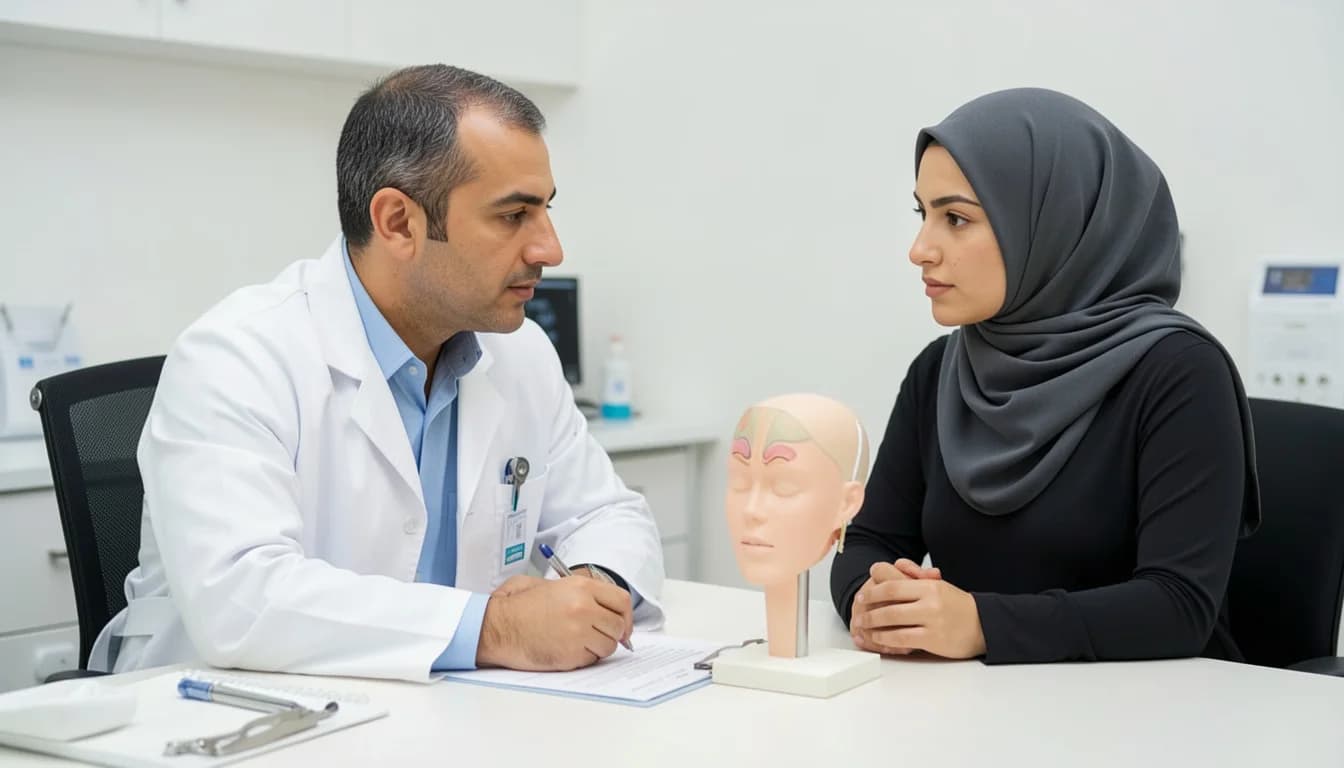
The doctor assesses the lesion, its borders, surface and surroundings, then examines the rest of the skin, scalp, soles, nails and nearby lymph nodes. Questions cover how long the lesion has been there, how fast it is changing, sun exposure history, previous tumours, family history and any immunosuppressive treatment.
A biopsy is taken under local anaesthetic — part of the lesion or all of it, depending on size and site — and sent to the laboratory to determine the type, how aggressive it is and how deep it goes. This step dictates the whole treatment plan and must never be skipped or replaced by guesswork from appearance or a photograph.
Once the diagnosis is known, the extent is assessed: lymph nodes are examined and, for some melanomas or large tumours, imaging or additional procedures may be requested. The treatment is then chosen and explained to you along with its alternatives and expected cosmetic outcome; complex cases are often decided by more than one specialty together.
The tumour is excised with a clear margin, usually under local anaesthetic, and the defect is closed with stitches, a graft or a flap in difficult sites. In Mohs surgery the margin is checked during the session and excision repeated layer by layer until the edges are clear. Topical or radiotherapy regimens are instead given over a course of sessions.
A regular follow-up plan is set: inspection of the excision site, the rest of the skin and the lymph nodes, training in monthly self-examination, and strict sun protection. Visits are more frequent in the first years and then spaced out, but they are not stopped, because a second tumour elsewhere is expected and must be found early.
Bring any previous biopsy or operation reports and older photographs of the lesion if you have them, since documenting how fast it has changed is genuinely useful. Tell the doctor about all your medicines, especially anticoagulants, antiplatelet agents, steroids and immunosuppressive drugs taken after transplantation or for autoimmune disease — and stop nothing on your own. Mention chronic illnesses, allergies to local anaesthetic, dressings or antiseptics, and any pacemaker, which affects the use of electrocautery. Do not apply creams, caustic pastes or home remedies to the lesion before assessment, because they distort its appearance and make diagnosis harder. For a long procedure such as Mohs surgery, arrange someone to drive you, follow the clinic's instructions about eating beforehand, and wear comfortable clothes that give easy access to the area.
Follow the wound-care instructions exactly: gentle cleaning, dressing changes on schedule, and no swimming, strenuous exercise or stretching of the skin until your doctor agrees. Protect the surgical site from the sun for months with a high-factor sunscreen or medical tape. Learn monthly self-examination using a mirror and good light, including the scalp, between the toes, the soles and the nails, and never cancel surveillance visits even after the wound has healed completely. **Seek review immediately if: bleeding does not stop with pressure; redness spreads with heat, pus and fever; or the wound edges separate. Seek review immediately, too, for a new lump or nodule near the tumour site, an enlarged lymph node, regrowth or ulceration in the scar itself, or any new patch or sore elsewhere that fails to heal within weeks — these are red flags for recurrence or a second tumour and must never be ignored.**
A biopsy usually takes 10 to 20 minutes and a simple excision under local anaesthetic 30 to 60 minutes, while Mohs surgery commonly runs two to four hours because the margins are re-examined during the session.
Dr Hannah Naasan is a consultant dermatologist in Abdali, Amman, caring for adults and children and providing dermatological procedures and aesthetic care. She …
There are currently 1 doctor profiles linked to Skin cancer treatment on ClinicsJo. Review the listed services and contact the practice to confirm availability with the doctor and branch you choose.
Start with an available doctor's profile and use the contact or booking options shown there. Confirm the service, practice location and appointment time with the clinic. If this list is empty, broaden your search using the directory links on this page.
Ask the practice for the current price and what it includes. A consultation fee shown on a profile is not necessarily the price of a procedure, tests or follow-up. Confirm any additional charges and insurance arrangements before your visit.