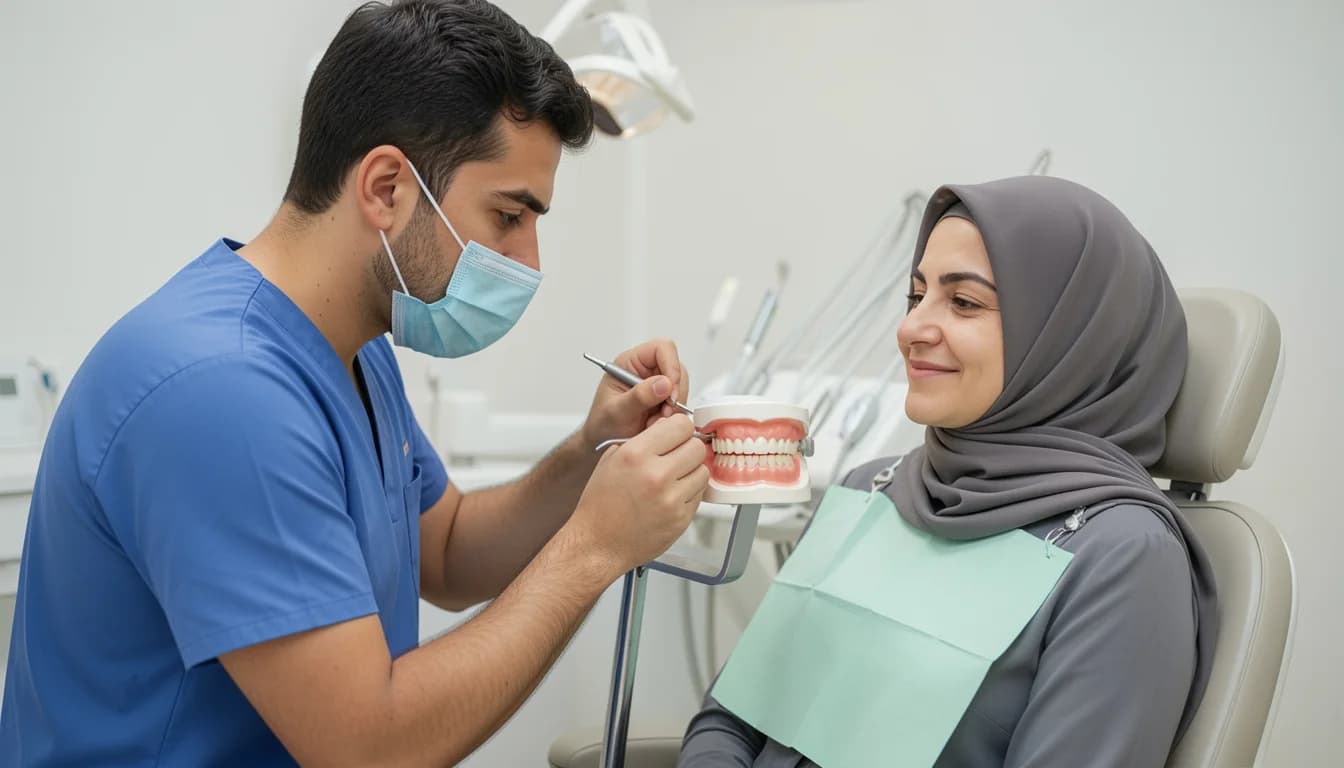
Treatment of tooth decay and inflammation in children Doctors in Jordan
علاج تسوس والتهاب الأسنان لدى الاطفال
Treatment of tooth decay and dental infection in children is a set of procedures that halt the progression of caries in primary and newly erupted permanent teeth and manage pulp inflammation and abscess. It includes restorations, caries-arresting materials, pulp treatment of primary teeth, crowns, and extraction with a space maintainer when a tooth cannot be saved.
One widespread myth costs children a great deal: the idea that a baby tooth will fall out anyway so it does not need treatment. Primary teeth must be treated, not neglected. They hold space and guide the eruption of the permanent teeth, and losing them early leads to crowding and drifting that later requires longer orthodontic treatment. More importantly, an abscess on a primary tooth sits directly above the developing permanent tooth bud and can damage the enamel of that permanent tooth or divert its eruption path. A painful tooth also costs a child sleep, appetite, and concentration at school.
The choice of treatment depends on the depth of decay, the vitality of the pulp, the child's age, and how long the tooth is expected to stay. Early enamel decay may be arrested with topical fluoride and changed habits, a moderate cavity is restored with a filling, decay reaching the pulp of a primary tooth is managed with pulp treatment followed by a protective crown, and a non-vital or badly broken-down tooth is extracted with a space maintainer placed afterwards. Materials that arrest decay without drilling are useful for very young or uncooperative children, but they leave a dark stain on the tooth and parents should know this in advance.
Managing the child is part of the treatment: simple explanation using a tell-show-do approach, short appointments, and positive reinforcement. Some children need inhalation sedation or general anaesthesia when they are very young, have many affected teeth, or have special needs, and that is a shared clinical decision after medical assessment rather than a marketing option. Suitability for any of these approaches is determined by clinical examination and radiographs.
The limits are clear. A filling restores what was lost but does not recreate natural enamel, and it does not prevent new decay in other teeth if habits stay the same. Fluoride arrests early lesions but does not treat a deep cavity. Any treatment succeeds only if the cause changes: the night-time milk bottle, sugary drinks, frequent sweet snacks between meals, and brushing that is not done twice daily under adult supervision.
3 specialists
Procedure steps
1
Examination and preparing the child
Every tooth is examined and the gums, signs of abscess, and swelling are assessed, along with a review of diet, brushing, and medical history. The child is introduced to the clinic and instruments using a tell-show-do approach, and trust is built before any uncomfortable step.
2
Radiographs and treatment planning
Limited radiographs are taken when needed to detect decay between teeth, judge its proximity to the pulp, and assess the developing permanent tooth. The plan is explained to parents with options, alternatives, and limits, and appointments are sequenced by urgency and pain.
3
Local anaesthesia and isolation
The site is anaesthetised gradually with a preceding topical agent to reduce the sensation of the needle, and the tooth is isolated with a rubber dam or suction to protect the airway and keep the field dry. The numb feeling is explained to the child beforehand so it does not frighten them.
4
Caries removal and the appropriate restoration
Decay is cleaned out and the restoration is chosen: a composite or glass-based filling for limited cavities, pulp treatment followed by a crown when inflammation reaches the pulp of a primary tooth, and extraction with a space maintainer if the tooth is broken down or non-vital with an abscess that cannot be saved.
5
Prevention plan and regular review
Topical fluoride is applied and deep fissures in the molars are sealed when indicated. Parents are coached on supervised twice-daily brushing and on reducing how often sugar is eaten, and a review is scheduled every 3 to 6 months according to the child's caries risk.
Before the procedure
Book the appointment at a time when your child is rested rather than tired, and give a light meal beforehand unless fasting was requested. Speak positively and simply, avoid words such as needle, pain, or promises that nothing will hurt, and never use a dental visit as a threat or punishment at home. Tell the dentist everything relevant to your child's health: heart conditions, asthma, seizures, bleeding disorders, drug allergies, current medications including supplements, and any special needs or developmental delay. Also mention any previous bad dental experience, because it changes how the visit is handled. Bring your child's reports and any earlier radiographs, and note where the pain is and when it worsens. Come with one accompanying adult if possible, bring a favourite toy, and promise a reward for cooperation rather than for not crying.
After the procedure
Do not let your child eat until the numbness has fully worn off, which usually takes one to three hours, and watch them, because children bite the numb lip or tongue without feeling it and create a swollen wound. Start with cool liquids and soft food, avoid hard, sticky, and hot items on the first day, and do not allow drinking through a straw after an extraction because it dislodges the clot. Give pain relief only at the dose the dentist prescribed rather than a dose estimated at home. Continue gentle supervised brushing twice a day, including over new fillings, keeping away from an extraction site on the first day and then resuming full brushing. Keep any space maintainer or crown clean and avoid chewing gum and sticky sweets. **Seek care immediately if there is facial swelling or swelling under the eye, fever with lethargy, pain increasing after the second day, bleeding that does not stop after ten minutes of pressure with clean gauze, difficulty swallowing or breathing, or a filling or crown that comes off.**
Expected duration
A single appointment usually takes 20 to 45 minutes, and multiple teeth are spread over short successive visits every one to two weeks.
تُعد د. يولا كوفالينكا من الكفاءات الطبية المتميزة في مجال طب الأسنان. تخرجت من جامعة لوغانسك الطبية الحكومية عام 2007، وكانت ضمن أوائل خمسة طلاب على دفعتها، وه…
يمتلك د. معتصم ارديسات خبرة مهنية واسعة في مجال طب الأسنان بدأت منذ عام 2007. تمتد مسيرته بين العمل الأكاديمي والممارسة السريرية في أوروبا والشرق الأوسط، مما من…
الدكتور محمد عرفات حسن هو طبيب أسنان وصاحب خبرات متقدمة في طب وجراحة الفم والأسنان، خرّيج جامعة دمشق العريقة في طب وجراحة الفم والأسنان (بكالوريوس)، وحاصل على ع…
Finding Treatment of tooth decay and inflammation in children services in Jordan
Which doctors are listed for Treatment of tooth decay and inflammation in children in Jordan?
There are currently 3 doctor profiles linked to Treatment of tooth decay and inflammation in children on ClinicsJo. Review the listed services and contact the practice to confirm availability with the doctor and branch you choose.
How can I find an appointment for Treatment of tooth decay and inflammation in children?
Start with an available doctor's profile and use the contact or booking options shown there. Confirm the service, practice location and appointment time with the clinic. If this list is empty, broaden your search using the directory links on this page.
What does Treatment of tooth decay and inflammation in children cost in Jordan?
Ask the practice for the current price and what it includes. A consultation fee shown on a profile is not necessarily the price of a procedure, tests or follow-up. Confirm any additional charges and insurance arrangements before your visit.
Explore related Pediatric Dentistry doctor directories