Jordan Eye Center
Sign in to the platform to view the phone number
74 viewsHours 08:00–19:00 · 6 days a weekInsurance not specified
Trusted medical platform in Jordan

These six ophthalmologists in Amman each publish intraocular lens implant among their services on ClinicsJo. If you searched for the best intraocular lens implant doctors in Jordan, note that this list is ordered by how complete each profile is, not by surgical skill or results. Compare qualifications, services, locations and opening hours below, then contact the clinic to book an examination.
| # | Doctor | Area | Rating | Experience | Consultation | Hours | Insurance | Suits | Profile score |
|---|---|---|---|---|---|---|---|---|---|
| 1 | Muataz Mohammad Harara | Mecca Street | — | — | — | 6 days · 08:00–19:00 | — | Lens implant patients who also have retinal or corneal concerns | 40/100 |
| 2 | Mohammad Akram Hawari | Mecca Street | — | — | — | 6 days · 08:00–19:00 | — | Families needing lens implant care plus children's or squint services | 40/100 |
| 3 | Mais Khaled Al Jbour | Mecca Street | — | — | 30 JOD | 6 days · 08:00–19:00 | Accepted | Patients preferring a female surgeon; eyelid or tear-drainage concerns too | 40/100 |
| 4 | Saif Al Rawashdeh | Mecca Street | — | — | 25 JOD | 6 days · 08:00–19:00 | Accepted | Lens implant or LASIK candidates comparing options at one centre | 40/100 |
| 5 | Amer Hajjaj | Fifth Circle | — | — | 25 JOD | 6 days · 09:00–18:30 | Accepted | Patients with diabetes or glaucoma preferring a Fifth Circle clinic | 40/100 |
| 6 | Khalaf Houshan | Mecca Street | — | — | — | 6 days · 08:00–19:00 | — | Adults weighing a cataract lens implant against laser vision correction | 38/100 |
From each profile as published today: approved reviews only, consultation fees only where the profile states them, confirmed weekly hours (the most common shift). «—» means the profile does not publish it.
Dr. Muataz Mohammad Harara is a consultant ophthalmologist and vitreoretinal surgeon at Jordan Eye Center on Mecca Street, Amman. He holds the Jordanian Board and Arab Board in Ophthalmology and an International Council of Ophthalmology qualification. His published services cover cataract surgery and intraocular lens implantation, along with retinal assessment and treatment, intravitreal injections, corneal transplantation, corneal cross-linking, laser vision correction and implantable vision-correction lenses. His profile notes that examination guides the choice of treatment. Confirmed hours are Saturday to Wednesday 08:00–19:00 and Thursday 08:00–16:00.
Suits: Lens implant patients who also have retinal or corneal concerns
Dr. Mohammad Akram Hawari is an ophthalmic surgeon at Jordan Eye Center on Mecca Street, Amman. He holds the Arab Board in Ophthalmology, membership of the Royal College of Surgeons of Edinburgh and an International Council of Ophthalmology qualification (FICO). His biography also notes membership of the European refractive surgery society. His practice combines cataract surgery and intraocular lens implantation with paediatric ophthalmology, children's vision testing, strabismus surgery, corneal cross-linking and corneal transplantation. Confirmed hours are Saturday to Wednesday 08:00–19:00 and Thursday 08:00–16:00.
Suits: Families needing lens implant care plus children's or squint services
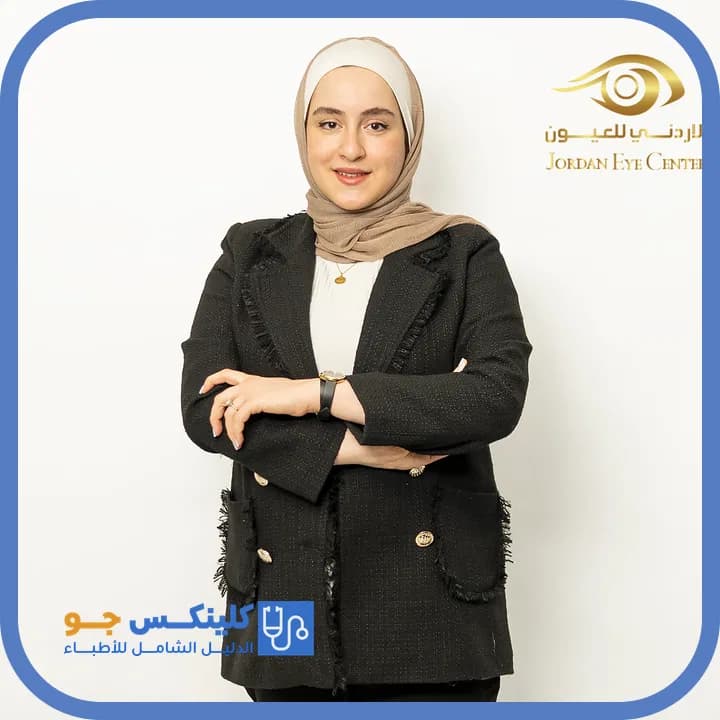
Dr. Mais Khaled Al Jbour is an ophthalmologist at Jordan Eye Center on Mecca Street, Amman. She studied medicine at the Hashemite University and holds the Arab Board in Ophthalmology and FICO; her biography also mentions training in the Royal Medical Services and specialist hospitals in Jordan. Alongside cataract surgery and intraocular lens implantation, her published services include oculoplastic and aesthetic eyelid surgery, tear-drainage care, paediatric eye care, strabismus correction, laser vision correction and implantable vision-correction lenses. Appointments are coordinated through the centre's team; confirmed hours are Saturday to Wednesday 08:00–19:00 and Thursday 08:00–16:00.
Suits: Patients preferring a female surgeon; eyelid or tear-drainage concerns too
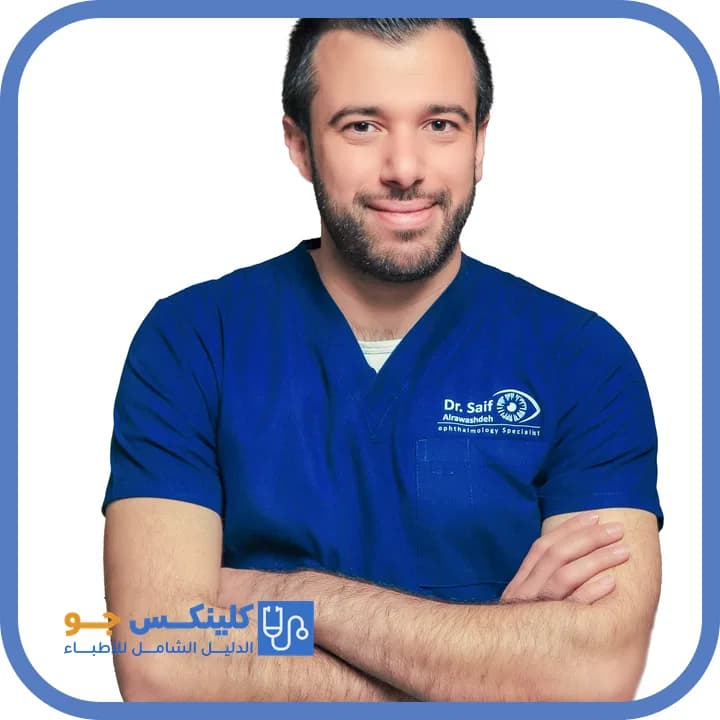
Dr. Saif Al Rawashdeh is an ophthalmology specialist at Jordan Eye Center on Mecca Street, Amman, and a medicine and surgery graduate of Jordan University of Science and Technology. He holds the Arab Board in Ophthalmology and FICO, and his biography notes membership of the Jordanian ophthalmology society. His published services include cataract surgery and intraocular lens implantation, laser and LASIK vision correction, strabismus surgery and children's eye care. Appointments are coordinated according to the eye condition and doctor availability, within confirmed hours of Saturday to Wednesday 08:00–19:00 and Thursday 08:00–16:00.
Suits: Lens implant or LASIK candidates comparing options at one centre
Dr. Amer Hajjaj is an ophthalmologist and eye surgeon at his own clinic at Fifth Circle, Amman. He graduated from the University of Jordan, completed ophthalmology residency at the Jordanian Royal Medical Services and holds the Jordanian and Arab Boards in Ophthalmology, Fellowship of the International Council of Ophthalmology and membership of the Royal College of Surgeons of Edinburgh. His published services include cataract removal and lens implantation, comprehensive eye examination, glaucoma care, diabetic eye care and screening, keratoconus treatment, dry eye treatment, LASIK and PRK, contact lens fitting and children's vision care. Confirmed hours are Saturday to Wednesday 09:00–18:30 and Thursday 09:00–15:00.
Suits: Patients with diabetes or glaucoma preferring a Fifth Circle clinic
Dr. Khalaf Houshan works within the Jordan Eye Center team on Mecca Street, Amman. His profile lists postgraduate ophthalmic study and microsurgical training in Moscow, and his biography states that his doctorate in microsurgery for myopia was obtained at the Fyodorov Eye Microsurgery Center. His work focuses on laser and LASIK vision correction, cataract surgery and intraocular lens implantation, with care also covering childhood amblyopia (lazy eye). His profile notes that suitability for refractive correction or cataract surgery with lens implantation is discussed after examination. Confirmed hours are Saturday to Wednesday 08:00–19:00 and Thursday 08:00–16:00.
Suits: Adults weighing a cataract lens implant against laser vision correction
Every matching doctor profile in this country was scored out of 100 for how complete and checkable its published information is, and the highest scores appear here in order. Featured placement does not change a profile's score, and the score does not measure treatment quality or outcomes — it tells you how much you can check before you call.
Ties are broken by the number of approved reviews, then published years of experience. Confirm the service, branch, appointment, fees and insurance coverage with the practice before visiting.
An intraocular lens (IOL) is a small artificial lens placed inside the eye. It is most often implanted during cataract surgery: the surgeon removes the natural lens that has become cloudy and puts the clear artificial lens in its place, usually in the same procedure. Some lenses are also used purely to correct short- or long-sightedness, either by replacing the natural lens or by placing an implantable lens in front of it. Several profiles on this page list these separately as "implantable vision-correction lenses" or "permanent lens implantation".
Lenses come in different designs, such as monofocal lenses (focused at one distance), toric lenses that also correct astigmatism, and lenses designed to give a wider range of focus. Which design, if any, is appropriate depends on the eye examination and measurements, your other eye conditions and how you use your vision day to day. Only your surgeon can advise on this.
Book an eye examination if you notice:
Mainstream guidance, including the NHS, generally suggests considering cataract surgery when the cataract is affecting daily activities such as reading, driving or work, rather than at a fixed stage.
Seek same-day help, or call 911 in an emergency, for:
All six ophthalmologists list cataract among their sub-specialties and publish lens implantation as a service. To narrow the choice, match your situation to what each profile actually publishes:
Remember that the order of this list reflects profile completeness only. If you arrived looking for the best intraocular lens implant doctors in Jordan, the most reliable guide is a thorough examination and a clear conversation about your options with the surgeon you choose.
A lens implant assessment is usually longer than a routine eye check. Expect a vision test, eye pressure measurement, a microscope examination of the front of the eye, and a look at the retina, often after drops that widen (dilate) the pupils. If surgery is being considered, the clinic will measure the eye (biometry) to calculate the lens power, and may scan the cornea.
Costs for lens implant surgery can vary with the lens type and the facility, so ask for clear written information before committing:
Book through the clinic or the profile's booking option. At Jordan Eye Center, several profiles note that appointments are coordinated by the centre's team according to your eye condition and doctor availability, so say clearly that you want a lens implant or cataract assessment.
All listed doctors practise in Amman. Five work at Jordan Eye Center on Mecca Street, with confirmed hours of Saturday to Wednesday 08:00–19:00 and Thursday 08:00–16:00. Dr. Amer Hajjaj's clinic is at Fifth Circle, with confirmed hours of Saturday to Wednesday 09:00–18:30 and Thursday 09:00–15:00.
If you are travelling from outside Amman, or visiting Jordan, allow time for a long first appointment and possible same-day tests. Because dilation blurs vision and you cannot drive yourself home after surgery, arrange a driver or companion. Confirm the exact entrance and parking when you book.
No clinic on ClinicsJo has published a price for Intraocular lens implant yet, so we do not quote an estimated figure. What is published is the consultation fee: 20–30 JOD (profiles: 10). The doctor sets the treatment price after assessing your case.
Other doctor profiles with a published fee: 5.
Before booking, ask the clinic for the all-inclusive price and what it covers, any extra tests or scans, how many follow-up visits are included, the payment options, and whether your insurance is accepted. You can reach them through the contact details on the doctor and clinic profiles on this page.
The figures above were published by the clinics and doctors themselves on ClinicsJo and may change. We do not estimate prices. Confirm the all-inclusive price with the clinic before booking. Offers on ClinicsJo
Prepared by: the ClinicsJo editorial team. Last updated 18 October 2026.
List data: the doctor and clinic profiles published on ClinicsJo — services, doctors, hours, insurers and addresses entered by the providers or compiled by our team from public sources. Reviews appear only after moderation, the verified badge only on profiles the platform administration verified, and no price appears unless the profile itself publishes it. Where the data comes from and how lists are ordered · Medical content policy
Health references: the health information in the guide is general and written to agree with the guidance of major health bodies. To read further or check it:
The full directory behind this list, and our other shortlists for the same topic and place.
This page helps you compare published profiles; it is not medical advice and does not rank clinical skill. In an emergency call 911 or go to the nearest emergency department.