Jordan Eye Center
Sign in to the platform to view the phone number
74 viewsHours 08:00–19:00 · 6 days a weekInsurance not specified
Trusted medical platform in Jordan

If you are looking for the best cornea specialists in Jordan, this page lists seven ophthalmologists whose profiles include cornea work. They are ordered by how complete and checkable their published information is, not by clinical skill or outcomes. You can compare qualifications, corneal services, clinic locations and confirmed hours. You will also find practical guidance on warning signs, choosing a doctor, preparing for your first visit and what to ask before booking.
| # | Doctor | Area | Rating | Experience | Consultation | Hours | Insurance | Suits | Profile score |
|---|---|---|---|---|---|---|---|---|---|
| 1 | Muataz Mohammad Harara | Mecca Street | — | — | — | 6 days · 08:00–19:00 | — | Corneal transplant, cross-linking, or combined cornea and retina concerns | 40/100 |
| 2 | Mohammad Akram Hawari | Mecca Street | — | — | — | 6 days · 08:00–19:00 | — | Families needing cornea care plus children's eye and squint services | 40/100 |
| 3 | Yazan Abdulkarim Shabaneh Al Tamimi | 7th Circle | — | — | — | 6 days · 09:00–17:00 | — | Dry eye, astigmatism or cornea concerns alongside glaucoma or cataract | 40/100 |
| 4 | Khaled Sharif | Jabal Amman | — | — | — | 6 days · 09:00–22:00 | — | Keratoconus assessment, cross-linking or keratoplasty, with evening hours | 40/100 |
| 5 | Lana Hubaishy | Jabal Amman | — | — | — | 6 days · 09:00–22:00 | — | Short-sightedness or astigmatism assessment for laser correction, evenings included | 38/100 |
| 6 | Mohammad Abu Samak | 3rd Circle | — | — | 30 JOD | 3 days · 16:00–18:00 | — | Patients with diabetes or retinal problems who also need corneal checks | 37/100 |
| 7 | Hala Makahleh | Jabal Amman | — | — | — | 6 days · 09:00–22:00 | — | Adults exploring LASIK or astigmatism correction after corneal mapping | 34/100 |
From each profile as published today: approved reviews only, consultation fees only where the profile states them, confirmed weekly hours (the most common shift). «—» means the profile does not publish it.
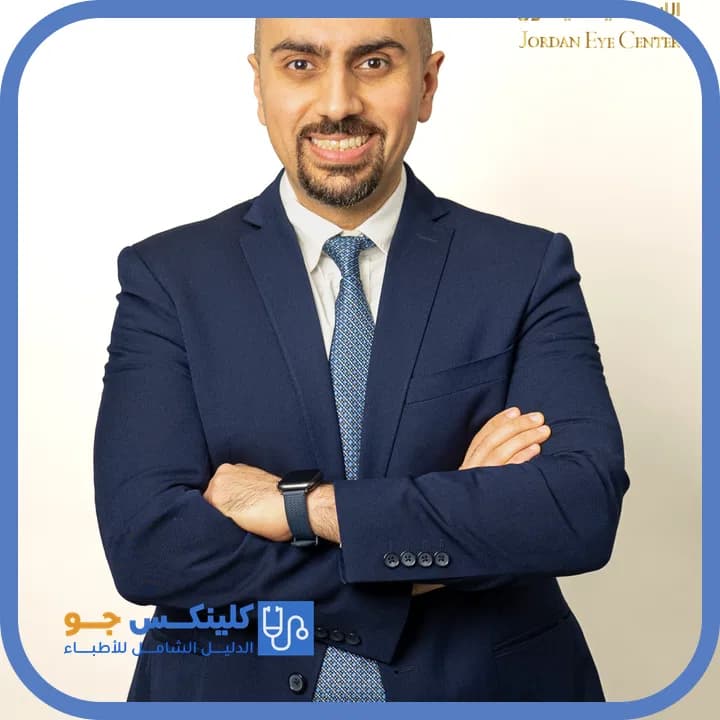
Dr. Muataz Mohammad Harara is a consultant ophthalmologist and vitreoretinal surgeon at Jordan Eye Center on Mecca Street, Amman. He holds the Arab Board and the Jordanian Board in Ophthalmology and a qualification from the International Council of Ophthalmology. His corneal services include corneal transplantation (keratoplasty), corneal cross-linking, laser vision correction and implantable vision-correction lenses. He also lists retinal assessment, intravitreal injections, and cataract surgery with lens implantation, which may help if you have more than one eye condition. His biography notes that examination guides the choice of treatment. Confirmed hours are Saturday to Wednesday 08:00–19:00 and Thursday 08:00–16:00.
Suits: Corneal transplant, cross-linking, or combined cornea and retina concerns
Dr. Mohammad Akram Hawari is an ophthalmic surgeon at Jordan Eye Center on Mecca Street, Amman. His listed qualifications are the Arab Board in Ophthalmology, Membership of the Royal College of Surgeons of Edinburgh and FICO. His biography also notes membership of the European refractive surgery society. His corneal services include cross-linking and corneal transplantation (keratoplasty), alongside cataract surgery and lens implantation. He also offers children's eye examinations, vision tests for children and strabismus surgery, so families may find his range useful. Confirmed hours are Saturday to Wednesday 08:00–19:00 and Thursday 08:00–16:00.
Suits: Families needing cornea care plus children's eye and squint services
Dr. Yazan Abdulkarim Shabaneh Al Tamimi practises at Shami Eye Center at the 7th Circle, Amman. He studied medicine and completed a higher specialty in ophthalmology at Jordan University of Science and Technology. He holds the Jordanian Board in Ophthalmology (2013) and FRCS Glasgow (2019). He also lists fellowship training in anterior segment and cataract surgery (2021) and in glaucoma surgery (2022) at King's College Hospital. His cornea-related services include corneal topography and imaging, dry eye treatment, astigmatism treatment and laser vision correction. He also offers glaucoma care, eye pressure measurement, phacoemulsification with lens implant and diabetic eye screening. Hours are Saturday to Wednesday 09:00–17:00 and Thursday 09:00–14:00.
Suits: Dry eye, astigmatism or cornea concerns alongside glaucoma or cataract
Dr. Khaled Sharif is a consultant ophthalmologist and medical director of Sharif Eye Centers, seeing patients at the Jabal Amman branch. He holds FRCS Glasgow and Fellowship of the Royal College of Ophthalmologists, London. His biography notes that he co-authored an atlas of corneal dystrophies and degenerations with T. A. Casey and has trained ophthalmic surgeons in refractive procedures. His services include keratoconus treatment, corneal cross-linking for keratoconus, keratoplasty, corneal topography, LASIK, permanent lens implantation and cataract surgery. The centre's confirmed hours are Saturday to Thursday 09:00–22:00. Consultations are arranged through the centre once his individual clinic session is confirmed.
Suits: Keratoconus assessment, cross-linking or keratoplasty, with evening hours
Dr. Lana Hubaishy is an ophthalmology specialist with the Sharif Eye Centers team at the Jabal Amman branch. She holds a medical degree from the University of Jordan and the Jordanian Board in Ophthalmology, and lists fellowship training in refractive laser surgery. Her profile focuses on refractive assessment: LASIK and laser vision correction, myopia correction and astigmatism treatment. These are supported by corneal examination and corneal topography and imaging. Her biography explains that correction options depend on each patient's examination and corneal condition. Confirmed hours are Saturday to Thursday 09:00–22:00, and appointments should be confirmed through the centre.
Suits: Short-sightedness or astigmatism assessment for laser correction, evenings included
Dr. Mohammad Abu Samak is a consultant ophthalmologist at Amman Eye Clinic, 3rd Circle, on Ibn Khaldoun Street. He studied medicine and surgery at the University of Jordan, holds the Arab Board in Ophthalmology and lists vitreoretinal fellowship training at Henry Ford Hospital in the United States. His cornea-related services include keratoconus cross-linking, corneal imaging and examination, and laser vision correction and LASIK. Much of his published scope is retinal: diabetic eye examination, diabetic retinopathy care, retinal hole laser, and retinal detachment and vitrectomy surgery. He also offers cataract surgery and care for raised eye pressure. Confirmed hours are Saturday 10:00–18:00 and Monday and Wednesday 16:00–18:00.
Suits: Patients with diabetes or retinal problems who also need corneal checks
Dr. Hala Makahleh is an ophthalmology specialist with the Sharif Eye Centers team at the Jabal Amman branch. She graduated from the University of Jordan's School of Medicine and holds the Arab Board in Ophthalmology. She also holds Membership of the Royal College of Ophthalmologists in the UK and lists fellowship training in refractive laser surgery. Her services are LASIK and laser vision correction, corneal topography and imaging, corneal examination and astigmatism treatment. Her biography describes vision assessment and discussion of suitable refractive correction options with each patient. Confirmed hours are Saturday to Thursday 09:00–22:00.
Suits: Adults exploring LASIK or astigmatism correction after corneal mapping
Every matching doctor profile in this country was scored out of 100 for how complete and checkable its published information is, and the highest scores appear here in order. Featured placement does not change a profile's score, and the score does not measure treatment quality or outcomes — it tells you how much you can check before you call.
Ties are broken by the number of approved reviews, then published years of experience. Confirm the service, branch, appointment, fees and insurance coverage with the practice before visiting.
The cornea is the clear front window of the eye. It does much of the focusing work, so even small changes in its shape or clarity can blur vision. Cornea care sits within ophthalmology. All seven doctors on this page are ophthalmologists who list cornea among their sub-specialties, though their wider scope differs.
Common reasons people see a cornea-focused ophthalmologist include:
Some corneal problems can threaten sight within hours. Go to an emergency department or call 911 in Jordan if you have:
Do not use leftover eye drops, especially steroid drops, without a doctor's advice.
People searching for the best cornea specialists in Jordan usually want someone whose experience matches their specific problem. Use the published services to narrow the list:
Qualifications are listed as each doctor published them. Read them as a starting point, then ask the clinic directly how often the doctor treats your particular condition.
A corneal assessment usually includes:
You may be given dilating drops, which blur vision and increase glare for several hours.
Ask the clinic these questions when you book:
Keep written confirmation of any quoted fee or approval.
This is a kingdom-wide list for Jordan, and each profile states its own city and district. Before you travel, open the profile and check the address and the map location where one is available. Allow extra time for traffic and parking, especially at evening clinic sessions.
If you are coming from another governorate or visiting Jordan, plan for the possibility of dilating drops or same-day imaging. Bring a companion, or book a taxi for the return trip, rather than driving.
Consultation fees of Cornea doctors in Jordan published on ClinicsJo: Mohammad Abu Samak (30 JOD). They are the fees the doctors' profiles show, for the consultation only; tests and procedures depend on your case.
Before booking, ask the clinic for the all-inclusive price and what it covers, any extra tests or scans, how many follow-up visits are included, the payment options, and whether your insurance is accepted. You can reach them through the contact details on the profiles on this page.
The figures above are the ones the profiles on ClinicsJo show and may change. We do not estimate prices. Confirm the price with the clinic before booking. Offers on ClinicsJo
Prepared by: the ClinicsJo editorial team. Last updated 18 October 2026.
List data: the doctor and clinic profiles published on ClinicsJo — services, doctors, hours, insurers and addresses entered by the providers or compiled by our team from public sources. Reviews appear only after moderation, the verified badge only on profiles the platform administration verified, and no price appears unless the profile itself publishes it. Where the data comes from and how lists are ordered · Medical content policy
Health references: the health information in the guide is general and written to agree with the guidance of major health bodies. To read further or check it:
The full directory behind this list, and our other shortlists for the same topic and place.
This page helps you compare published profiles; it is not medical advice and does not rank clinical skill. In an emergency call 911 or go to the nearest emergency department.