
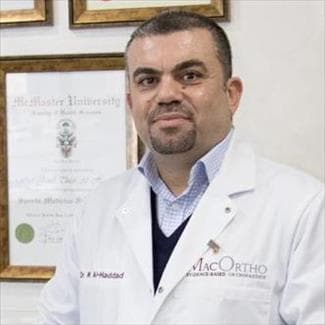
Dr. Wael Al Haddad Orthopaedic Clinic
Dr. Wael Al Haddad is a consultant orthopedic surgeon with Jordanian and Arab Board certification and advanced training at McMaster University in Canada. His wo…
Hours not listedInsurance not specified6 views
Trusted medical platform in Jordan

إصلاح التمزق العضلي في الكتف
Rotator cuff repair is surgery that reattaches a torn shoulder tendon to its footprint on the humeral head using small anchors and sutures. Although patients commonly describe the problem as a torn shoulder muscle, the tear is almost always in the tendon rather than in the muscle belly, and the supraspinatus tendon is the one most often involved. The repair is usually performed arthroscopically through keyhole incisions, and sometimes through a small open incision depending on tear size and the surgical team's judgement. Repair is generally considered for a full-thickness tear after a clear injury, or for a chronic tear with night pain that prevents sleep and weakness on lifting the arm that has not improved after an adequate trial of guided physiotherapy. Most small partial tears are managed without surgery, using a supervised strengthening programme for the cuff and shoulder blade muscles, temporary modification of overhead activity, and treatment of any coexisting causes of pain. It is just as important to know what the operation cannot do. It stitches tendon back to bone; it does not rebuild a muscle that has wasted or turned fatty after years of tearing. In large chronic tears the tendon end may not reach its footprint at all, and your surgeon may discuss partial repair, tendon transfer or reverse shoulder replacement instead. The operation does not treat coexisting shoulder arthritis, and it never removes the need for prolonged rehabilitation: tendon-to-bone healing takes weeks, and regaining useful strength takes months. Results depend on the size and age of the tear, tissue quality, your age, smoking and diabetes, and above all on adherence to the rehabilitation plan. No web page or imaging report can tell you whether you need surgery. Candidacy is decided by clinical examination of shoulder strength and range of motion alongside the images, and for some patients the right decision is to delay surgery or avoid it altogether.
Clinical examination of shoulder strength and range of motion with tendon-specific tests, plus plain films and MRI to define tear size, tendon retraction and muscle quality. The non-surgical alternative is discussed before any decision to operate.
Usually general anaesthesia, often combined with a regional nerve block to reduce pain after surgery. You are positioned either semi-sitting or on your side, and the whole shoulder and arm are prepared and draped.
Small portals admit the camera and instruments. Inflamed tissue in the subacromial space is addressed, a bony spur or thickened ligament pressing on the tendon may be removed, and a retracted tendon is gently released.
The bone footprint is prepared, then small anchors are inserted and their sutures passed through the tendon to draw it back onto bone, in a single-row or double-row configuration according to tear shape and tissue quality.
The portals are closed and a sling applied. You are given a staged programme that begins with protected passive motion, progresses to active motion, and only later moves on to graded strengthening once healing allows.
Tell your doctor about every medicine you take, especially blood thinners, aspirin and herbal supplements, and never stop a prescribed medicine on your own. Mention diabetes, heart disease, high blood pressure, any drug allergy, and any previous shoulder surgery or injection. Follow the fasting instructions you are given before anaesthesia. Stop smoking before and after surgery if you can, because smoking impairs tendon-to-bone healing. Arrange someone to drive you both ways and do not drive yourself on the day. Prepare your home in advance: loose front-opening clothes, an extra pillow so you can sleep semi-upright, and daily items within reach of your healthy arm. Before you leave, ask which sling you will use, for how long, and when your first physiotherapy session is scheduled.
Wear the sling for as long as your surgeon specifies, move your fingers, wrist and elbow early to avoid stiffness, and do not lift your arm using your own muscles or push and pull with it until you are cleared to do so. Apply ice to the shoulder in short intervals during the first days, and sleep semi-upright if lying flat is painful. Attend physiotherapy from the very start: the staged schedule is what protects the repair while restoring motion, and rushing into strengthening can cause the repair to fail. Keep the wound clean and dry as instructed. **Seek care immediately if you develop fever or chills, redness, warmth or discharge from the wound, sudden severe pain with new inability to move, numbness with a pale or cold hand, or calf pain and swelling, breathlessness or chest pain.**
Usually 60 to 120 minutes depending on tear size, with a few hours to one overnight stay for observation.
Dr. Wael Al Haddad is a consultant orthopedic surgeon with Jordanian and Arab Board certification and advanced training at McMaster University in Canada. His wo…
There are currently 1 doctor profiles linked to Shoulder Rotator Cuff Repair on ClinicsJo. Review the listed services and contact the practice to confirm availability with the doctor and branch you choose.
Start with an available doctor's profile and use the contact or booking options shown there. Confirm the service, practice location and appointment time with the clinic. If this list is empty, broaden your search using the directory links on this page.
Ask the practice for the current price and what it includes. A consultation fee shown on a profile is not necessarily the price of a procedure, tests or follow-up. Confirm any additional charges and insurance arrangements before your visit.